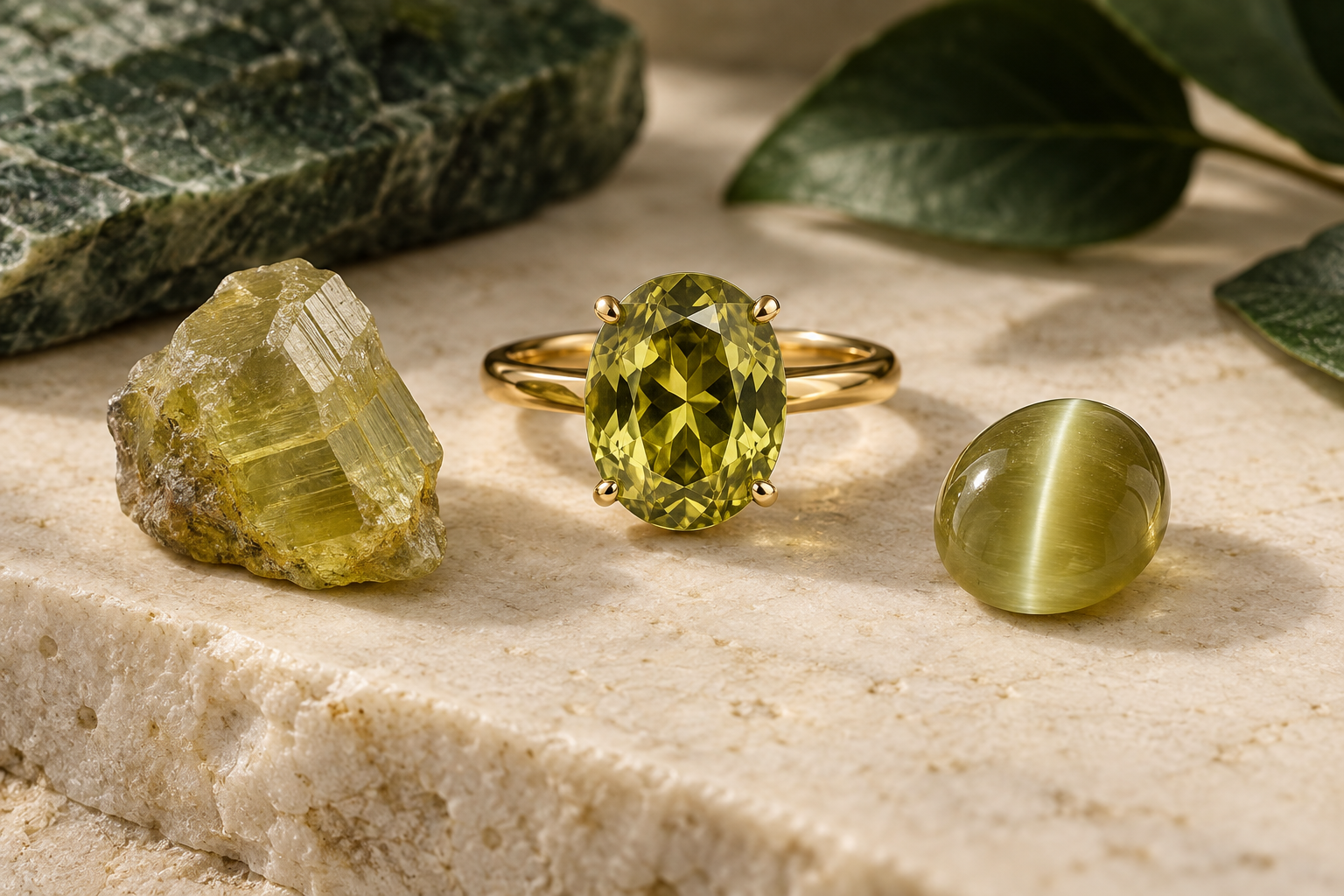
Meaning at a glance
Chrysoberyl is a durable gem species distinct from beryl; alexandrite and cat’s-eye phenomena require accurate naming and disclosure.
What chrysoberyl is and how it differs from beryl
Chrysoberyl is a beryllium aluminum oxide mineral species with a Mohs hardness around 8.5, which places it among the harder gem materials and makes it well suited for many types of jewelry (Gemological Institute of America). Although the similar-sounding name might suggest a relation, chrysoberyl is not a variety of beryl (the mineral family that includes emerald and aquamarine); the two are chemically and structurally distinct (Smithsonian National Museum of Natural History; GIA).
Within chrysoberyl the trade and gemological literature recognize important varieties defined by optical phenomena rather than by separate chemical species. The best-known are alexandrite, a chrysoberyl that shows a pronounced color change under different lighting, and cymophane or 'cat’s-eye' chrysoberyl, which shows a narrow, moving band of light called chatoyancy (GIA; Guide to Phenomenal Gems). Identifying these varieties correctly is central to accurate description and value.
Historical evidence and cultural notes
The scientific and collecting record for chrysoberyl varieties is best documented in gemological and museum literature rather than in broad, uniform cultural traditions. The Gemological Institute of America (GIA) provides mineralogical history and documentation about chrysoberyl’s varieties and their recognition in the gem trade, including the historical prominence of alexandrite as an item of gemological interest (GIA). The Smithsonian National Museum of Natural History places chrysoberyl in the wider context of gem materials and collecting, recording how museums and collectors have long valued specimens for their optical effects and crystallography (Smithsonian).
When authors or dealers describe chrysoberyl’s place in a particular culture—such as stories linking alexandrite to 19th-century Russia or local folklore where stones were mined—those claims are cultural or historical narratives that should be referenced to primary historical sources or museum records. The modern gemological literature emphasizes the material’s physical properties and the science of its phenomena rather than a single, universal cultural meaning (GIA; Smithsonian).
Documented historical meanings versus modern personal interpretations
Documented historical meanings specifically attached to chrysoberyl varieties are limited in the professional gem literature. Gemological and museum sources focus on identification, locality, and optical phenomena rather than consistent symbolic attributions across cultures (GIA; Smithsonian). Where specific historical associations exist in primary historical records, those should be cited directly; general gemological references rarely present a single, global symbolic tradition for chrysoberyl.
By contrast, modern personal interpretations are common and varied. Contemporary owners and jewelers may ascribe meanings such as transformation to alexandrite because of its dramatic color change, or protection and clarity to cat’s-eye stones because of their strong single-band light. These are modern, personal, or marketing-driven interpretations rather than universally documented historical meanings. If you want a piece that carries a particular symbolic value, treat those meanings as contemporary choices and not as historically uniform facts.
How chrysoberyl varieties appear in jewelry
Chrysoberyl is used in jewelry in ways that take advantage of both its durability and its optical effects. Faceted chrysoberyl tends to be cut to maximize color and brilliance; alexandrite, when it shows a clear and attractive color change, is often faceted and set into rings and pendants to display both daytime and incandescent appearances (GIA).
Cat’s-eye chrysoberyl (cymophane) is typically fashioned as a cabochon so that the narrow band of reflected light—the cataract or 'eye'—is visible and mobile across the surface. Those cabochons are commonly used in rings, cufflinks, and pendants where the chatoyant band can be appreciated. Jewelers also select mounting styles and settings that protect the stone’s girdle and pavilion while allowing light to reveal the effect (Guide to Phenomenal Gems; GIA).
Because chrysoberyl is relatively hard and resistant to abrasion, it is a sensible choice for jewelry intended for regular wear, such as engagement rings and everyday pendants. That hardiness differentiates it functionally from softer gems, but it does not eliminate the need for proper setting and care.
Practical guidance for selecting chrysoberyl and for gifting
Start by identifying the variety you want and insisting on accurate naming. If the stone is sold as alexandrite, the seller should be able to explain the color change and provide images under different light sources or, better, gemological documentation. If the material is described as 'cat’s-eye' or cymophane, the seller should demonstrate the chatoyancy. The Gemological Institute of America stresses the importance of correct identification and disclosure for chrysoberyl varieties (GIA).
Request a reputable certificate or report when buying a higher-value chrysoberyl, especially alexandrite or large, fine cat’s-eye stones. A laboratory report will confirm species, variety, and whether the material is natural, synthetic, or treated. Certification provides independent verification and supports long-term value retention.
Evaluate the stone’s optical performance for the chosen variety. For alexandrite, judge the strength and clarity of the color change under warm and cool light; for cat’s-eye, look for a sharp, centered band that moves cleanly across the cabochon. Also attend to cut quality, proportions, and polish, since they influence how strongly the phenomena appear.
Consider practicality and lifestyle when gifting. Chrysoberyl is well suited to rings and daily-wear pieces because of its hardness, but the setting should still protect the stone’s edges. Choose a mounting that secures the gem and reduces exposure to strong knocks. Communicate any modern symbolic meaning you attach to the piece as a personal sentiment rather than presenting it as an objective historical fact.
Care and maintenance
Chrysoberyl’s hardness makes it resistant to scratches, but it is not indestructible. Clean chrysoberyl jewelry with warm, soapy water and a soft brush; rinse and dry thoroughly. Many chrysoberyl pieces are safe for ultrasonic and steam cleaning, but you should confirm with the seller or a lab report when a stone has unusual inclusions, fracture filling, or mounting constraints before using mechanical cleaners (GIA; Guide to Phenomenal Gems).
Store chrysoberyl separately from softer gems to avoid abrasion and check metal settings periodically to ensure prongs and bezels remain secure. For cabochon cat’s-eye stones, avoid hard knocks that could chip the dome or damage the subtle chatoyancy. When in doubt about a specific cleaning method, consult a professional jeweler.
Summary
Chrysoberyl is a clearly defined and durable gem species distinct from beryl, and its varieties—most notably alexandrite (color-change) and the cat’s-eye or cymophane (chatoyant)—are identified by their optical phenomena. The professional gemological literature emphasizes accurate identification and disclosure, and collectors or buyers should rely on reputable reports and careful inspection when acquiring chrysoberyl jewelry (GIA; Guide to Phenomenal Gems; Smithsonian). Modern symbolic meanings are personal and varied; documented historical symbolism in the technical literature is limited, so present any intended meaning as contemporary sentiment when gifting.
Frequently asked questions
Is chrysoberyl the same as beryl or aquamarine?
No. Chrysoberyl is a distinct mineral species from beryl. Beryl includes stones such as emerald and aquamarine, while chrysoberyl is chemically and structurally different and is noted for its hardness and particular optical phenomena (GIA; Smithsonian).
What is the difference between alexandrite and alexandrite chrysoberyl?
Alexandrite is the trade name for the color-change variety of chrysoberyl. If a stone is called alexandrite, the seller should be able to demonstrate or document the characteristic color change and identify it as chrysoberyl rather than another color-change material (GIA).
Are cat’s-eye chrysoberyls the same as other cat’s-eye gems?
The term 'cat’s-eye' refers to the chatoyancy effect, which appears in several gem materials. Cat’s-eye chrysoberyl (cymophane) is valued for a sharp, narrow band of light and is the chrysoberyl variety associated with that effect; correct material identification and disclosure are important (Guide to Phenomenal Gems; GIA).
Can chrysoberyl be worn every day?
Yes. Chrysoberyl’s hardness and toughness make it suitable for everyday jewelry like rings and pendants, but no gem is indestructible. Choose protective settings, inspect mounts regularly, and follow sensible cleaning and storage practices.
How can I be sure an alexandrite is genuine?
Ask for independent gemological documentation from a reputable laboratory and request images or demonstrations of the color change under different light sources. Reputable reports confirm species, variety, and whether treatments or synthetics are involved (GIA).
What should I look for when buying cat’s-eye chrysoberyl?
Look for a sharp, centered chatoyant band that moves cleanly across the cabochon, good polish and symmetry, stable color, and a reputable identification or certificate. Evaluate the setting to ensure the cabochon is well protected.
Sources and further reading
- Chrysoberyl — Gemological Institute of America
- Guide to Phenomenal Gems — Gemological Institute of America
- Gems and Minerals: Beauties and Building Blocks — Smithsonian National Museum of Natural History