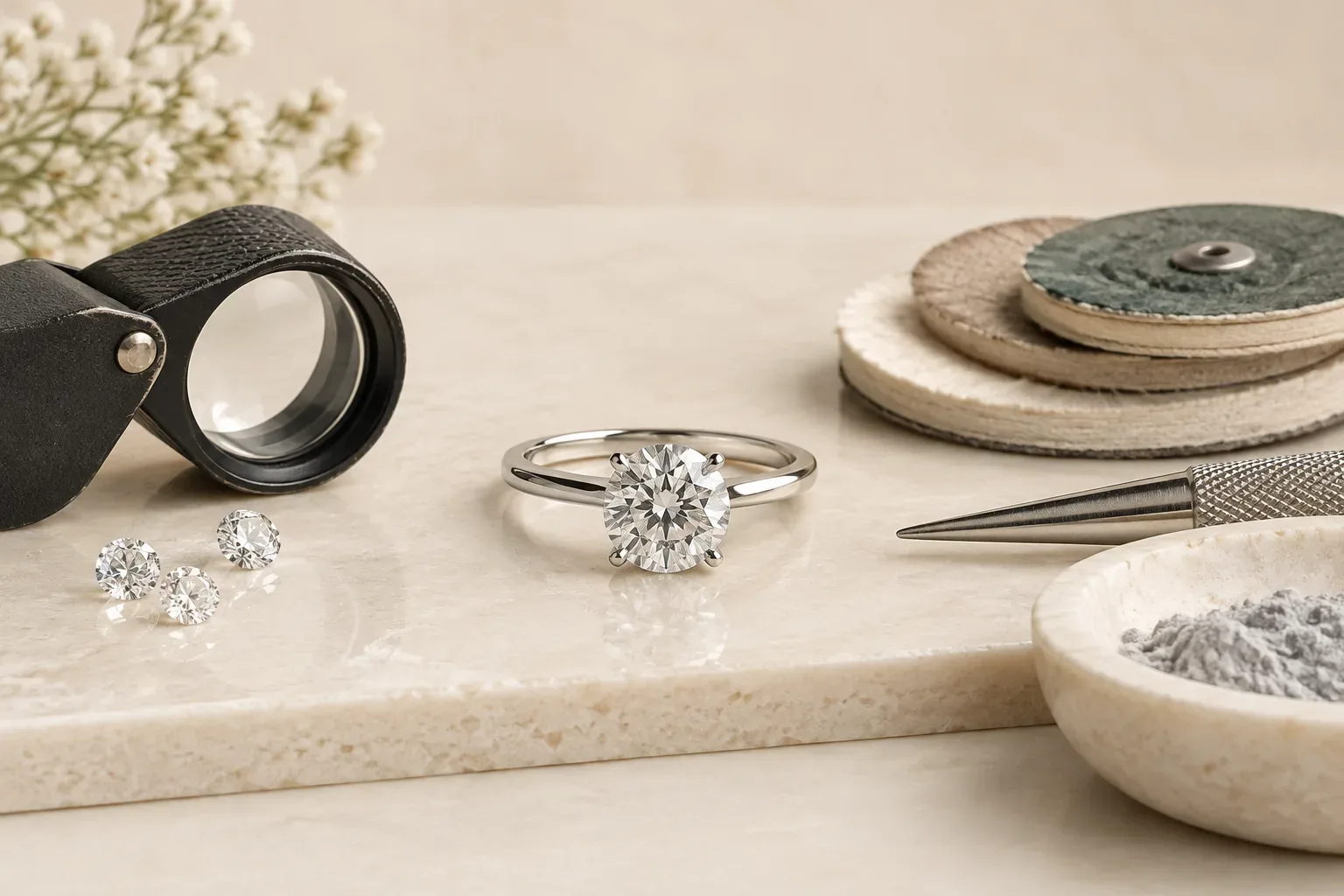
Meaning at a glance
Diamond polish explained: polish describes the smoothness and finish of a diamond's facet surfaces. Grading (Excellent to Poor) affects light performance, durability, and value; you can see some defects with magnification, but accurate grades and treatments require a qualified jeweler or gem laboratory, and sellers must disclose treatments and origins.
Direct answer: what 'diamond polish' means
In short, diamond polish refers to the quality of the finished surfaces on a diamond's facets — how smooth and accurately the facets were polished after cutting. Grades typically range from Excellent (or Polish Excellent) down through Very Good, Good, Fair and Poor on laboratory reports. A diamond's polish affects its sparkle, the uniformity of light return, and in some cases long‑term durability. For shopping purposes, understand that an 'Excellent' polish is rarely visible to the unaided eye once mounted, while lower polish grades can sometimes show surface blemishes that slightly reduce brilliance or create areas that collect dirt. The Gemological Institute of America (GIA) explains that polish and other finish parameters are distinct grading factors and that treatments, disclosures and detectability raise separate consumer questions.
What the term covers technically
Technically, polish describes the microscopic condition of facet surfaces after cutting and finishing. Polishing removes saw marks and refines facets so that light can be reflected cleanly. When polish is poor, tiny nicks, pits, grain lines or polish lines remain and can scatter light. Laboratories use standardized grading protocols to assess polish under magnification and controlled lighting, and the resulting grade appears on a diamond's report.
Historical evidence and documented practice
Human modification of gemstones and the application of cutting and polishing techniques have a long history, and gemological reference material documents that treatments and human interventions evolved over centuries. The Gemological Institute of America provides an overview of gem treatments and the long‑standing human role in shaping gem appearance, which includes cutting and finishing practices that lead to modern polish standards. Historical surveys in general show that as lapidary tools and optical understanding improved, standards for finish and precision became more exacting; laboratory grading systems like those used today are a product of 19th‑ to 20th‑century gemological development rather than an ancient practice.
Separating documented historical meanings from modern personal interpretations
Documented historical meanings around diamonds tend to focus on status, wealth and technical mastery of cutting rather than on the specific technical attribute we call 'polish'. Gemological literature indicates that finish and workmanship were historically markers of skill, but precise polish grading is a modern technical category used by labs and trade publications. Modern personal interpretations about polish — for example, that a high polish is a symbol of perfection or purity — are contemporary, subjective readings rather than historic, documented symbolism. When discussing meaning, it is important to distinguish what gem labs and historical sources have recorded (workmanship, durability and optical quality) from individual or cultural symbolism people may attach today.
How polish appears in jewelry and what to look for
In finished jewelry, polish is visible only at close range or under magnification. A well‑polished diamond presents uniform, crisp facet junctions and smooth facet surfaces that allow light to travel and reflect cleanly. Poor polish can manifest as tiny surface pits, faint lines, or a slightly frosted look in areas, and these imperfections can collect oil and dirt more readily, making a stone appear duller. Once a diamond is set, mounting settings, metal reflections and companion stones also affect perceived sparkle, so polish is one of several factors that combine to create the final look of a piece.
Decision criteria and practical trade‑offs when buying
When you evaluate polish as part of a purchase decision, consider these trade‑offs: polish interacts with cut, symmetry and carat to determine how a diamond looks and performs. For many shoppers, a polish grade of Excellent or Very Good offers the best balance of appearance and resale value, while a Good grade may be acceptable if budget constraints exist and the diamond appears lively to the unaided eye. Opting for a lower polish grade can lower price, but be aware of possible visible surface defects and greater cleaning needs. The Gemological Institute of America emphasizes that polish is distinct from treatments and that labs use defined criteria to separate finish issues from internal clarity or color characteristics.
What you can (and cannot) verify yourself
You can make several practical checks without a laboratory. Under bright light and with a 10× loupe or microscope at a jeweler's counter, you can look for obvious surface blemishes, lines or pits and see whether the diamond looks clean and bright. However, you cannot reliably assign an official polish grade at home. Official polish grades require standardized lab equipment, controlled lighting and trained graders; only a qualified jeweler or a gemological laboratory can produce a verifiable polish grade and detect some treatments or enhancements. The Federal Trade Commission requires sellers to make clear disclosures about origin, treatments and whether a gem is natural or lab‑created, so ask for written documentation and laboratory reports when polish, treatments or origin affect value.
Care guidance: safe cleaning and preservation of polish
Polish itself does not 'wear off' in normal use, but surface damage that affects finish can occur during repair work or exposure to harsh abrasives. Use non‑abrasive jewelry cleaners, warm water and mild soap or solutions recommended for diamonds. Avoid ultrasonic cleaners and steamers if the ring contains other delicate gemstones or if the setting is compromised; a professional jeweler can advise. If a diamond shows surface damage from knocks or poor repair, a qualified lapidary or jeweler can repolish facets, but repolishing reduces weight slightly and can affect proportions and value. For these reasons, conservative care and routine professional inspections help preserve finish and overall condition.
Gifting and selection guidance — respectful, practical advice
When gifting a diamond with polish in mind, request a current independent laboratory report that lists polish and other finish grades, and ask the seller to provide any provenance or treatment disclosures in writing. For an engagement ring or heirloom piece, prioritize cut and overall visual performance and select a polish grade that aligns with the recipient's preferences and your budget. If you or the recipient value technical excellence and potential resale value, choose Excellent or Very Good polish from a reputable source. If the recipient prefers a warmer or more antique look, surface textures and certain historical finishes may be appropriate, but those are stylistic choices rather than standard polish grades. Always respect cultural or personal symbolism: some recipients may not prioritize technical grades and instead value story, provenance or design over laboratory distinctions.
Limits, disclosure and where to get verification
A seller can provide much useful information, but the most reliable verification comes from a recognized gemological laboratory and from written disclosures required by consumer protections. The Federal Trade Commission emphasizes that consumers should get clear distinctions among natural, lab‑created, treated and imitation materials and that sellers provide written disclosures. For definitive polish grading, durability assessments after repairs, or detection of treatments, request an independent laboratory report from an accredited facility. Keep in mind that repolishing, recutting or treatments can change a report, so obtain documentation that matches the actual stone you are buying.
Final practical checklist
Ask for a lab report that lists polish and related finish grades, view the stone under magnification if possible, compare appearance rather than relying on a single grade, inquire in writing about treatments and origin, and consider professional inspection for mounted stones. Remember that polish is one component of a diamond's overall performance and value; balance technical grades with visual effect, maintenance needs and the story you want the piece to carry.
Frequently asked questions
Does polish change a diamond's value significantly?
Polish can affect value, but its impact is usually less than cut, carat weight and clarity. An Excellent or Very Good polish typically commands higher prices than lower grades, while Good may be acceptable visually for budget buys. For precise valuation, rely on an independent lab report and a professional appraisal.
Can I improve a diamond's polish after purchase?
Yes, a skilled lapidary or jeweler can repolish facets, but repolishing removes a small amount of weight and can alter proportions and grading. Repolishing should be done sparingly and documented, and it is best performed by a qualified professional.
Will I see the difference between Excellent and Very Good polish with the naked eye?
Most unaided observers will not notice the difference between Excellent and Very Good polish once a diamond is mounted. Differences are usually apparent only under magnification or to trained graders in controlled conditions.
How can I verify a seller's polish claim?
Request an independent laboratory report that lists the polish grade and ask for written disclosures about treatments and origin. If the report is missing, ask the seller to obtain one from an accredited lab or have the diamond inspected by a qualified jeweler.
Do treatments affect polish or vice versa?
Treatments and polish are separate considerations. Some surface treatments or laser drilling can affect appearance and may require disclosure. The Gemological Institute of America explains that treatments, detectability and care create distinct consumer questions, so ask for lab documentation whenever treatments are possible.
Sources and further reading
- Imaginaire Digital — Imaginaire Digital
- Gemological Institute of America — Gemological Institute of America
- Federal Trade Commission — Federal Trade Commission