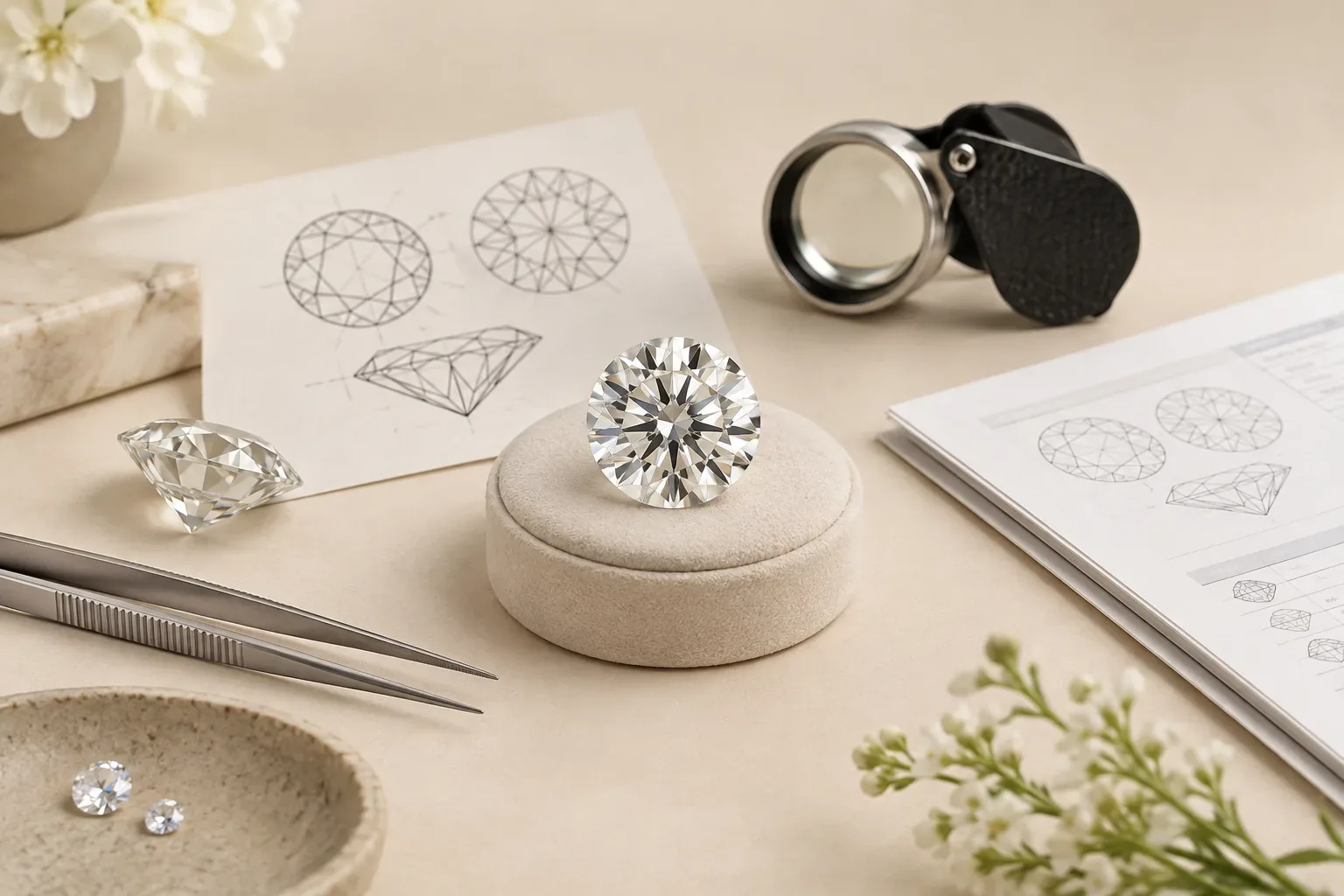
Meaning at a glance
A diamond symmetry report guide should define symmetry as a lab-graded facet- and proportion-based evaluation used by modern gemological laboratories, explain decision criteria and trade-offs (appearance versus price and setting), provide safe care guidance tied to treatments and disclosure rules, and make clear which checks require a qualified jeweler or laboratory to verify.
What a symmetry report actually is
In practice, a symmetry evaluation is one component of an overall diamond report produced by gemological laboratories. It records observable facet alignment, girdle and culet behavior, and other cutting details that can affect how light returns from the stone. Laboratories express symmetry findings as grades or as written comments depending on their protocols, and those findings are meant to be repeatable assessments performed under controlled conditions.
Symmetry is distinct from cut grade, clarity, and color, though it interacts with them. A symmetry grade focuses on the geometric relationships among facets and the technical execution of the cut rather than on intrinsic material origin or treatments.
Historical evidence and documented practice
There is no long record of formal ‘‘symmetry reports’’ before the development of modern gemological laboratories; the practice of issuing detailed, standardized symmetry grades belongs to the contemporary laboratory era. Explicit, documented lab-style grading and disclosure practices are part of modern gemology and consumer protection frameworks rather than older cultural traditions.
Government and professional guidance emphasize the modern need for consistent disclosure and testing. The Federal Trade Commission highlights that consumers need clear written disclosure about whether a gemstone is natural, lab-created, treated, or imitation and that sellers should provide accurate written information. The Gemological Institute of America documents the technical side of gem treatments, detectability, durability and special care, reinforcing that the technical evaluation of stones and their treatments is a laboratory-driven activity rather than a folkloric tradition.
Because symmetry reports are a technical output, historical symbolism about diamonds from earlier periods (for example, diamonds as status symbols in various cultures) should not be conflated with the technical practice of symmetry grading, which is a late 20th–21st century development tied to the rise of systematic gemological testing.
Documented history versus modern personal interpretations
Documented history for the subject of symmetry reports is limited: the evidence shows that symmetry grading and structured reporting are products of modern gemological practice and consumer-protection expectations. This is a documented, technical lineage rooted in laboratories and regulatory disclosure norms.
Modern personal interpretations—such as the belief that perfect symmetry conveys particular spiritual properties or a signifier of a specific personal meaning—are individual or cultural interpretations applied to an essentially technical attribute. Such personal meanings are valid as personal sentiment but are not documented historical meanings of the laboratory practice itself.
How symmetry influences jewelry appearance and design
Symmetry contributes to the visual effects you notice: ideal facet alignment tends to produce a balanced pattern and can make a round brilliant or other cut appear more lively and predictable in its light performance. Asymmetries can create visible pattern shifts, bow-tie effects in certain fancy cuts, or irregular reflections that are apparent in some viewing angles.
The impact of symmetry depends on shape and setting. For example, round brilliants are often judged more strictly for symmetry because their pattern is highly regular, while some fancy shapes tolerate minor asymmetry without a large hit to perceived beauty. Settings such as heavy bezels, ornate halos, or colored side stones can mask or distract from minor symmetry issues, while open solitaire settings make facet performance more visible.
Decision criteria and practical trade-offs
When you read a symmetry report, treat it as one technical input among several. Buyers commonly weigh symmetry against cut quality, carat weight, color, clarity, and budget. Minor symmetry deviations that are noted on a lab report do not always translate to a visible difference once a diamond is set and worn. The shopper’s priorities—maximum sparkle, budget, finger size and setting style—should guide how much weight to place on symmetry.
There are practical trade-offs: stricter symmetry standards often mean higher price per carat. Conversely, accepting a symmetry grade that is ‘‘good’’ rather than ‘‘excellent/ideal’’ can allow you to allocate budget toward a larger size or higher clarity while still achieving an attractive overall appearance. Because visual impact can be subjective, use the report in combination with live or video viewing and, when important, an independent inspection by a qualified jeweler or laboratory.
What you can verify yourself and what requires a professional
A shopper can confirm that a seller provides a written report and can read the reported symmetry grade or comments. You can examine a diamond in different lighting and settings, compare how two stones look side by side, and decide whether performance satisfies your personal taste. The Federal Trade Commission recommends that consumers insist on clear written disclosures about origin and treatments.
What you cannot reliably verify at home are many of the technical determinations on a lab report. Detecting certain treatments, confirming exact laboratory-measured proportions or verifying a lab’s internal procedures generally require specialized instruments and experience. For these matters, only a qualified jeweler with appropriate equipment or an accredited gemological laboratory can provide the necessary verification.
Safe care guidance tied to lab disclosure and treatments
Because treatments and durability concerns can change the correct care method, always check lab and seller disclosures before performing cleaning or repair. The Gemological Institute of America emphasizes that treatments, detectability, durability and special care create distinct consumer questions and that different materials and treatments call for different handling.
If a lab report or seller states that a stone has been treated, ask how that affects cleaning and routine wear. For routine cleaning of untreated diamonds that are set in jewelry, warm water, mild detergent and a soft brush are commonly recommended; for any diamonds that have been bonded, fracture-filled, or otherwise treated, seek professional guidance before ultrasonic cleaning or steam treatments. When in doubt, consult a qualified jeweler or the issuing laboratory for recommended care steps.
Selection and gifting guidance
Be respectful of sentimental context: when gifting an engagement ring or heirloom piece, prioritize what the recipient values—size, overall brilliance, metal and setting style—alongside technical attributes. Ask whether the recipient prefers a particular look (classic, modern, vintage) and whether they want a report from a well-known laboratory.
Insist on a written report from a reputable lab and written disclosure about whether the stone is natural, lab-created, or treated, in line with FTC guidance. If the purchase is important and budget allows, choose a stone with a symmetry grade that aligns with your visual expectations and have the piece independently appraised or inspected by a qualified jeweler. For significant purchases consider selecting stones with reports from reputable laboratories and retain those reports as part of the gift documentation.
Limits and final recommendations
A symmetry report is a technical snapshot produced by a laboratory or a qualified grader. Use it as a decision tool, not a singular arbiter of beauty. The modern evidence base and consumer-protection frameworks show that buyers should combine lab reports, seller disclosures, and independent professional inspection when value, rarity or sentimental importance warrant extra assurance.
If you need verification beyond the written report—such as confirming treatment detectability, authenticity, or precise proportion measurements—engage an accredited gemological laboratory or a qualified jeweler. For shopping trends and consumer demand context, recent market data indicate strong interest in engagement rings and classic diamond styles, which is useful when balancing market availability with personal taste.
Frequently asked questions
What does a symmetry grade tell me that a cut grade does not?
A symmetry grade isolates how well the diamond's facets and cutting features are aligned and executed, while a cut grade is broader and considers proportions, light return and overall performance. Use symmetry as a technical supplement to the cut grade when comparing stones.
Can I rely on a seller’s photo or video to judge symmetry?
Photos and videos can help you assess visual appearance but are not substitutes for a written laboratory report for technical details. For important purchases, obtain a written report and, if necessary, an independent inspection by a qualified jeweler or laboratory.
If a report notes minor symmetry issues, should I avoid the stone?
Not necessarily. Minor symmetry deviations often have limited visible impact, especially once the diamond is set. Consider your priorities, compare stones visually, and weigh trade-offs among size, clarity, color and price.
How can I verify whether a laboratory report is genuine?
Confirm the lab's name and report number, check the issuing laboratory's online registry if available, and, for high-value purchases, request an independent verification from an accredited gemological laboratory or qualified jeweler.
Does symmetry affect how to clean or care for a diamond?
Symmetry itself does not change cleaning methods, but any treatments disclosed on the report may. Follow care guidance tied to treatments and consult the lab or a professional jeweler before using ultrasonic or steam cleaning on treated stones.
Sources and further reading
- Imaginaire Digital — Imaginaire Digital
- Gemological Institute of America — Gemological Institute of America
- Federal Trade Commission — Federal Trade Commission