Meaning at a glance
Malachite is a banded green copper carbonate with a long decorative history and low hardness; transformation or protection meanings are cultural interpretations, not physical effects.
What malachite is and how its patterns form
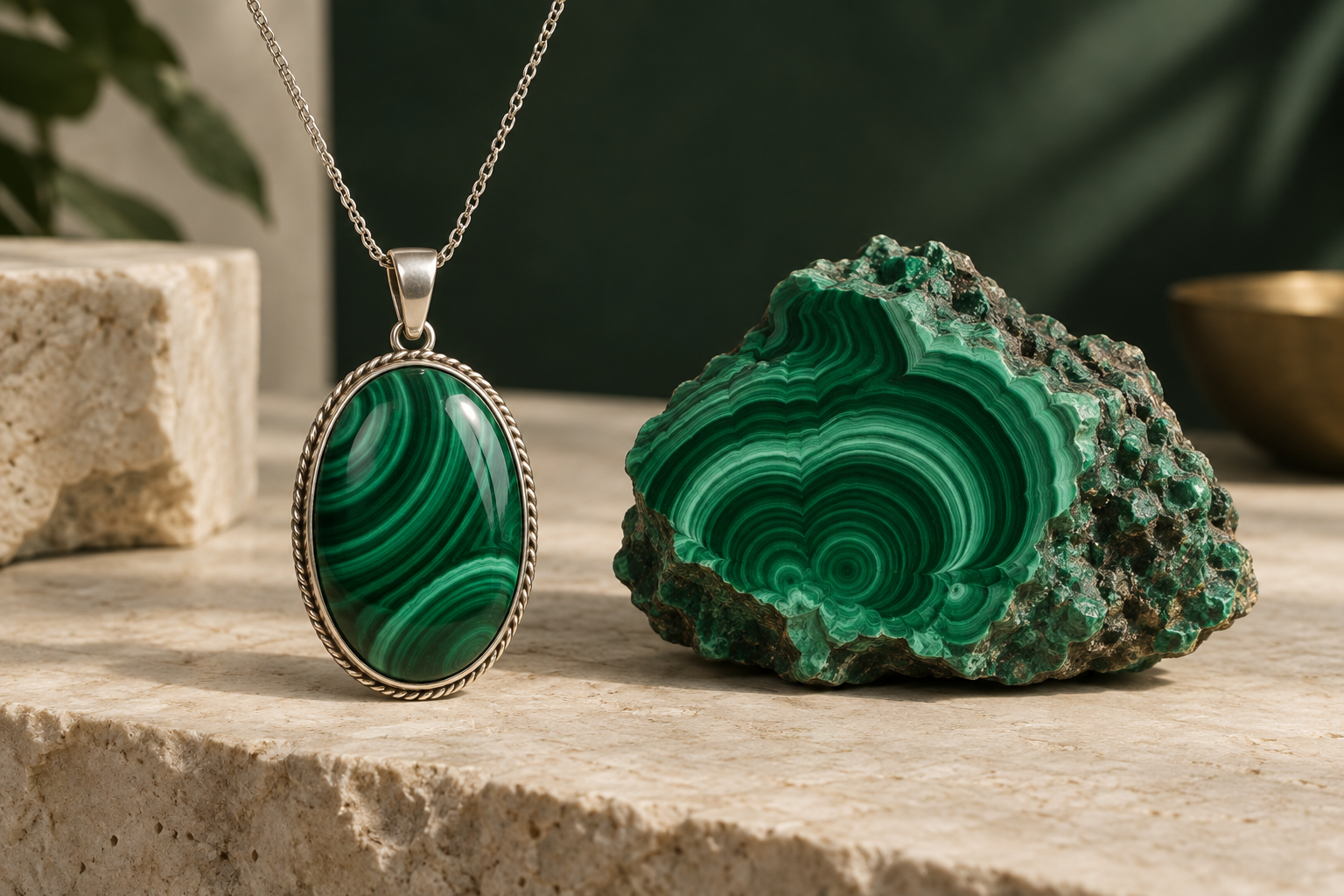
Malachite is a copper carbonate mineral recognized for vivid green color and characteristic banding. The Smithsonian National Museum of Natural History describes the mineral’s identity and its association with green shades among copper-bearing minerals. The banding and concentric patterns that make malachite visually striking come from successive growth and replacement of mineral layers, producing rounded or striped forms rather than a single uniform color.
Those layered patterns—rings, swirls, and bands of lighter and darker green—are the feature most buyers and designers look for when choosing malachite for jewelry or ornament. Because the patterns are internal to the mineral, each piece is unique: two cabochons cut from the same rough can show very different bands or 'eyes.'
Documented historical use: what museums and gem authorities record
The decorative use of malachite is well documented in museum and gemological literature. The Smithsonian National Museum of Natural History notes malachite’s long history as a decorative mineral, where its color and banding made it desirable for inlay, small carved objects, and pigment. The Gemological Institute of America (GIA) places malachite in a jewelry context as a historically used ornamental stone and describes how lapidaries and artisans employed it in decorative arts, including large architectural and household objects in certain periods.
Those published records show malachite appearing in multiple cultural contexts. For example, museum collections and scholarly descriptions identify malachite objects in ancient Egyptian material culture and in later decorative traditions; gemological commentary highlights its popularity in decorative arts such as Russian ornamental work in palace interiors and objects. When referring to those uses, it is important to rely on the named institutions’ documentation rather than generalized claims: these organizations catalog examples and describe how malachite was handled and displayed in specific periods.
Documented historical meanings versus modern interpretations
Historical records from museums and gemological institutions document malachite’s material uses—its role as a pigment, a carved decorative stone, or an inlay material—but they do not establish universal metaphysical properties. Where sources note symbolic associations historically, they are careful to link those associations to particular cultures or periods rather than to a universal meaning.
Modern literature and popular jewelry marketing often ascribe meanings such as protection, transformation, or balancing energy to malachite. These are cultural and personal interpretations rather than physical effects of the mineral. The thesis supported here is explicit: malachite’s visual properties and historical use are facts about the stone; interpretations that it protects, heals, or transforms are symbolic or spiritual attributions made by people and communities, not measurable effects of the mineral itself.
How malachite appears in jewelry and decorative objects
In jewelry, malachite is commonly cut as cabochons to best show its bands and swirls. Smooth rounded cabs are used in rings, pendants, and earrings because faceting does not suit the stone’s texture and color banding. Beads and small carved elements are also popular, since the material polishes well and displays pattern even in smaller sizes.
Beyond personal jewelry, malachite has historically been used for inlay panels, small boxes, tabletops, and large ornamental objects. The GIA and museum collections document examples where artisans used slabs of malachite to create striking matched patterns in decorative panels and furniture. In contemporary design, malachite is often set in silver or gold as a centerpiece in styles that emphasize the stone’s graphic green bands.
Selecting malachite: what to look for and what to ask
When selecting malachite, assess pattern quality, color variation, and overall stability of the piece. Strong, well-defined banding or 'eyes' is typically considered attractive; evenness of polish and lack of pits or fractures indicate careful cutting. Because malachite can vary from light to deep green, choose the tone that best fits your aesthetic and the setting you plan to use.
Ask the seller whether the malachite is natural, stabilized, or treated. Some malachite pieces are cut from soft, porous sections or assembled from thin veneers; others may be glued into composite pieces. For jewelry intended for frequent wear, prefer thicker cabochons or pieces with protective settings. Consider the recipient’s lifestyle: malachite makes excellent pendants and earrings for everyday wear but rings will require more protective design if worn daily.
Gifting guidance: respectful and practical advice
If you are gifting malachite, be explicit about its properties rather than asserting a universal symbolic meaning. Explain that malachite is prized for its green banding and decorative history and that cultural meanings vary. A thoughtful card that notes the stone’s decorative history and personal significance to you or the recipient is often more meaningful than unsupported claims about health or physical effects.
Choose a style appropriate to the recipient’s routine. For someone with an active daily life, a pendant or pair of studs will keep the malachite safer than an exposed ring. When in doubt, pick a setting that shields the stone’s edges and back, and include written care instructions so the recipient understands how to maintain the piece.
Care and maintenance: what to avoid and how to clean
Malachite is softer and more chemically sensitive than many gem materials, so care matters. The Gemological Institute of America advises that malachite is delicate compared to harder gems and that it should be protected from knocks, abrasives, acids, and household chemicals. Steam and ultrasonic cleaning are not recommended for porous or softer stones such as malachite.
The safest cleaning method is a soft cloth or a gentle brush with warm water and a mild, pH-neutral soap, followed by immediate drying. Avoid soaking for long periods, exposure to acids (including vinegar or acidic cleaners), and prolonged contact with perfumes or cosmetics. Store malachite jewelry separately from harder gems to prevent scratching, and consider fabric-lined boxes or pouches to cushion pieces when not worn.
Summary: appreciating malachite responsibly
Malachite jewelry meaning is best understood in two parts: the stone’s objective attributes—its banded green color, decorative history, and material softness—and the varied symbolic meanings people attach to it across cultures and time. The Smithsonian and the GIA document the mineral’s identity and decorative role; cultural or spiritual meanings belong to the contexts in which people use the stone.
Choose malachite for its striking visual character, not as a substitute for medical or safety measures. Select pieces and settings that respect the stone’s softness, and provide clear care instructions when gifting. That approach honors both the material history and the personal meanings people create around this enduring green mineral.
Frequently asked questions
What does malachite symbolize?
Malachite’s symbolic meanings vary by culture and personal belief. Historically it has been used decoratively in several cultures; modern attributions such as protection or transformation are cultural interpretations rather than physical properties of the mineral.
Is malachite safe to wear every day?
Malachite is relatively soft and can be scratched, chipped, or damaged by acids and harsh chemicals. For everyday wear choose protected settings and pieces such as pendants or earrings rather than exposed rings, and follow gentle cleaning and storage guidance.
How should I clean malachite jewelry?
Clean malachite with a soft cloth or a soft brush, warm water, and a mild, pH-neutral soap. Rinse and dry immediately. Do not use ultrasonic cleaners, steam, or acidic cleaners, and avoid prolonged soaking.
Can malachite be treated or stabilized?
Some malachite items may be assembled from veneers or stabilized with resins; always ask the seller for treatment and assembly information. Treatments affect value and care requirements, so transparency from the seller is important when buying.
Is malachite a birthstone?
Malachite is not a traditional modern birthstone in the standard lists. It is appreciated as a decorative and collectible mineral but is not assigned as an official birthstone by the principal modern birthstone lists.
Can malachite be used in engagement rings?
Because malachite is soft and sensitive to wear, it is generally not recommended for everyday engagement rings unless the design protects the stone extremely well and the wearer understands the need for careful handling.
Sources and further reading
- Malachite — Smithsonian National Museum of Natural History
- The Glory of Green Gems — Gemological Institute of America