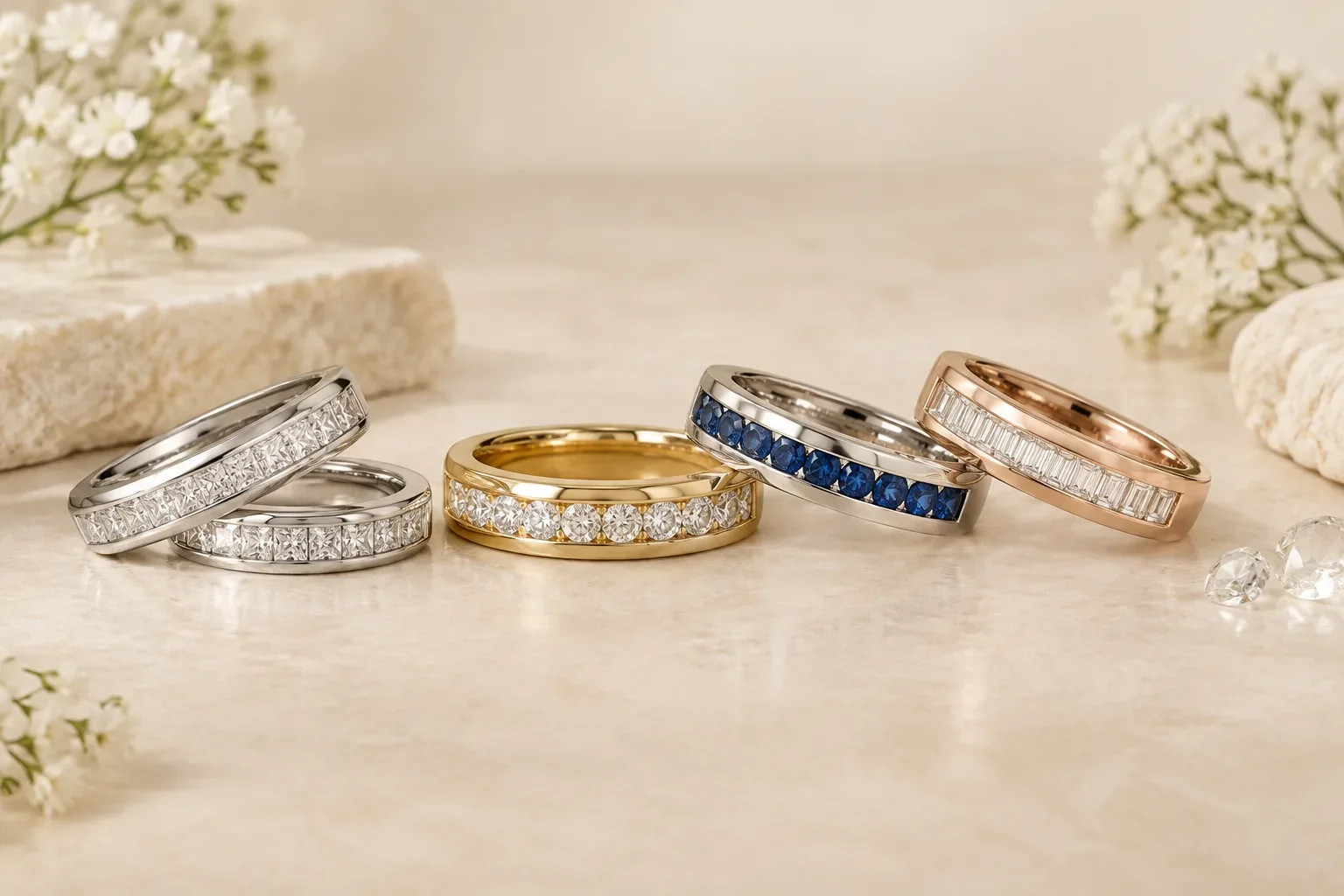
Meaning at a glance
Channel setting wedding band pairing requires decisions about ring profile and shape, the channel gap between stones, and metal compatibility; this guide gives clear decision criteria, practical trade-offs, care tips grounded in gem and trade guidance, and explains what requires a qualified jeweler or gemological laboratory to confirm.
What we mean by 'channel setting wedding band pairing'
A channel setting wedding band pairing describes the choice and combination of a wedding band that uses a channel setting—stones set in a continuous groove between two metal walls—with an engagement ring or another band so they sit together on the finger. The pairing question covers three practical areas: the shapes and rhythm of the stones (round, princess, baguette, etc.), the physical gap or flushness between rings when worn together, and the metal chosen for the channel walls and shanks.
Historical evidence and cultural notes
The approved reference set for this guide does not provide a long cultural genealogy for the channel setting as a named historical motif. Contemporary trade and trend sources focus on present demand and design directions rather than ancient symbolism. Industry trend reports note modern demand patterns—such as oval engagement rings, diamond studs, and a strong interest in versatile, stackable styles—rather than a documented historical origin for the channel setting specifically (Imaginaire Digital; Jewelers Mutual).
Because the sources here do not claim an ancient cultural symbolism for the channel-set band, avoid attributing a historic cultural meaning to the channel setting unless you find primary historical sources or museum records. In other words, current evidence documents how and why people choose channel-set bands today, not a universal cultural history linking the channel setting to a particular ritual or belief.
Documented meanings versus modern personal interpretations
Documented meanings in these professional and consumer sources concern practical matters: trends, craftsmanship values, repair and care considerations, and consumer protections around gemstone disclosure. For example, Jewelers Mutual describes current demand trends such as modern stacking and versatility that explain why consumers choose channel-set bands today; these are contemporary, market-driven meanings rather than age-old symbolism.
Modern personal interpretations—such as reading the channel setting as a symbol of continuity or protection for the stones—are valid as individual sentiment but are not documented in the trade or regulatory sources cited here. Distinguish emotional or sentimental meanings you and your partner assign from documented industry guidance about wear, treatment disclosure and design trade-offs.
How the channel motif and related gemstones appear in jewelry
In jewelry design, a channel setting places stones flush in a metal channel so no prongs are visible along the edge. This creates a linear, uninterrupted profile that supports stackable and low-profile bands favored in modern stacking trends (Jewelers Mutual). Channel settings commonly appear with small round brilliant diamonds, baguettes, or princess cuts; the choice of cut affects how tightly stones sit together and the perceived continuity of the band.
The appearance is also shaped by metal finish and color. A polished white metal makes diamonds read brighter, while warmer metals change perceived color and contrast. The overall motif—clean lines and continuous sparkle—supports versatility and gender-neutral styling that recent trend reports identify as important to many buyers (Imaginaire Digital; Jewelers Mutual).
Shape, gap and metal choices: decision criteria and trade-offs
Shape choices: Match stone shapes for the cleanest visual fit. Round brilliants in a channel require more rounded channels and may leave small light gaps between stones. Princess and baguette cuts can create a straighter visual line but need precise sizing to avoid light leakage or chipping at corners. Decide whether you prioritize uninterrupted sparkle (favoring similarly shaped stones set edge-to-edge) or a mixed look that emphasizes contrast.
Gap and fit: The physical gap between a channel band and an adjacent ring depends on shank height, shank curvature, and whether the engagement ring has side stones or a low bezel. A flush fit minimizes gap but increases the risk that one ring abrades the other over time. A small intentional gap reduces rubbing and can prolong metal and stone edges. The trade-off is visual continuity versus long-term wear.
Metal choices: Match metals when you want a seamless appearance, but consider hardness and workability. Platinum is very durable and resists wear, which benefits channel walls protecting stones; it also tends to be heavier. Palladium or high-karat yellow gold has a warmer color but softer walls, which may require more frequent maintenance to prevent channel deformation. Consider the metal’s compatibility with the wearer’s lifestyle and the stones’ hardness when deciding.
Practical trade-offs: A tight, low-profile channel looks sleek but concentrates impact forces on stone edges; a slightly taller channel offers more protection but raises the profile. Choosing a harder metal and a modest gap will favor longevity; choosing a low-profile, perfectly flush look favors immediate aesthetics but requires disciplined care and more frequent inspections.
Care guidance and limits on verification
Care: Follow standard gemstone-care guidance for channel-set bands. Clean gently with mild detergent and a soft brush; avoid ultrasonic or steam cleaning for stones that may be treated or filled unless confirmed safe by a qualified jeweler. Regular inspection of channel walls is important because any loose stone inside a channel can affect adjacent stones.
Treatments, disclosure and verification limits: The Gemological Institute of America explains that gemstone treatments affect durability and care, and many treatments can be detected only with proper testing. The Federal Trade Commission emphasizes that consumers require clear written disclosures distinguishing natural, lab-created, treated, cultured and imitation materials. What a shopper can reasonably verify at purchase is usually limited to what the seller discloses and visible fit and finish. Confirming whether a stone is natural unheated, heat-treated, fracture-filled, or lab-grown often requires a gemological laboratory report or a qualified jeweler using specialized tools.
When to use a jeweler or lab: Ask a qualified jeweler to inspect fit and channel integrity before purchase if you want a guaranteed flush fit and to understand repairability. If you need definitive identification of origin or treatments for insurance or resale, require a laboratory report from a recognized gemological facility. Rely on seller documentation for disclosure at the point of sale in line with FTC guidance.
Practical selection and respectful gifting guidance
Start with the wearer’s daily life. If the wearer has an active job or hobbies that expose rings to knocks, choose a slightly taller channel with a harder metal or accept a small gap to reduce abrasion. For readers looking for stacking versatility, prioritize lower profiles and shared metal colors across rings to preserve a coordinated look favored by modern shoppers (Jewelers Mutual; Imaginaire Digital).
Talk about maintenance and expectations. When gifting a ring, include care instructions and any disclosure paperwork the seller provides. If you are commissioning a matched set, decide whether you want both rings sized and shaped to be flush from the outset or prefer separate rings that pair closely but can be serviced independently. Communicate any symbolic intent you attach to the design—this personal meaning is the most lasting part of a gift, but be clear about the practical care it will require.
When buying online versus in-store: Online offerings may deliver excellent value and a broad selection, but ask for clear photos of the channel profile and for written disclosure of stone origin and treatments as required by the FTC. If the seller cannot provide clear documentation or close-up images of the channel construction, see the piece in person or request a return option and inspection by a jeweler before finalizing insurance.
Frequently asked questions
Can you make two rings sit completely flush when one is channel-set?
You can often achieve a near-flush fit, but a perfectly flush long-term fit is a trade-off. A totally flush pairing increases rubbing between metal walls and stones and may cause faster wear. A qualified jeweler can modify shanks for a closer fit and advise on maintenance, while laboratory tests are not required for fit but are needed to verify stone treatments or origin.
Which stone shapes work best in a channel when pairing with an engagement ring?
For the cleanest visual line, match stone shapes between bands. Princess and baguette cuts create straighter joins and visually continuous lines, while round brilliants offer more sparkle but may show small gaps between stones. Consider practicality: sharper-cornered stones need precise setting to avoid chipping and may demand a jeweler’s expertise.
How should I care for a channel-set wedding band?
Clean gently with mild soap and a soft brush and inspect channel walls regularly. Avoid ultrasonic or steam cleaners for stones that might be treated unless a qualified jeweler confirms they are safe. Schedule routine professional checks to ensure channels remain secure and stones are not loosening.
Do I need a lab report for a channel-set band?
You do not need a lab report just for fit or metal matching, but if stone origin or treatments affect insurance or resale value, request a gemological laboratory report. The FTC requires clear seller disclosure about whether stones are natural, lab-created, or treated, and the Gemological Institute of America notes that many treatments require testing to detect.
Which metals are recommended for durability in channel settings?
Platinum and harder white metals offer stronger channel walls that resist deformation and protect stones. Softer gold alloys can be used for warmer tones but may need more frequent maintenance. Match metal choice to the wearer’s lifestyle and the intended frequency of wear.
Sources and further reading
- Imaginaire Digital — Imaginaire Digital
- Jewelers Mutual — Jewelers Mutual
- Gemological Institute of America — Gemological Institute of America
- Federal Trade Commission — Federal Trade Commission