Meaning at a glance
Answer the distinct search intent behind 'Cluster Setting engagement ring checklist' with evidence-led definitions, decision criteria, practical trade-offs, safe care guidance, and clear limits on what a shopper can verify without a qualified jeweler or gemological laboratory.
Direct answer — what this checklist does
This checklist gives an evidence-led set of definitions, decision criteria, practical trade-offs, safe care guidance, and clear limits on what a shopper can verify without a qualified jeweler or gemological laboratory when considering a cluster setting engagement ring.
What is a cluster setting and how it appears in jewelry
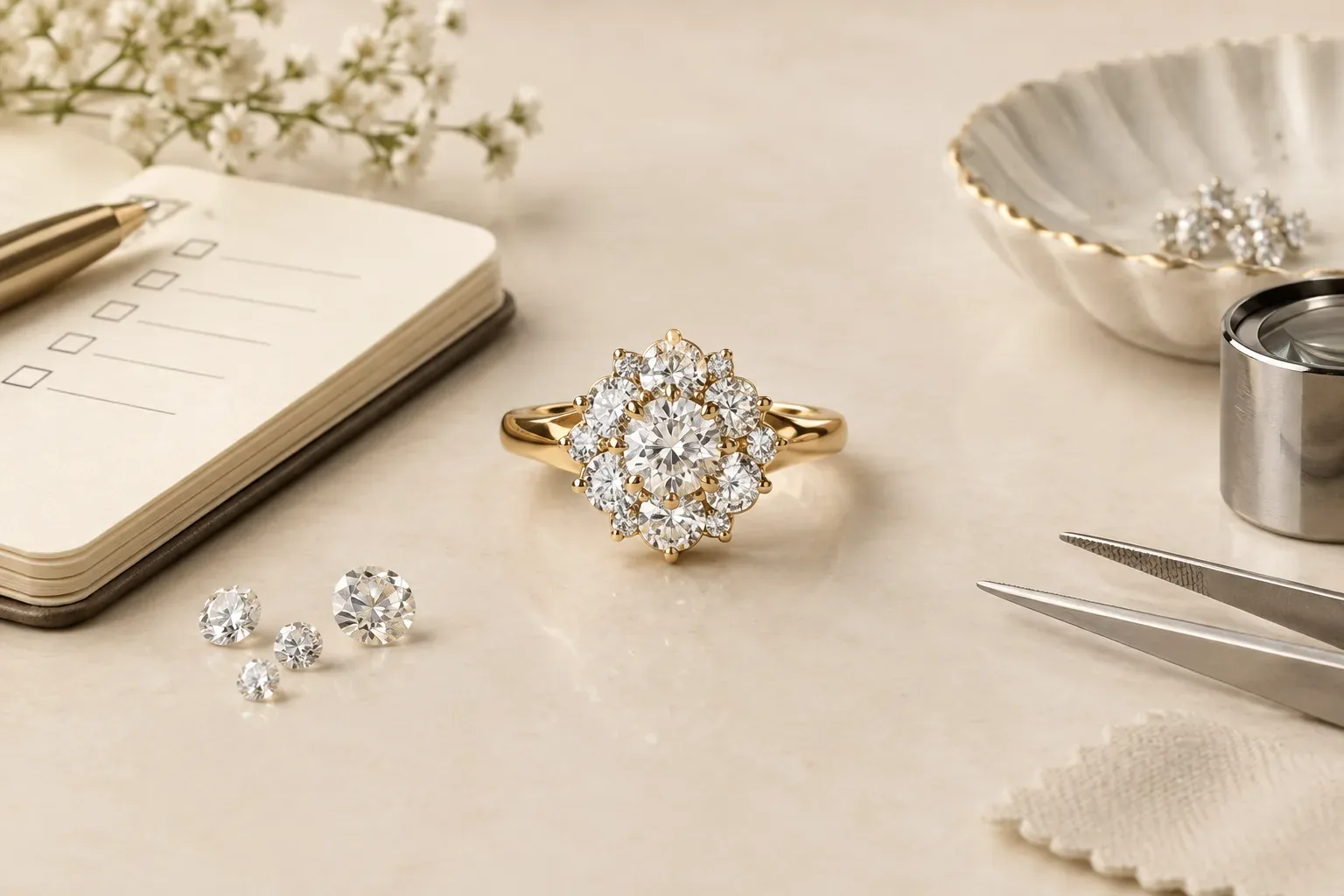
A cluster setting groups several smaller stones around a center or arranges many small stones into a single visual unit so they read as a larger motif. Designers use cluster settings with diamonds, colored gemstones, or mixed stones to increase perceived sparkle, adjust visual proportion, or create floral and geometric motifs that read as a single focal element.
In practice, cluster rings appear in a range of styles from tight pavé-like arrangements to looser halo or floral clusters. Metalwork choices (prongs, beads, or bezel elements) and the height of the mounting strongly affect how protective, repairable, and cleanable the cluster will be.
Historical notes and limits of the evidence
Cluster-style compositions are commonly associated in trade histories with nineteenth- and early twentieth-century jewellery fashions such as Victorian and Edwardian designs, and are repeatedly referenced in popular overviews of jewellery evolution. Those associations are widely circulated by jewelers, collectors and museum catalogues as a general provenance convention rather than a universal rule.
The current, approved sources for this checklist focus on modern consumer behaviour, trend patterns and consumer protections rather than primary historical scholarship. Imaginaire Digital and Jewelers Mutual document contemporary demand and styling trends for engagement rings and related jewellery, while the Gemological Institute of America and the Federal Trade Commission focus on gemstone treatments and disclosure that affect buying decisions today. For primary historical documentation you should consult museum catalogs, specialist monographs or academic jewellery histories.
Documented historical meanings versus modern personal interpretations
Documented historical meanings of cluster arrangements are not uniform and vary by region, maker and period; trade histories often describe floral or clustered motifs as evoking natural forms in Victorian and Edwardian decorative language, but these interpretations are contextual and not universal.
Modern personal interpretations are diverse: some buyers choose a cluster setting because it reads as vintage, because it emphasizes sparkle over single-stone size, or because it offers a more economical way to achieve a larger visual presence. Imaginaire Digital and Jewelers Mutual both show strong contemporary interest in varied styles, colored gemstones and craftsmanship, which helps explain why cluster settings remain popular in modern engagement rings.
Key decision criteria to include on your checklist
Define the look you want: Do you prefer the appearance of many small stones as a single visual unit, a halo around a single center, or a floral geometric cluster? Photographs from multiple angles and a clear description of the silhouette and profile will help you compare options.
Confirm materials and disclosures in writing: Ask whether stones are natural, lab-created, treated, or simulants and request written disclosure. The Federal Trade Commission advises consumers to require clear distinctions among natural, lab-created, treated, cultured and imitation materials.
Ask about gemstone treatments and durability: The Gemological Institute of America explains that treatments affect detectability, durability and care needs, so request details on any heat treatment, fracture filling, surface diffusion, or coating and whether the seller will disclose these in writing.
Verify mounting and repairability: Ask how stones are set (shared prongs, beads, bezel), what metal is used, and how easily the ring can be resized or repaired without disturbing the cluster. Cluster settings with many shared prongs can be more delicate to resize or repair.
Confirm certification and appraisal: For diamonds or high-value gems ask which grading laboratory (if any) issued a report and what the report covers. Be realistic: lab reports and verified carat weights require a gemological laboratory or qualified appraiser for definitive confirmation.
Practical trade-offs to weigh
Sparkle versus stone size perception: A cluster setting often maximizes surface area and scintillation for a given budget, making the ring read as larger than a single stone of comparable cost. That visual advantage may matter more to some buyers than the rarity or resale profile of a single, larger certified diamond.
Durability and cleaning: Many small stones and shared prongs mean more edges and crevices where dirt can collect and more potential points of failure if a prong is knocked. This trade-off affects ongoing care and insurance considerations.
Cost and resale: Cluster rings can be more economical to buy for a given visual impact, but resale markets generally favor well-documented single-stone diamonds with laboratory grading. Expectations for resale value should be set accordingly.
Customization and maintenance: Intricate cluster work allows for highly personal design but can require more maintenance, such as periodic prong checks and professional cleanings.
Questions to ask sellers — the checklist you can use in-store or online
Can you provide a written disclosure of whether the stones are natural, lab-created, treated, or simulants, and specify any treatments applied? The FTC emphasizes the need for these distinctions in writing.
Who graded the stones and is there a laboratory report or certificate I can see? If a seller cites a grading report, note the issuing laboratory and request a copy.
What is the metal type, its hallmark, and what karat or alloy composition is used? Ask how resizing or repair will be handled given the cluster design.
How are the stones set and how many prongs or bezel elements surround the cluster? Request close-up photos or a video to inspect the setting from multiple angles.
What care and maintenance do you recommend, and do you offer warranty, service plans, or return policies that cover lost or damaged stones?
What you can verify yourself versus what requires specialists
Without a jeweler or lab you can verify visible aspects such as symmetry, finish, visible hallmarks, seller documentation, and whether the piece matches images and descriptions provided. You can also check the seller’s written disclosures about treatments and origin.
You cannot reliably confirm gemstone treatments, precise identity, origin, or accurate carat weight and grading without a qualified jeweler’s instruments or a gemological laboratory report. The GIA notes that some treatments are detectable only by laboratory testing and that disclosure and professional testing are distinct consumer protections.
If definitive grading or treatment detection matters to you, plan to obtain a lab report from a recognized gemological laboratory or an independent appraisal that references lab-grade equipment.
Safe care guidance for cluster engagement rings
Because cluster settings have many small stones and shared prongs, follow a gentle cleaning regimen and avoid harsh chemicals. Regularly inspect prongs and settings for loosening and have a jeweler check the ring at least annually.
Be mindful of activities that could stress small stones or prongs and consider removing the ring for heavy physical work. Jewelers Mutual highlights current consumer interest in craftsmanship and versatility; thinking about lifestyle compatibility helps avoid damage and costly repairs.
If stones are treated, ask the seller whether the treatment affects heat or chemical sensitivity so you can avoid damaging care methods. GIA guidance on treatments and care is the appropriate reference for treatment-specific instructions.
Gifting and selection guidance delivered respectfully
Start with conversation rather than assumptions: If the ring is a surprise, try to gather preferences about style, metal, and gemstone durability indirectly or consult close friends or family who know the recipient’s taste.
Prioritize clear disclosures and documentation to avoid misunderstandings after gifting. A ring accompanied by clear paperwork about materials and any treatments shows respect for transparency and helps future servicing or resale.
Consider alternative options to a surprise when material details matter. If a recipient prefers a single-stone aesthetic, a cluster may disappoint; if they prefer vintage flair or more sparkle for the budget, a cluster setting can be an excellent, meaningful choice.
Making the final purchase decision
Ensure the seller provides written disclosure about stone type and treatments, a clear returns or exchange policy, and answers to the checklist questions above before you buy. If you need definitive grading or treatment detection, budget for a lab report or independent appraisal and factor that into your timeline.
Balance aesthetic desires, lifestyle durability, and documentation needs. Cluster settings are a legitimate design choice that deliver specific visual benefits and practical trade-offs; knowing those trade-offs in advance makes the purchase more satisfying and reduces surprises.
Frequently asked questions
What are the most important questions to ask when buying a cluster engagement ring?
Ask for written disclosure on whether stones are natural, lab-created, treated, or simulants; request copies of any grading reports; ask how the stones are set and what metal is used; confirm resizing, repair and warranty policies; and ask about recommended care. The FTC advises clear distinctions and written disclosures for these material categories.
Can I verify a gemstone’s treatments or exact grading at home?
No. Some treatments and precise grading require laboratory testing or instruments used by qualified gemologists. The Gemological Institute of America notes that detectability and disclosure of treatments are specialist tasks, so obtain a lab report if treatment or exact grading matters to you.
Are cluster settings harder to care for than single-stone rings?
They can be. Cluster settings have more small stones and shared prongs, which can trap dirt and introduce more potential points of failure. Regular inspection, gentle cleaning and professional checks are recommended to maintain integrity.
Does a cluster setting affect resale value?
Resale markets often favor single well-documented stones with laboratory grading. Cluster settings may offer greater visual presence for a lower purchase price but typically do not command the same resale premiums as certified single-stone diamonds.
What documentation should I insist on before buying?
Insist on written disclosure about whether stones are natural, lab-grown, treated or simulants, any available grading reports, the seller’s return and warranty policy, and clear statements on repair and resizing. The FTC emphasizes the importance of these disclosures for consumers.
Sources and further reading
- Imaginaire Digital — Imaginaire Digital
- Jewelers Mutual — Jewelers Mutual
- Gemological Institute of America — Gemological Institute of America
- Federal Trade Commission — Federal Trade Commission