Meaning at a glance
Toi et Moi settings can be durable for everyday wear, but durability depends on the stones, the mount design and metal, and disclosed treatments; buyers should weigh trade-offs between profile and protection, ask specific questions about gemstone treatments and mounting security, and arrange a professional inspection for anything the seller cannot verify.
What a Toi et Moi setting is and how it appears in jewelry
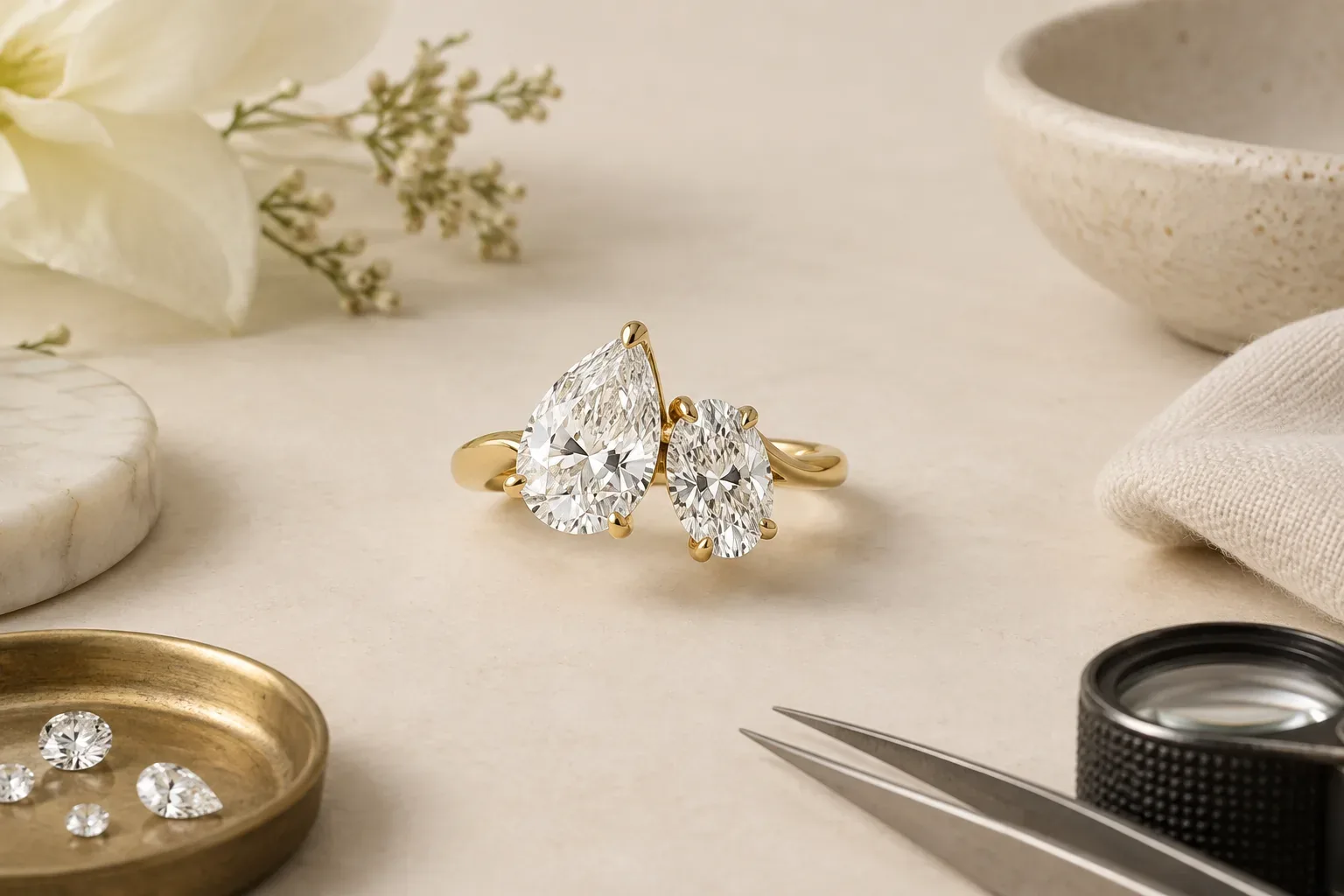
‘Toi et Moi’ is French for ‘you and me’ and describes a two‑stone ring layout in which two gemstones sit side by side rather than as a single center stone. In contemporary jewelry this takes many forms: matched diamonds, mixed diamond and colored gemstone pairs, or contrasting shapes and sizes. The two stones may be set with shared prongs, individual prongs, bezels, or tension-style mounts, and the relationship between the stones—how closely they sit, the angle between them, and whether they are flush to the band—matters for both appearance and durability.
Modern retail and design emphasis on fluid forms, color and versatility increase the popularity of two‑stone settings in engagement jewelry. Industry trend reporting for 2026 highlights a market appetite for fluid silhouettes, colored gemstones and craftsmanship that supports versatile, stackable styling, which helps explain why buyers choose the Toi et Moi motif today (Jewelers Mutual; Imaginaire Digital).
Historical evidence and limitations in the available sources
The sources provided for this article do not include primary historical documentation about the origin or early cultural uses of the Toi et Moi motif. Because the approved evidence set focuses on modern market trends, consumer disclosure and gem treatment issues, readers should treat historical narratives as separate research tasks and consult specialized jewelry history references or museum records for primary attributions.
In short: this article uses the approved sources to explain contemporary durability, care and consumer protections; it does not assert historical claims about specific periods or cultures because those claims are not present in the supplied evidence.
Documented historical meanings versus modern personal interpretations
The approved sources used here do not document historical symbolic meanings for the Toi et Moi motif. Where historical meanings are quoted in other contexts you will often see them presented as cultural or romantic symbolism, but those are modern interpretations or later storytelling rather than evidence found in the provided references.
Today, many buyers choose a Toi et Moi ring for personal reasons—representing partnership, contrast, or balance—and retailers and designers frequently promote these modern interpretations. Personal symbolism is valid, but it is distinct from academic or archival history; the consumer protections and disclosure practices emphasized by the Federal Trade Commission remain relevant regardless of symbolic intent, because they affect the material facts about what you are buying.
Durability factors specific to Toi et Moi settings
Stone selection: The physical durability of a Toi et Moi ring starts with the gemstones themselves. Some gem materials are more resistant to scratching, chipping and cleavage than others. The Gemological Institute of America highlights that treatments, detectability and special care create distinct consumer questions about gemstone durability and required care, so always ask whether either stone has been treated and what that means for daily wear (GIA).
Mount profile and protection: Two stones set side by side often create higher profiles, asymmetrical edges or exposed corners that are more likely to catch on fabrics or be struck during everyday activity. Settings with lower profiles, protective bezels or well executed prong work that shields vulnerable corners will generally reduce snagging and impact risk. Conversely, high-set, protruding stones and open galleries increase the chance of catching and mechanical damage.
Shared prongs and proximity: When a Toi et Moi uses shared prongs or very close settings, damage to one stone—such as a strike that loosens a prong—can threaten the adjacent stone. Independent, well-constructed prongs or bezel edges that surround each stone create a more isolated failure mode where a single incident is less likely to affect both stones.
Metal choice and workmanship: The alloy, thickness of shanks and the quality of soldering or cast elements determine how well the mount resists bending and how repairable it is. Increased consumer interest in craftsmanship and versatility has placed a premium on solid construction in 2026 industry reporting, so prioritize a finished ring where joins and prongs look robust and well executed (Jewelers Mutual; Imaginaire Digital).
Snagging risk: why two stones can catch more and what reduces it
Two stones produce more edges and transition points than a single center stone, and every exposed facet, pavilion tip or prong end is an opportunity to snag clothing or fibers. Rings with side-by-side stones that sit at different heights increase contact points with sleeves or pockets. To reduce snagging risk choose a lower profile, a design with guarded prongs or a partial bezel, and make sure countersinks and gallery work are finished smoothly.
Practical daily choices also matter. If your lifestyle involves regular hands‑on work, sports, or frequent fabric contact, a Toi et Moi with protective settings or a pair of harder, more durable stones will generally be a safer everyday option than a delicate, high‑set display piece.
Repair risk and what increases future repair costs
Repair risk rises when the design places strain on narrow shanks, when prongs are thin, or when unusual angles make resetting or re‑profiling difficult. Likewise, if either gemstone has been subjected to treatments that weaken its structure—something the GIA warns consumers to understand—repairs can be more complex and expensive because some treatments limit what heat or chemicals a stone can tolerate during repair.
Another cost driver is rarity or custom work. Intricate, hand‑engraved gallery work or bespoke mounts often cost more to repair than simpler commercial settings. The current market emphasis on craftsmanship may encourage buyers toward detailed work, but that also means you should budget for maintenance and choose a trusted jeweler who can describe likely repair procedures and costs up front (Jewelers Mutual).
What a shopper can and cannot verify without a jeweler or gemological lab
You can do useful pre‑purchase checks on your own: examine high‑resolution images or the ring in hand to look for obvious damage, strong asymmetry in the stone alignment, visible chips or poorly finished prong tips, and hallmarks indicating metal type. Ask the seller for written disclosures about the gemstone’s origin (natural, lab‑created), any treatments, and any warranties.
You cannot reliably verify internal treatments, enhancements, or certain durability attributes without laboratory testing or a professional gemologist’s equipment. The Federal Trade Commission stresses the consumer need for clear distinctions among natural, lab‑created, treated, cultured and imitation materials with written seller disclosures, so insist on documentation when sellers make claims you cannot test visually (FTC). For any nontrivial doubt about treatment or authenticity, a gemological laboratory or qualified appraiser is the appropriate verifier.
Practical selection and gifting guidance
If you expect daily wear, prioritize the combination of durable stones and protective mount design over purely decorative choices. Ask the seller for specific information about treatments and request clear photos or a viewing to evaluate profile and prong protection. Consider whether you want two matching stones for visual symmetry or contrasting stones that will require different care regimes and possibly more frequent servicing.
When gifting, be explicit about aftercare and document what the ring includes: origin statements, any treatment disclosures, warranty terms and a recommended schedule for professional inspection. Industry trends toward versatility and gender-neutral styling mean many modern Toi et Moi rings are designed to be stackable or to pair with bands, so check that the ring’s profile will accommodate any future wedding band or stacking preference (Imaginaire Digital; Jewelers Mutual).
Safe daily-care habits
Routine, gentle cleaning and periodic professional checks reduce long‑term repair risk. Avoid harsh thermal shocks or chemical exposures if the seller has disclosed treatments or sensitive materials, and remove the ring for heavy manual work or contact sports. For any cleaning or polishing beyond gentle soap-and-water, consult the maker or a trained jeweler, because some treatments and certain gem materials require special procedures to avoid damage (GIA).
Decision checklist before purchase
Before buying a Toi et Moi engagement ring for everyday wear, confirm the following with the seller or a professional: written disclosure of gemstone origin and treatments; clear photos or an in-person inspection showing prong quality and profile; information about metal alloy and visible hallmarks; and warranty or repair options. If a seller cannot provide these basics, plan to get an independent appraisal before committing to wear it daily.
Final limits and when to seek professional help
This article gives evidence-led decision criteria, care guidance and practical trade-offs drawn from the approved industry sources. It does not replace a hands-on examination. For structural questions about a particular ring’s mounting strength, metal alloy composition, or to detect undisclosed treatments, you will need a qualified jeweler’s inspection or laboratory testing. Treat verbal claims about durability with caution unless accompanied by documentation or a professional verification.
Frequently asked questions
Is a Toi et Moi ring more likely to snag than a single-stone ring?
Because it exposes more edges and transition points, a Toi et Moi design can have a higher snagging risk than a simple single center stone. The extent of that risk depends on the stones’ profile, prong protection and how the stones sit relative to the band. Choosing a lower-profile design or protective bezels and confirming good prong workmanship reduces snagging potential.
What questions should I ask a seller about treatments and durability?
Ask the seller for written disclosure of whether either gemstone is natural, lab-created or treated and what specific treatments were applied. Request guidance on the recommended care and any limitations those treatments impose. The Gemological Institute of America emphasizes that treatments affect detectability and care, and the Federal Trade Commission requires clear distinctions in seller statements, so insist on documented answers rather than verbal assurances.
Can I verify gemstone treatments myself at home?
No. Some treatments and internal enhancements cannot be reliably detected without laboratory equipment or a qualified gemologist. If treatment disclosure is important to you, request laboratory reports or an independent appraisal before purchase.
How often should a Toi et Moi ring be inspected professionally?
There is no single rule that fits every ring, but manufacturers and insurance professionals recommend routine inspections at least once a year for engagement rings worn daily and more often if you notice loose stones or visible wear. Industry trends emphasize craftsmanship and maintenance, so a yearly check aligns with common practice for preserving structural integrity.
Are there ring styles that make a Toi et Moi safer for everyday use?
Yes. Designs with lower profiles, protective bezels or guarded prongs, and rings where each stone is independently secured tend to be safer for daily wear. Also consider matching the pair of stones in durability characteristics so both respond similarly to routine exposure and cleaning.
Sources and further reading
- Imaginaire Digital — Imaginaire Digital
- Jewelers Mutual — Jewelers Mutual
- Gemological Institute of America — Gemological Institute of America
- Federal Trade Commission — Federal Trade Commission