Meaning at a glance
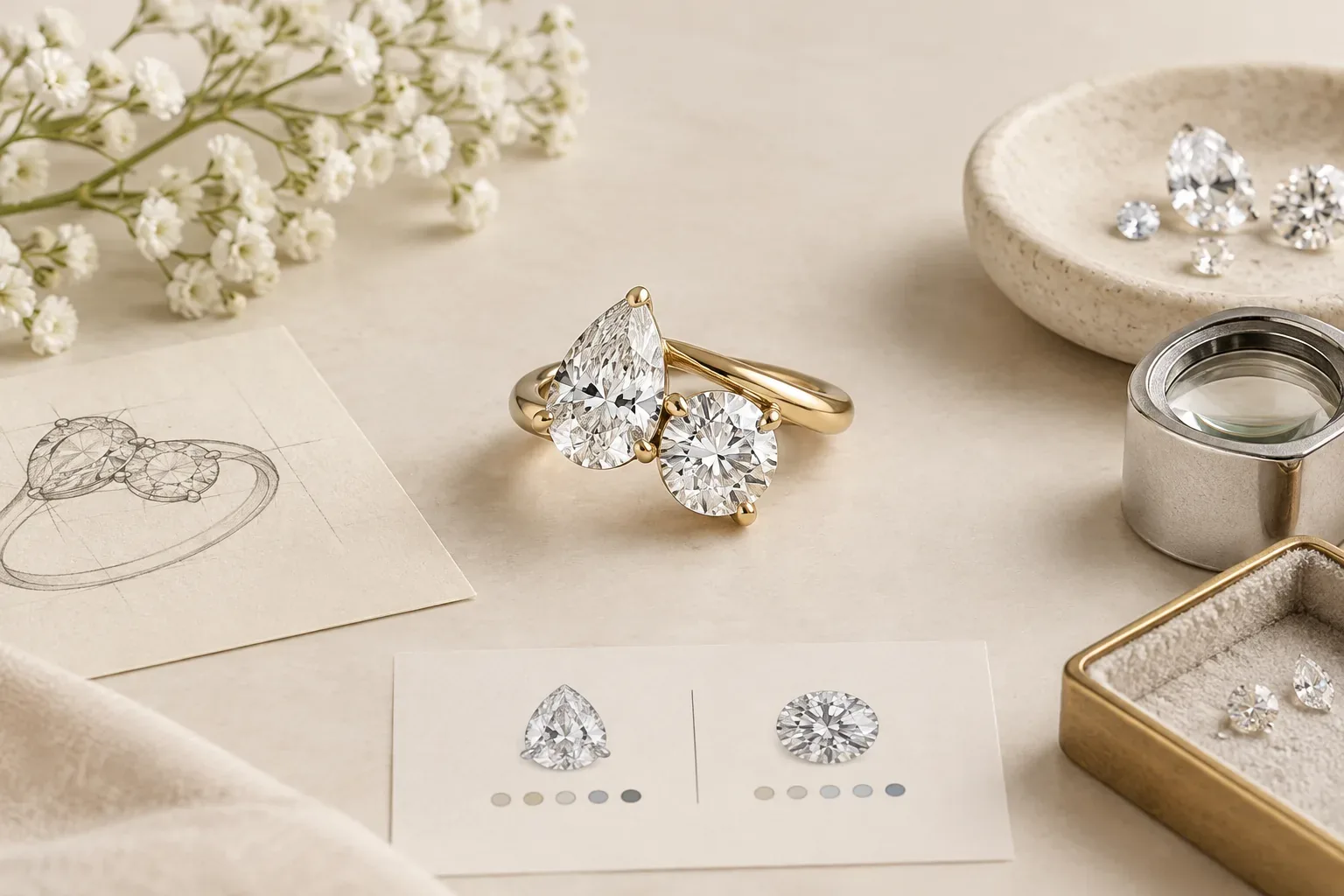
A toi et moi setting features two stones set side-by-side to symbolize two individuals; this guide defines the style, separates what historical sources can and cannot verify, summarizes modern demand and practical trade-offs, and lists what buyers can only confirm with a qualified jeweler or gemological laboratory.
Quick answer
Concise answer: a toi et moi engagement ring is a two-stone setting in which two distinct gems sit next to one another to form a single composition, and a buyer should choose it when they value a symbolic twin-stone look, want more visual variety than a single solitaire, or prefer an asymmetric or vintage-inspired aesthetic. This guide gives decision criteria, realistic trade-offs, safe care steps, and clear limits on what a shopper can verify without professional testing, in line with the evidence-led approach required for an informed purchase.
What 'toi et moi' means and how the motif appears in jewelry
The phrase 'toi et moi' is French for 'you and me' and is used in jewelry to describe a ring with two main stones placed side-by-side so each stone remains distinct while contributing to a single composition. The two stones may be matched diamonds, a diamond paired with a colored gemstone, or two different colored gems. Designers vary the effect through stone shape, size, setting style and metal work; some toi et moi rings emphasize symmetry, others emphasize contrast or a gently offset pairing.
In practice, the motif appears in engagement rings as a center design that replaces a single solitaire, and in other jewelry such as pendants or brooches. Settings range from low-profile bezels and prongs that hug both stones closely to higher-profile designs with a split shank or decorative shoulders to balance the visual weight of the pair. Jewelers often use the two-stone format to introduce color contrast, mix gem cuts, or create a personal combination such as birthstones.
What the modern market and trends say
Recent trade and consumer trend summaries highlight strong contemporary interest in non-traditional forms, colored gemstones, and gender-neutral styling. Jewelers Mutual reports that demand is centering on fluid forms, modern stacking, colored gemstones, craftsmanship, versatility and gender-neutral styling, which helps explain why two-stone settings have re-emerged as a popular engagement choice rather than a niche antique revival. Imaginaire Digital’s 2026 search data for the UK also shows ongoing demand for engagement ring categories and styles, indicating buyers are actively researching alternative center styles alongside traditional solitaires.
Historical evidence and what can be documented
Careful buyers should note that the set of approved sources for this article does not include primary historical studies of the toi et moi motif, so this guide does not assert a precise origin date or single cultural birthplace. That absence means we cannot reliably attribute the style to a specific period or patron from the supplied references. When historical origin is important to you, seek primary historical scholarship, auction-house descriptions that cite provenance, or museum records rather than general trend or consumer guidance sources.
If you encounter claims about specific historic owners, royal commissions or exact decades for the motif, ask the seller for documentary provenance or a museum citation. For example, an auction catalogue or archival record is the appropriate evidence for an object's age and provenance; those are verifiable items a buyer can request, but they are outside the scope of the four approved sources used here.
Documented historical meanings versus modern personal interpretations
Because the historical record is not provided in the approved sources, this article separates two kinds of understanding. Documented historical meanings require archival or academic citation and cannot be asserted from trade or consumer trend reports alone. Modern personal interpretations, by contrast, are living practices: many buyers today choose a toi et moi for romantic symbolism (two lives joined), for aesthetic contrast (two colors or cuts), or for family reasons (pairing birthstones). These modern meanings are subjective and not universal; different cultures and individuals attribute different symbolic value to the same visual motif.
Treat claims about historic symbolism with caution unless a seller provides provenance or a credible historical source. Do not assume a single, universal meaning; the motif’s appeal today is often personal rather than strictly traditional.
Decision criteria: who suits a toi et moi engagement ring
Choose a toi et moi if you want an engagement ring that reads as intimate and narrative rather than strictly classical. The style suits wearers who like visible contrast or balance between two stones, those who want the opportunity to combine a diamond with a colored gem, and people who appreciate asymmetry or vintage-inspired silhouettes. It also works well for someone who wants a ring that can later be reframed as an anniversary or two-person heirloom by replacing one stone.
Consider hand size and finger shape: two larger stones can visually widen the finger, while a smaller pair or offset shapes can lengthen it. Also consider lifestyle: settings with exposed prongs could snag if the wearer is highly active or works with their hands frequently. If you anticipate heavy daily wear, opt for sturdier settings such as bezel or low-profile prong work and choose gemstones with higher scratch resistance.
Practical trade-offs to weigh
Visual variety versus matching and resale: combining two different gems increases personal expression, but it can reduce broad resale appeal compared with a classic single diamond solitaire. Cost and budget allocation: two stones give you additional design levers—you can spend more on a single larger stone or split budget across two smaller higher-quality stones; both approaches change the overall visual impact and resale profile.
Complexity of setting and maintenance: two stones mean two sets of claws, bezels or seats to inspect; more metalwork and stone junctions can increase the risk of loosening over time. Sizing and ring stacking: find out how a wedding band will sit beside a two-stone ring—some toi et moi rings pair well with a contoured band, others need a custom band or a complementary style. These are practical trade-offs you should verify with the jeweler before purchase.
Care, treatments, and what requires expert verification
General care: clean toi et moi rings regularly with a soft toothbrush and mild soapy water, rinse and dry with a soft cloth, and have prongs or bezels checked every six to twelve months by a jeweler. For higher-fragility gems or softer colored stones, ask the jeweler about vibration and impact resistance and consider a protective setting such as a bezel.
Treatments and disclosure: the Gemological Institute of America highlights that treatments, disclosure, detectability, durability and special care create distinct consumer questions for gemstones. The Federal Trade Commission requires clear disclosure of natural, lab-created, treated, cultured and imitation materials, so ask for written confirmation of any treatments and whether the seller will provide a gem report. Importantly, certain treatments and origin claims require laboratory analysis to confirm; a seller can disclose known treatments but some features—stability under heat, diffusion treatments or origin—are only scientifically verifiable by a qualified gemological laboratory.
What you can and cannot verify without a pro
You can verify basic facts yourself such as the seller’s written disclosure about whether a stone is natural, lab-created, or treated; the presence or absence of a third-party certificate when one is offered; ring size; metal karat or plating as stated on documentation; and the visible quality of setting work. You can also compare visual elements such as color contrast or symmetry by inspecting photos or the piece in person.
You cannot reliably verify treatments that require spectroscopy or microscopic analysis, the exact geographic origin of a gemstone, or nuanced durability claims without a qualified jeweler or a gemological laboratory. If those matters are material to your purchase, request a current gem report from an accredited laboratory and verify treatment disclosures in writing before you complete the sale.
Practical selection and respectful gifting guidance
When selecting or gifting a toi et moi ring, begin by asking clear questions about the recipient’s existing jewelry, preferred metals and whether they wear rings on the chosen finger daily. If you are unsure of size or style, consider a temporary token or a custom consultation with the recipient present so the final choice can be collaborative. For surprise proposals, discreetly borrow a worn ring to get size guidance or choose a slightly resizable setting and confirm the seller’s return and resize policy.
Respectful gifting also means transparency: if a stone is treated or lab-grown, disclose that to the recipient and keep paperwork accessible. If the ring is a family or heirloom piece being repurposed, discuss the intended outcome with family members and a jeweler experienced in setting transfers to maintain structural integrity and respect provenance.
Final checklist before you buy
Before purchasing, verify the seller provides written disclosure about gem origin and treatments, request any available independent gem reports, inspect or ask for clear images of the setting junctions between the two stones, confirm ring resizing and repair policies, and consider the long-term wearability of the chosen setting. If a claimed historical provenance or unique cultural meaning is central to your decision, ask for documentary evidence such as an auction catalogue entry or museum record.
Conclusion
A toi et moi engagement ring is a distinctive, flexible choice that offers personal expression through pairing and contrast. Use the decision criteria and trade-offs above to match the style to the wearer’s lifestyle and preferences, insist on written disclosures for gemstones and treatments, and obtain a gemological report when material authenticity or origin is important. When in doubt about treatment, durability or provenance, rely on a qualified jeweler or an accredited gemological laboratory for confirmation.
Frequently asked questions
What is a toi et moi engagement ring?
A toi et moi engagement ring places two main stones side-by-side as a single composition, often to symbolize two individuals or to combine two different gems for contrast or color.
Is a toi et moi ring considered vintage or modern?
Both. The two-stone format has historical appearances and modern reinventions, but the approved sources for this guide do not document a single origin; contemporary demand is driven by current trends such as fluid forms and colored gemstones.
Can I get a lab-created or treated gemstone in a toi et moi setting?
Yes. Lab-created and treated gemstones are widely available, but the Federal Trade Commission requires sellers to disclose whether a stone is natural, lab-created or treated, so request written disclosure and documentation before purchase.
How do I care for a toi et moi ring?
Clean regularly with mild soapy water and a soft brush, dry with a soft cloth, and have settings checked by a jeweler every six to twelve months. For softer gems, choose protective settings and avoid harsh chemicals and knocks.
What can only a gem lab or qualified jeweler verify?
A qualified jeweler or gemological laboratory is required to confirm treatments, determine geographic origin, verify subtle enhancement methods, and provide an authoritative grading or certification of a gemstone’s properties.
Will a toi et moi ring pair with a wedding band?
It depends on the ring’s profile and the band design; many toi et moi rings pair well with a contoured band or a custom wedding band, but some require specially shaped bands to sit flush.
Sources and further reading
- Imaginaire Digital — Imaginaire Digital
- Jewelers Mutual — Jewelers Mutual
- Gemological Institute of America — Gemological Institute of America
- Federal Trade Commission — Federal Trade Commission