Meaning at a glance
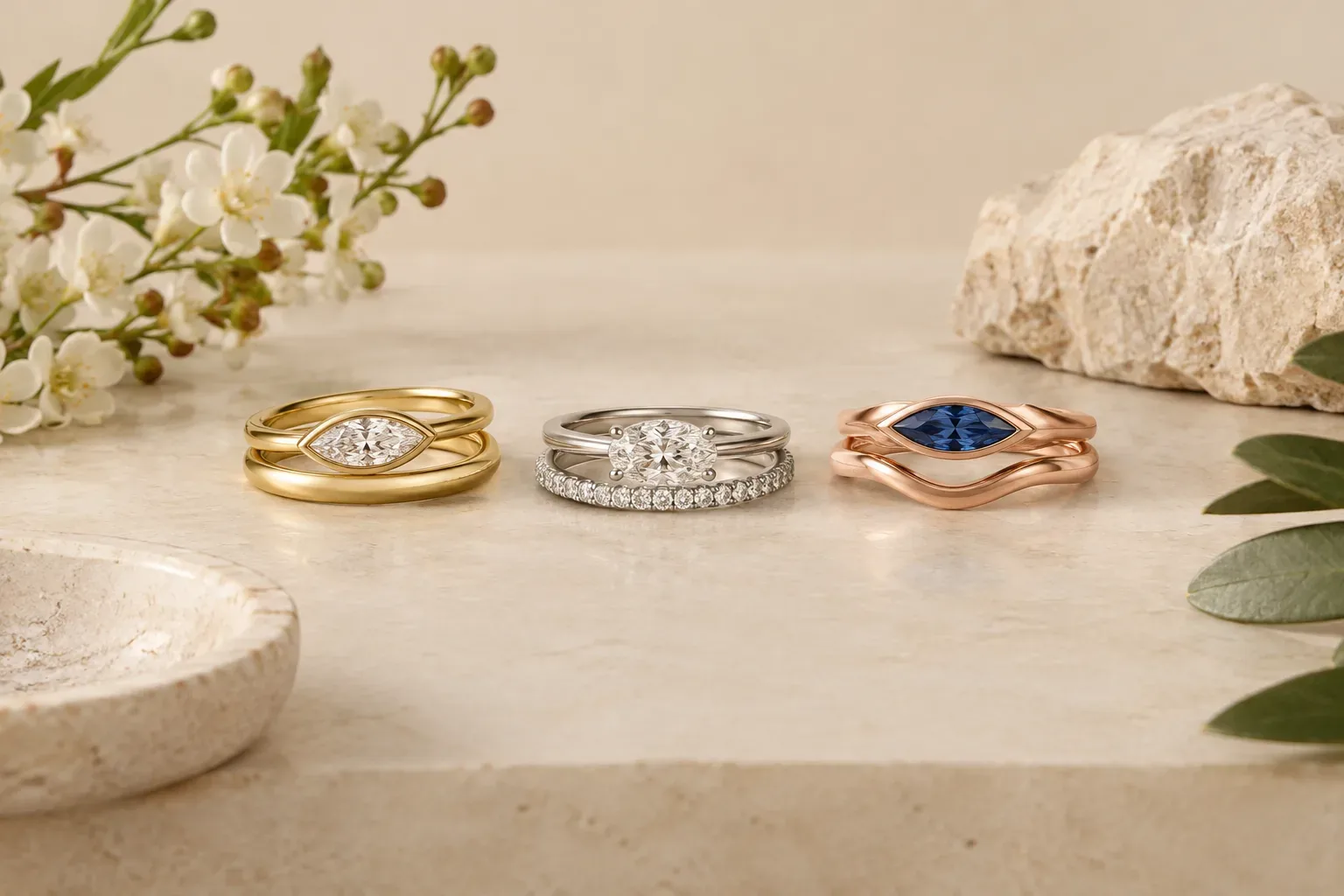
East-west settings are a contemporary stylistic choice—often used with ovals, marquises and emerald cuts—that require deliberate band shaping or compromise on fit. Use stone shape, profile, and metal hardness as your decision criteria; verify treatments, origin or precise grading only with a qualified jeweler or gemological laboratory.
What the term means and why it matters
“East-west setting” refers to mounting an elongated or directional center stone—most often an oval, marquise, or emerald cut—so its long axis runs horizontally across the finger rather than vertically. The look emphasizes horizontal lines, which change how a wedding band sits next to the engagement ring and how the pair reads on the hand.
This orientation matters for pairing because it changes the visual footprint of the engagement ring and often creates a gap in a conventional straight wedding band. Solving that gap affects both aesthetics and function: a contoured or notched band will sit closer but may be more complex or costly to resize; a straight band may leave a visible space but is simpler to adjust later.
Historical evidence and cultural context
There is little documented evidence tying an east-west setting to a particular culture or historic period in authoritative trade and consumer sources included in this briefing. Contemporary trade reporting identifies east-west as a modern styling choice rather than a recovered ancient rite. In particular, Jewelers Mutual’s 2026 trends analysis highlights modern stacking, fluid forms and gender-neutral styling as drivers of current ring design, which helps explain the east-west popularity as part of recent design trends rather than as a historical cultural symbol.
Market visibility data from Imaginaire Digital also shows strong consumer interest in oval engagement rings and other elongated shapes—data that supports the modern rise of east-west orientations as an aesthetic response to demand for those shapes rather than as a documented historical tradition. In short, the published evidence here points to a modern, market-driven origin rather than a specific cultural ritual documented by these sources.
Documented historical meanings versus modern personal interpretation
Because the sources consulted do not record a consistent historic or cultural symbolism attached to the east-west orientation, any symbolic meaning you assign to an east-west ring is a modern personal interpretation. Personal meanings—such as reading the horizontal orientation as stability, horizon symbolism, or nonconformity—are valid for the wearer but are not documented historical facts in the cited trade or consumer references.
When you choose an east-west setting for symbolic reasons, distinguish your personal narrative from documented history. State clearly that the symbolism is personal or contemporary rather than a traditional cultural meaning, especially if gifting across cultural contexts where assumptions about symbolism could cause misunderstanding.
How this motif appears in jewelry: shapes and settings
East-west settings are most commonly applied to oval, marquise, and emerald-cut center stones. Ovals often produce a soft horizontal silhouette; marquises create a more dramatic, pointed horizontal profile; emerald cuts read very architectural across the finger.
Practical setting types include bezel, prong, and halo mounts. A bezel east-west can present a low profile that is comfortable for daily wear but may obscure some of the stone’s light performance. Prong settings maximize visible facets and sparkle but raise the stone higher and can catch on clothing. Halo settings expand the visual footprint and can help the band sit more like a matched pair, but they also add width and maintenance considerations.
Key pairing decisions: shape, gap, and profile
Shape: Choose a wedding band that complements the stone silhouette. For horizontally set ovals, a gently contoured band that mirrors the curve of the halo or bezel gives a nearer-flush fit. For marquise or emerald cuts, consider a shallow V-cut or flat profile band that follows the stone’s shoulders.
Gap management: You can accept a small, visible gap (simpler and easier to resize) or commission a contoured or notched wedding band that locks into the engagement ring’s outline (cleaner look but usually more expensive and trickier to resize). Another option is a shared-metal enhancer or jacket that connects the rings and disguises the space.
Profile and height: Low-profile pairs are more comfortable for active hands and safer for bezel settings. High-profile prongs look more dramatic but increase snag risk and may require a stronger metal or prong reinforcement over time.
Metal choices and trade-offs
Color and contrast: Matching metals gives a uniform look; mixing colors—white with yellow or rose gold, or rose gold with platinum—creates contrast. Consider the wearer’s existing jewelry and skin tone, but remember that mixed-metal trends are contemporary styling choices rather than historical conventions.
Hardness and repairability: Platinum is exceptionally durable and resists thinning but may require polishing to address surface scratches. Gold alloys (14k or 18k) are easier to size and more straightforward to re-tip or re-shank if the ring needs repair. Jewelers Mutual’s trends emphasize craftsmanship and versatility; choose metals that fit the wearer’s lifestyle and repair expectations.
Plating and finish: Rhodium plating on white gold affects color over time and may require replating. Consider finishes—high polish, satin, hammered—not only for looks but for how visible wear will be over years of daily wear.
Gemstone treatments, disclosure and what you can verify
Gemstones frequently undergo treatments that affect durability, appearance, and value. The Gemological Institute of America (GIA) details how treatments influence detectability, care and disclosure. The Federal Trade Commission (FTC) requires clarity in seller disclosures about whether a gem is natural, treated, lab-created, cultured, or an imitation.
What you can verify without a lab: you can inspect written disclosures from a reputable retailer, request a bill of sale that lists known treatments, and ask for what tests the seller performed. What you cannot reliably verify at home: whether a stone has been subjected to some treatments (for example, high-temperature diffusion or certain color-fill processes) or the precise geographic origin and grading details for many gem types. For those determinations, a qualified jeweler or a gemological laboratory report is necessary.
Care guidance for east-west pairs
Daily wear: Low-profile bezel or halo east-west settings and matching contoured bands reduce snagging. If the wearer uses their hands a lot, prefer lower profiles and harder metals to minimize damage.
Cleaning and inspection: Clean gently with warm water and a mild soap or a jewelry cleaner recommended for the specific metal and stone. Have settings checked periodically by a jeweler—especially prongs on high-profile prong-set east-west stones—because horizontal orientation can change how force is distributed on mountings.
Special care for treated stones: Follow any specific recommendations the seller or a lab provides. Some treatments reduce scratch resistance or make a stone more porous; in those cases, avoid ultrasonic cleaners and protect the stone from heat and chemicals, as GIA guidance emphasizes.
Practical selection and respectful gifting guidance
Ask preference questions sensitively: Instead of assuming the wearer prefers an east-west look, ask about their daily activities, current jewelry colors, and whether they like snug or flexible stacks. If the ring is a surprise, consult their close friends or family about sizes and metal choices, or consider an adjustable presentation band that can be exchanged.
Commission versus ready-made: If the aesthetic is important—matched metals, near-flush fit, or a specific contour—commission a custom wedding band so the jeweler can measure the engagement ring precisely. If budget or timing is a constraint, purchase a straight band that can be resized or replaced later; this keeps options open and respects the practicality of repair and resale.
Cultural sensitivity: Do not attribute cultural or religious meaning to the east-west orientation unless you have explicit evidence or the wearer identifies that symbolism. Personalize the ring with engraved messages or commissioning motifs that reflect the wearer’s story rather than assigning an assumed cultural meaning.
When to consult a jeweler or laboratory
Consult a qualified jeweler when you need accurate fit measurements, contour planning, or an estimate for resizing and repair work. Ask for written quotes that specify whether the band will be soldered, laser-welded, or cast to match the engagement ring.
Consult a gemological laboratory or request a laboratory report when you need independent verification of treatments, origin, or precise grading—for instance if the stone’s value or insurability depends on those facts. The FTC and GIA guidance make clear that certain determinations cannot be made reliably without lab testing and documented disclosure.
Final considerations
East-west settings are a contemporary design choice with practical pairing consequences: shape, profile, metal and the decision to contour or accept a gap are the primary trade-offs. Use the wearer’s lifestyle and aesthetic priorities to guide the choice, rely on written disclosures for gemstone treatments, and call on a qualified jeweler or lab for technical verification.
For more help selecting meaningful pieces and pairing rings thoughtfully, see related guidance on our Jewelry Guides and gift-selection articles.
Frequently asked questions
Will an east-west engagement ring always need a contoured wedding band?
No. A contoured or notched wedding band gives a near-flush look, but many people accept a small gap and pair a straight band for simplicity and easier resizing. Choose based on priorities: seamless appearance versus interchangeability and ease of repair.
Which stone shapes work best east-west?
Oval, marquise and emerald cuts are the most common east-west shapes because their elongated proportions look intentional horizontally. Round stones can be set east-west in special mounts, but the effect is less typical.
Can I verify gemstone treatments or origin at home?
No. You can and should ask for written seller disclosures, but determining certain treatments, geographic origin or exact grading often requires laboratory testing by a qualified gemological institution as explained by the GIA and the FTC.
Is it safe to mix metals between an east-west engagement ring and wedding band?
Yes, mixing metals is a contemporary styling choice. Consider how the metals age, their hardness, and whether the wearer has a strong preference. Keep repair and resizing considerations in mind, since different alloys behave differently when worked on.
How should I care for an east-west setting with a treated gemstone?
Follow seller or lab instructions. Many treated stones need gentler cleaning, avoidance of ultrasonic cleaners, and protection from heat and harsh chemicals; the GIA provides guidance on treatment-related care.
Sources and further reading
- Imaginaire Digital — Imaginaire Digital
- Jewelers Mutual — Jewelers Mutual
- Gemological Institute of America — Gemological Institute of America
- Federal Trade Commission — Federal Trade Commission