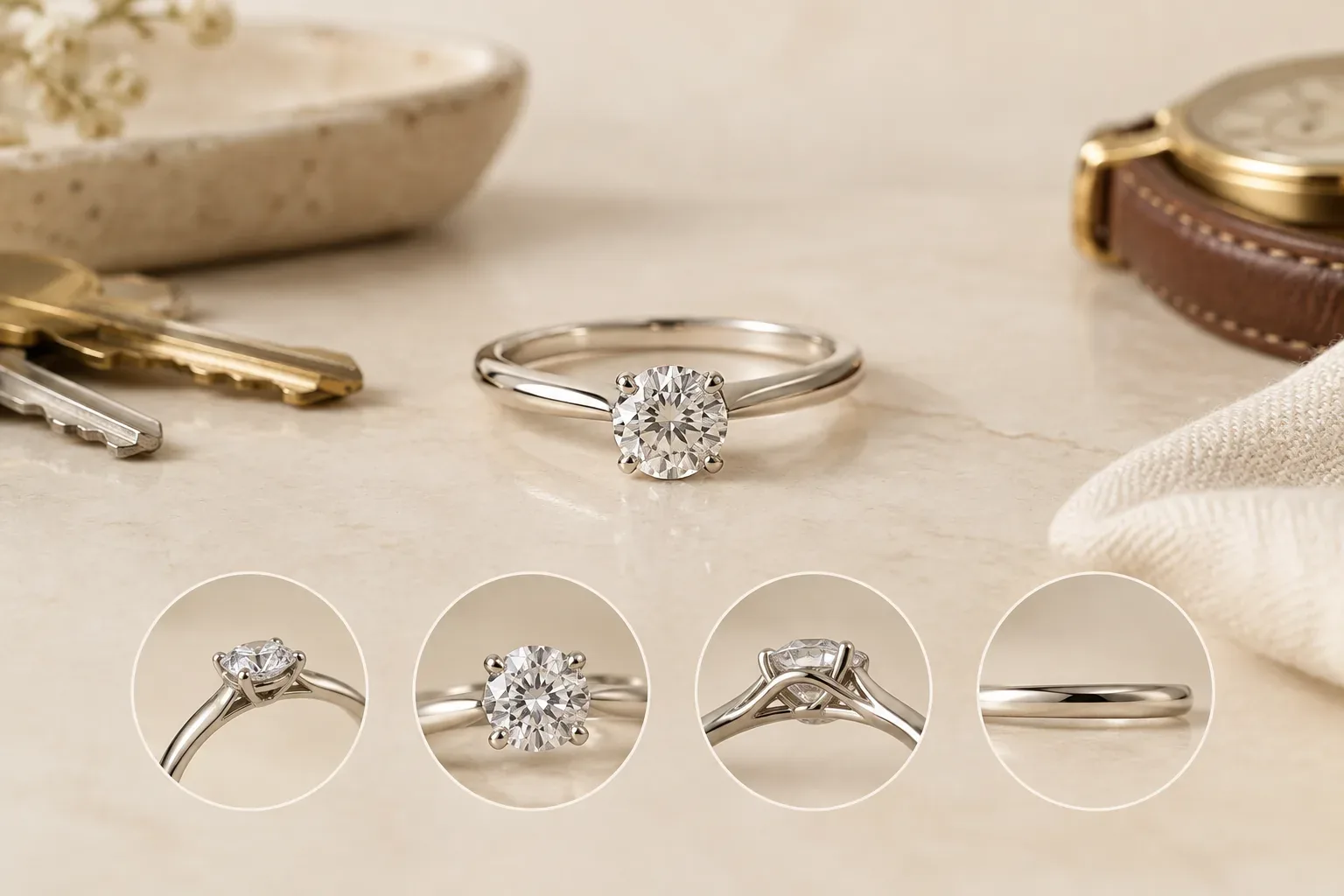
Meaning at a glance
A low-profile setting generally reduces snagging and mechanical leverage on a centre stone compared with high-prong or tall settings, but durability depends on the exact setting type, the gemstone's material properties and treatments, the metal and workmanship; this article gives definitions, decision criteria, practical trade-offs, safe care guidance, and what shoppers cannot verify without a qualified jeweler or laboratory.
What we mean by a low-profile setting and common types
“Low-profile” is a descriptive term used by jewelers to indicate that the centre stone sits closer to the finger and the band, with less vertical height above the shank than a traditional high-set, cathedral or tall-prong engagement ring. Common low-profile constructions include full or partial bezels, flush (gypsy) settings, low prongs and channel-set designs where side stones sit level with the band.
Different low-profile types change how force is transmitted to the stone and metal. A full bezel wraps metal around the girdle and often protects the stone’s edges; flush settings embed the stone into the band so the crown is nearly level with the metal; low prong settings use shorter prongs that hold the stone without much elevation. Each approach reduces snagging but has different implications for inspection, cleaning and repair.
Historical evidence and what the approved sources show
The specific historical distribution of “low-profile” settings across named cultures or centuries is not documented in the approved evidence for this article. Contemporary industry and consumer sources that we are using focus on modern trends, manufacturing and consumer protection rather than detailed archaeological or cultural histories.
Market and trade reporting for 2026 from Imaginaire Digital and Jewelers Mutual show strong consumer demand for engagement rings and a broader preference for fluid forms, versatility and lower-profile, modern styling in recent collections. These sources document present-day popularity and product focus rather than assigning symbolic meanings or establishing historical cultural origins for low-profile techniques. For durability and material-care questions, authoritative technical guidance from the Gemological Institute of America (GIA) and consumer protection rules from the Federal Trade Commission (FTC) are the relevant references.
Documented meanings versus modern personal interpretation
Because the approved sources address contemporary trends and material care rather than symbolic histories, any symbolic meaning attached to a low-profile setting should be treated as a modern personal or cultural interpretation rather than a documented historical meaning. Some buyers prefer low-profile rings for practicality, understated style, or gender-neutral aesthetics—preferences supported by the 2026 trend reporting—but these are consumer choices and not universal symbolic statements.
Separating documented facts from personal meaning matters when you gift or choose a ring. The functional benefits—reduced snagging potential or a lower centre of gravity—are evidence-led claims about performance. Personal meanings such as “modesty,” “modernity,” or “durability as character” are valid choices for individuals but are not universal or historically proven meanings in the sources used here.
How low-profile settings appear in actual jewelry and what that means for durability
In practice, low-profile settings appear in engagement rings as full bezels, partial bezels, flush-set stones, low prongs and continuous channel settings. A full bezel often gives strong edge protection and resists chipping on stones with vulnerable edges, while a flush setting reduces protrusions that catch on fabrics. Low prongs reduce catch points but still provide visibility and light to the stone.
Durability depends on two linked facts: how the metal protects the stone and how the gemstone itself resists impact and wear. The GIA highlights that treatments, detectability and the intrinsic durability of gem materials create distinct consumer questions, so a protective setting cannot fully compensate for a soft or heavily treated stone. In other words, a well-made bezel around a soft, treated gem reduces some mechanical risk but does not remove the need for careful wear and inspection.
Daily wear, snagging risk and repair trade-offs
Compared with a high-prong solitaire, a low-profile ring usually reduces snagging on clothing and lowers the moment arm that can bend prongs or twist settings during impact. That makes low-profile designs a good practical choice for people who use their hands frequently or prefer minimal catch points.
However, trade-offs exist. Flush and some bezel constructions are more integrated into the band and can be harder or more expensive to repair if a stone comes loose or the metal is damaged because a jeweler may need to cut and remount the stone or reflow metal to restore original dimensions. Low prong settings resist snagging but leave the crown area more exposed than a full bezel; conversely, full bezels can slightly reduce apparent brilliance for some stones because they cover the girdle and part of the crown.
Practical selection and respectful gifting guidance
Start with lifestyle and stone choice. Ask how you or the recipient uses their hands, whether they do regular manual work or sports, and whether ease of daily wear is a priority. If practicality is the priority, low-profile bezels and flush settings are reasonable options. If brilliance and maximum light return are the priority, discuss low prong designs that balance visibility and lower profile.
Discuss the gemstone honestly with the seller and ask for any laboratory or grading reports. The FTC requires clarity about natural versus lab-created materials and treatments, so request written disclosures and certificates where available. If the recipient values symbolic meaning, discuss whether the ring’s look and practical benefits align with the sentiment being expressed; remember that symbolic readings are personal, not universal.
Safe care, maintenance and signs that a ring needs professional attention
For everyday care, remove the ring for heavy manual tasks, abrasive cleaning, swimming in chlorinated water or exposure to household chemicals. Even low-profile rings should be inspected periodically—look for loose stones, uneven bezels, thinning metal in high-wear spots and chips on the gemstone. Clean gently as recommended by the seller or follow general guidance from gem authorities.
Have a qualified jeweler inspect the ring at least annually or sooner if you feel a stone move or the setting looks damaged. Because some low-profile repairs require more invasive work, ask a prospective jeweler about typical repair procedures and costs before purchase so you know whether the piece is easy to maintain in the long term. If you plan to insure the ring, discuss the policy with an insurer and keep documentation and receipts.
What you can and cannot verify without a jeweler or laboratory
You can verify several practical things at the point of sale without lab testing: that the setting sits low, that prongs or bezels look even, that metal hallmarks or maker marks exist, and that the seller provides written disclosures and any available certificates. You can also perform basic tactile checks—gently twist the band and feel for stone movement—but do these cautiously to avoid damage.
What you cannot reliably verify without equipment or expert testing is whether a gemstone is natural versus lab-grown, whether it has undisclosed treatments, or the precise nature and extent of internal inclusions and structural weaknesses. The GIA and the FTC both make clear that treatments, detectability and written disclosure matter for consumers, so if those questions are important, obtain a gemological report from a recognized laboratory before purchase or have a qualified jeweler examine the piece.
Practical checklist before you buy or gift a low-profile engagement ring
Before finalizing a purchase, ask to see written disclosures and any independent gemstone reports, verify the warranty and repair policy, confirm the expected long-term maintenance needs, and have the seller explain how a repair would be done if a stone becomes loose. Consider insuring the ring and store documentation safely. These practical steps reduce the uncertainty around durability and repair risk and align expectations between buyer and recipient.
Bottom line
Low-profile settings often improve daily wearability by reducing snagging and mechanical leverage, but they are not inherently indestructible. Durability is a systems question involving setting design, metal quality, gemstone hardness and treatments, and workmanship. Use the seller’s disclosures and any gemological reports to verify material identity and treatment history, choose a setting that matches the recipient’s lifestyle, and commit to routine inspection and professional servicing to manage long-term risk.
Frequently asked questions
Are low-profile settings less likely to snag?
Generally yes: low-profile settings present fewer protrusions and therefore have a lower snag risk than high-set prong rings. That reduction in snagging helps lower the chance of a sudden pull that could bend prongs or loosen a stone, but it does not eliminate all risk and depends on the specific setting type and workmanship.
Do low-profile settings make rings harder to repair?
Some low-profile constructions such as flush or deep bezels can be more complex to repair because the metal is integrated tightly around the stone; repairs may require cutting, resetting or specialist soldering. Low prong styles are often easier to re-tip or re-prong, but each repair scenario depends on the ring’s construction and the jeweler’s skills.
Will a low-profile setting protect a soft or treated gemstone?
A protective setting like a full bezel reduces direct edge contact and some impact risk, but it cannot change the intrinsic hardness or toughness of a gemstone or fully negate risks from treatments. The GIA notes that treatments and material durability affect care needs, so choose stones and settings with those limits in mind.
How often should I have a low-profile engagement ring inspected?
A reasonable guideline is an annual inspection by a qualified jeweler, or immediately if you notice movement, chips, or visible damage. Frequent-hand users or those in manual professions may wish to inspect more often.
What can I verify myself at purchase and what needs lab testing?
You can verify fit, feel, visible workmanship, hallmarks and ask for written disclosures and certificates. You cannot reliably verify natural vs lab-grown status or some treatments without gemological testing; the FTC and GIA recommend asking for laboratory reports for those questions.
Sources and further reading
- Imaginaire Digital — Imaginaire Digital
- Jewelers Mutual — Jewelers Mutual
- Gemological Institute of America — Gemological Institute of America
- Federal Trade Commission — Federal Trade Commission