Meaning at a glance
Answer the distinct search intent behind 'Cathedral Setting engagement ring checklist' with evidence-led definitions, decision criteria, practical trade-offs, safe care guidance, and clear limits on what a shopper can verify without a qualified jeweler or gemological laboratory.
What is a cathedral setting (definition and design basics)
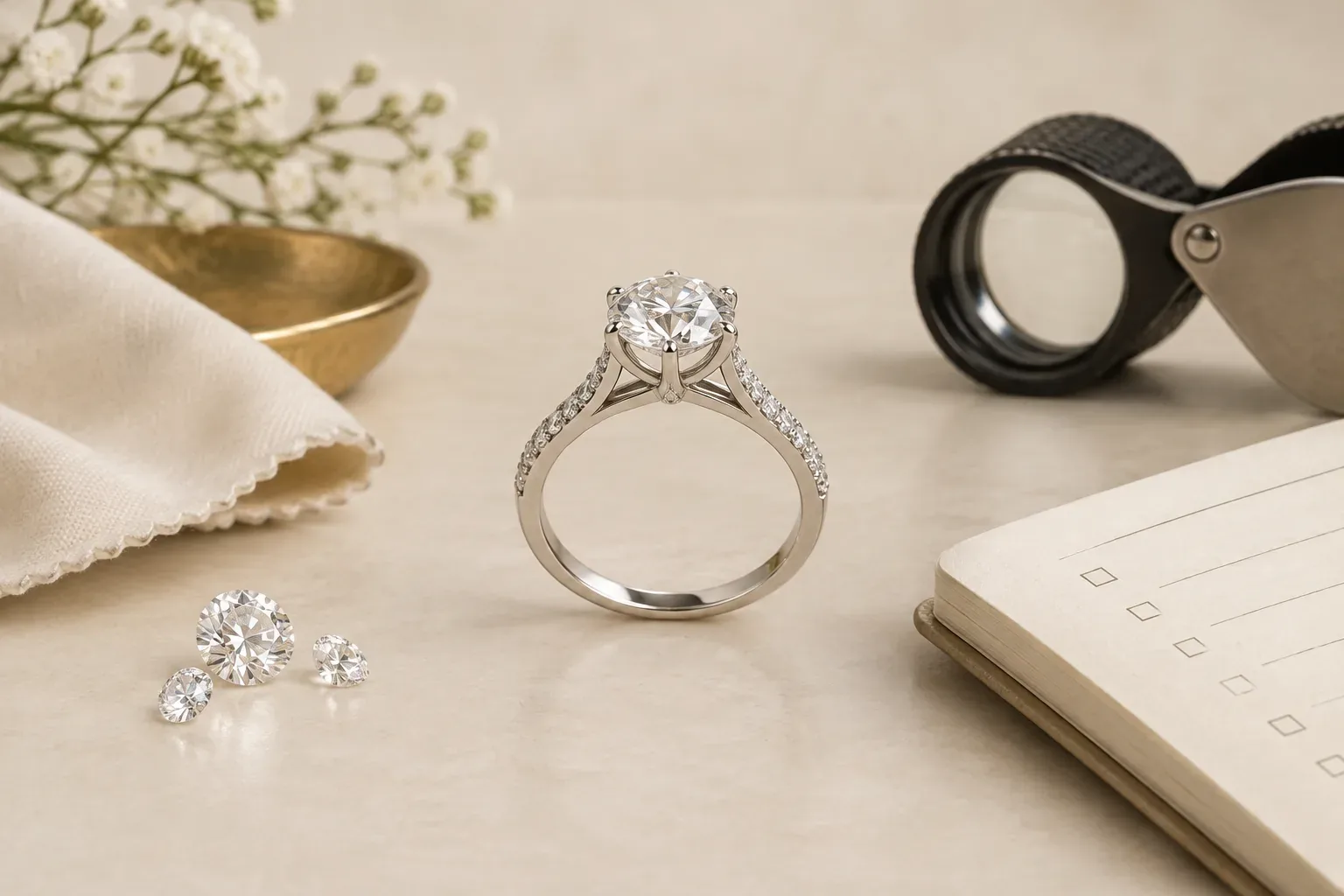
A cathedral setting is a ring profile in which the shank rises in graceful arches on either side of the center stone to form supporting shoulders that visually and structurally lift the center stone above the band. The raised arches are reminiscent of architectural buttresses — hence the name — and they can be simple, tapered, pierced, or decorated with additional accent stones.
Design variations range from subtle elevation that adds a few millimetres of height to dramatic arches that create a prominent cathedral silhouette. The choice of elevation, shank thickness, and prong style affects the ring’s appearance, comfort, and how the stone is protected from knocks.
Historical evidence and provenance
Consulted trade and consumer sources for this guide do not provide a single, well-documented cultural origin or precise historical date for the cathedral setting; modern trade literature focuses on style, fit and consumer demand rather than an original inventor or cultural provenance (Jewelers Mutual; Imaginaire Digital).
Because the sources used here emphasize contemporary trends and consumer questions, any specific origin story offered outside primary historical scholarship should be treated as interpretation rather than documented fact. For shoppers who want a historically authenticated provenance for a particular antique piece, professional appraisal and provenance research beyond retail descriptions are necessary.
Documented meanings versus modern personal interpretation
There is no consensus in the trade and consumer sources consulted that the cathedral setting carries a documented symbolic meaning dating to a particular culture or period. That absence of a documented historical meaning means modern symbolic associations are personal and contemporary rather than universal (Jewelers Mutual; Imaginaire Digital).
Modern wearers and givers may interpret the cathedral silhouette as elegant, architectural, or uplifting. Those interpretations are valid as personal meaning, but they should not be presented as historical fact. Distinguish between recorded provenance and contemporary sentiment when discussing symbolism with recipients or when marketing a piece.
How the cathedral motif appears in jewelry
The cathedral motif appears primarily in the ring’s profile: the metal shank sweeps upward to create arches that support the center stone. Jewelers execute this motif in many metals, commonly in platinum, 18K and 14K gold, and in mixed-metal designs. The arches also offer practical space for prongs, halo additions, or accent stones set into the shoulder.
Gemstones used in cathedral settings range from diamonds to colored gems. The elevated design highlights the center stone and can make a stone appear larger by allowing more light to reach its facets, but the exact optical effect depends on the stone’s cut, setting style and the height of the cathedral arch.
Practical selection checklist: questions to ask before buying
What is the exact ring profile and elevation in millimetres? Ask the seller to show side-view photos or a CAD/render so you can judge how high the center sits and how that will work with a wedding band and daily tasks.
What metal and karat is the ring, and are there hallmarks? Confirm the metal type and look for hallmarks or written certification. Metal choice affects durability, finish, and how often you may need to service prongs and shanks.
What are the center stone specifications in writing? Obtain the stone’s carat weight, exact measurements, cut grade (if applicable), colour and clarity notes, and whether it is natural, lab-created, treated or an imitation. Federal Trade Commission guidance requires clear distinctions among natural, lab-created, treated, and imitation materials and written seller disclosures.
Has the stone been treated? If yes, what treatments were applied and are they stable? The Gemological Institute of America explains that treatments vary in detectability and durability; ask for written disclosure and, if treatment affects care, request written aftercare instructions.
Is there a grading report or laboratory certificate? For diamonds and high-value coloured stones, request a certificate from a recognized lab. Understand that a store report differs from an independent lab report and that only a qualified gemological laboratory can reliably confirm origin and many treatments (GIA).
How secure are the prongs and the cathedral arches? Ask whether the cathedral construction uses reinforced shoulders and how many prongs support the center. Higher elevation can increase exposure to knocks; confirm prong thickness and whether accent stones add risk of catching.
Compatibility with a wedding band: will the cathedral profile require a contoured band, a spacer, or a guard? Ask to see the ring paired with common band styles so you can judge how the pair will sit and whether stacking or soldering is recommended.
Resizing, repairs and warranty: can the cathedral ring be resized easily and without compromising the arches or set stones? Request the seller’s policy on resizing, warranty, and whether the seller provides routine maintenance such as prong tightening and polishing.
Return policy and written guarantees: ask for the full return policy in writing, how long you have to return or exchange, and what documentation is supplied with the sale (receipts, certificates, appraisals).
Insurance and appraisal recommendations: ask whether the seller offers an independent appraisal for insurance purposes and whether they provide aftercare guidance to support an insurance claim if damage occurs.
Trade-offs and decision criteria
Higher elevation emphasizes the center stone and can create a dramatic look, but it increases risk of snagging and may expose the stone to more impact. Decide whether the visual priority of height outweighs the practical priority of low-profile durability.
A thicker, reinforced cathedral shank offers more protection but adds weight and may reduce comfort. Thinner, more delicate arches look lighter and more ornate but require more frequent inspection and possibly earlier repair.
Accent stones on the cathedral shoulders create sparkle but add points that need maintenance. If daily, hands-on work is expected, choose simpler shoulders or ensure you accept routine maintenance commitments.
Care, maintenance and realistic verification limits
Routine care for cathedral settings includes periodic inspection of prongs and arches for wear, professional cleaning and tightening of prongs as needed. Have the setting checked by a jeweler at least once a year or more often if the ring is exposed to daily wear and knocks.
Follow treatment-specific care when applicable. The Gemological Institute of America warns that certain treatments change a gemstone’s durability and care needs; always get written aftercare instructions when a stone has been treated (GIA).
Understand what you cannot verify without pro help. Only a qualified jeweler or a gemological laboratory can reliably confirm gemstone origin, identify many treatments, or detect certain simulations. The Federal Trade Commission emphasizes the consumer’s right to written disclosures and the limits of unaided inspection; do not rely solely on photographs or salesroom claims for such facts (FTC).
Respectful gifting and selection guidance
When buying as a gift, prioritize the recipient’s comfort and lifestyle over surprising them with an extreme profile. If you are unsure about ring size or band style preferences, consider a temporary ring to propose with or a less personalized surprise followed by a joint selection of the final piece.
Respect cultural and personal preferences: some wearers prefer low-profile, durable rings for hands-on occupations; others value a visible elevated silhouette. If cultural symbolism matters to the recipient, discuss meanings and preferences beforehand or present a choice that shows you researched their values (see related Jewelry Guides).
If you choose to surprise, include the full purchase documentation and a generous return or resizing window so the recipient can have the ring adjusted or exchanged comfortably if needed.
Final checklist summary
Before you buy a cathedral setting engagement ring, confirm elevation and fit, obtain written stone specifications and treatment disclosures, ask for a grading report when appropriate, check resizing and warranty policies, understand maintenance obligations, and know which facts require a qualified jeweler or lab for confirmation.
Use the seller’s written disclosures and independent lab reports where available, and balance the visual priorities of a cathedral silhouette against day-to-day practicality and long-term maintenance commitments (Jewelers Mutual; GIA; FTC; Imaginaire Digital).
Frequently asked questions
Does a cathedral setting make a stone look bigger?
A cathedral setting can make a center stone appear more prominent by elevating it and allowing more light to reach its facets, but the perceived size gain depends on the stone's cut, actual measurements, and the height of the arches rather than being guaranteed.
Can a cathedral setting be resized easily?
Resizing is usually possible, but the complexity depends on the shank design and whether accent stones or pierced work extend around the band; always ask the seller about resizing policies and whether resizing might alter the cathedral arches.
How often should I have a cathedral setting checked?
Have the prongs and arches inspected by a qualified jeweler at least once a year, and more frequently if the ring is worn daily or subjected to knocks; routine checks reduce the risk of stone loss.
Can I tell if a gemstone is treated just by looking?
No. Many treatments are not visible to the unaided eye; reliable identification of treatments and origin requires a qualified jeweler or a gemological laboratory report (GIA).
What written documents should I get when buying?
Request written stone specifications, treatment disclosures, metal type and hallmarks, any laboratory grading report, the seller's return and warranty policy, and aftercare instructions; the FTC requires clear disclosures about natural, lab-created, treated and imitation materials.
Sources and further reading
- Imaginaire Digital — Imaginaire Digital
- Jewelers Mutual — Jewelers Mutual
- Gemological Institute of America — Gemological Institute of America
- Federal Trade Commission — Federal Trade Commission