Meaning at a glance
Pairing a wedding band with a cathedral setting means matching the wedding band to the engagement ring’s profile, the ‘gap’ the arches create, and the choice of metal while balancing protection, comfort, and stackability; use contouring or custom work when a straight band won’t sit flush, verify gemstones with documentation or a qualified lab, and follow GIA and FTC guidance on treatments and disclosures.
Quick answer
A cathedral setting wedding band pairing decision centers on three practical issues: the engagement ring’s profile and stone shape, the physical gap created by the cathedral arches, and whether metals should match or be contrasted for aesthetics and durability. Choose a contoured or notched wedding band if you need a flush fit; accept a small visible gap if you prioritise protection or a high profile; and always check paperwork and seller disclosures for gemstones because laboratory-grade testing or a qualified jeweler is needed to confirm treatments or origin.
What a cathedral setting is and why it matters for pairing
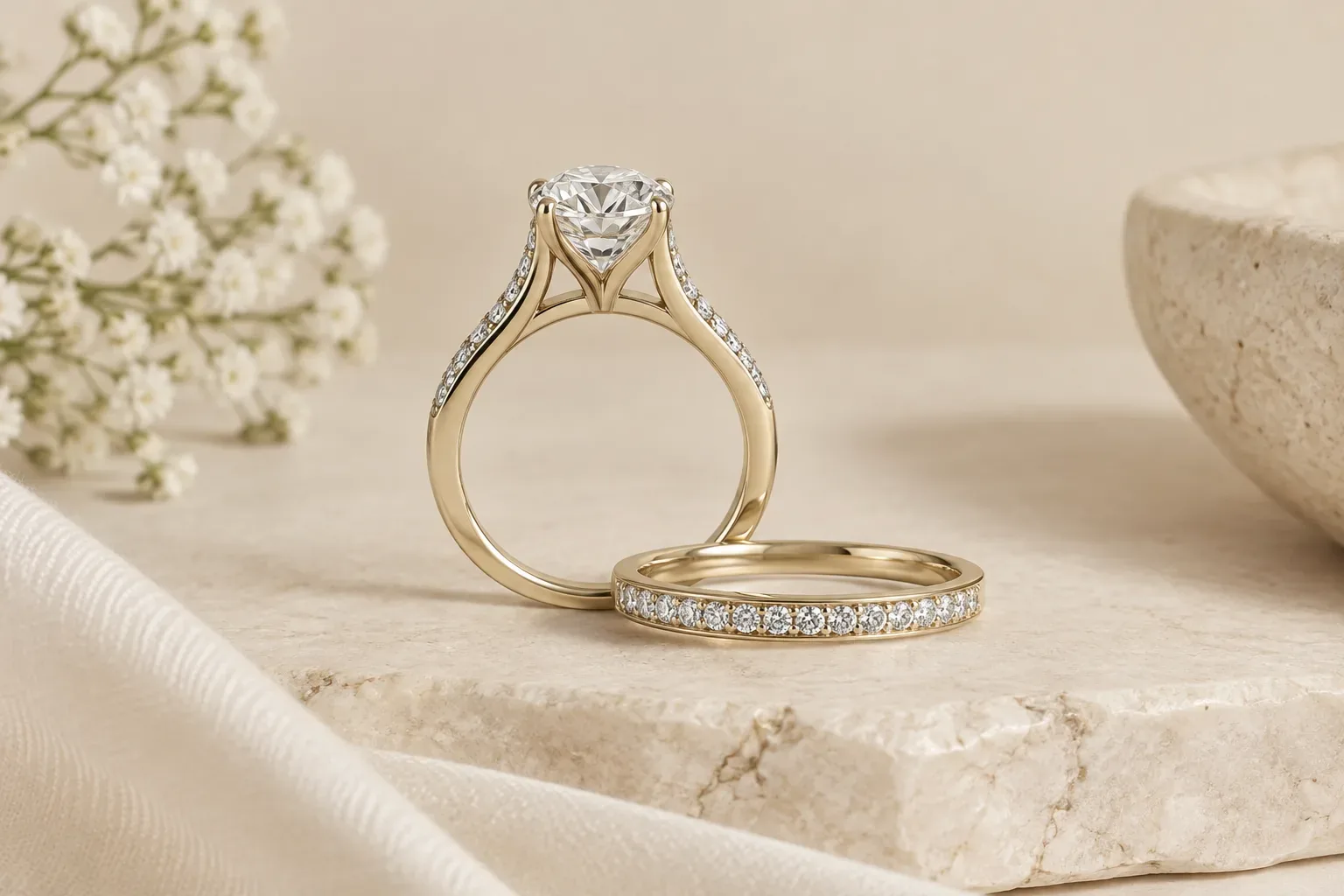
A cathedral setting uses raised, arching shoulders that sweep up to support and visually elevate the center stone. The arches create a higher profile and often a defined gap where a traditional straight wedding band might not sit cleanly against the engagement ring. That altered silhouette is the essential technical reason wedding band pairing needs special attention: band shape, width and thickness determine whether the two rings stack flush, leave a visible space, or require custom contouring.
Documented history and how meaning has been recorded
Industry and consumer sources reviewed for this guide do not supply a long, documented cultural history that assigns specific symbolic meanings to the cathedral setting across distinct civilizations. Contemporary trade research focuses on current design demand rather than antique symbolism: for example, market analyses and trend reports describe consumer interest in forms, stacking and versatility rather than historical ritual meanings (Imaginaire Digital; Jewelers Mutual).
Because formal academic or archival claims about a cathedral setting’s symbolic history were not part of the materials used here, separate the documented record from modern interpretation: documented industry records show the cathedral as a structural style and a popular design choice, while any romantic meanings—such as ‘lofted protection’ or ‘architectural elegance’—are modern, personal, or marketing-driven interpretations rather than historically verified cultural beliefs.
How the cathedral motif appears in jewelry
In practice, I see cathedral motifs expressed as solid arching shoulders that rise from the shank toward the center stone, split shanks that flare and rejoin beneath the stone, and pavé or accent stones set along those arches. Jewelers also translate the motif into variations such as high‑profile cathedral settings that expose the girdle and pavilion for light, and low‑profile cathedral styles that mimic the arch without a lot of extra height.
Those physical choices influence how a wedding band must be designed to pair successfully: a full arch with side accent stones needs either a matching contoured band that follows the arch, a notched band that accepts the arch, or a narrow stackable band that fits above or below the arch rather than directly against it.
Pairing decision criteria: shape, gap, and metal
Shape: Start with the engagement stone’s outline. Round and cushion cuts tend to wear well with slightly curved or simple contoured bands, while elongated stones such as marquise, oval or emerald cuts often benefit from a band that mirrors the shank profile or includes subtle curvature to avoid visual mismatch.
Gap: Measure the physical gap created by the cathedral arches. A shallow gap (a few tenths of a millimetre) is often acceptable with a slim band. A deeper gap usually requires a contoured or notched band for a flush look. Keep in mind that leaving a small gap can improve airflow and reduce wear on prongs, but it will produce a visible seam between rings.
Metal choices: Matching metals create the most traditional and visually seamless pairing, and in many cases matching alloys provide comparable wear characteristics. Contrasting metals can be attractive and modern, but different alloys have distinct hardness and maintenance needs—platinum resists wear better than most gold alloys but is heavier; higher‑karat gold is softer and dents more easily. Consider hypoallergenic alloys for sensitive skin and remember that plated surfaces may wear over time.
Practical trade-offs and common pairing solutions
Protection vs stackability: A taller cathedral setting protects the center stone’s girdle and makes it appear larger, but interferes with a flush wedding band. If protection is the priority, accept a contoured band or a separated stack (bands that sit above and below the engagement ring) rather than a flush straight band.
Matching vs contrasting metal: A matched metal band is the least work and usually the most re‑sale-friendly. If you want a two‑tone look, you can choose a thinner contrasting band or a mixed‑metal contoured band that is soldered to sit flush; just note that soldered or permanently joined rings complicate future resizing and repairs.
Custom vs off‑the‑shelf: Many shoppers find an off‑the‑shelf contoured band that approximates the arch. When off‑the‑shelf options are inadequate, custom notching or a tailor‑made contour will yield the best fit but increases cost and lead time. Jewelers Mutual’s market insights emphasise craftsmanship and versatility as consumer priorities, so investing in custom work for a long‑worn pair is often recommended.
Care, verification limits, and what requires an expert
Gemstone treatments, origin and durability: Laboratories and specialist gemologists are needed to verify treatments, whether a stone is natural, lab‑created or an imitation, and to identify certain durability concerns. The Gemological Institute of America (GIA) explains that treatments and their detectability affect care and longevity and that professional testing is the proper way to confirm a stone’s identity and treatment history.
Seller disclosures and consumer protections: The U.S. Federal Trade Commission (FTC) advises consumers to rely on clear written disclosures for natural versus lab‑created materials and for treatments. You can and should request written disclosure and any lab reports at the point of sale. Without those documents or a lab report, a shopper cannot reliably confirm treatments or origin on their own.
Routine upkeep and inspection: For everyday care, gently clean the setting with warm soapy water and a soft brush and avoid ultrasonic cleaners for stones that might be treated or porous. Have prongs and settings inspected professionally at least once a year, more often if the ring is worn daily. Jewelers Mutual recommends regular inspection and routine maintenance as part of protecting your jewelry investment.
Respectful selection and gifting guidance
Ask about lifestyle and daily wear: If the wearer works with their hands or values a low profile, prioritise a lower cathedral height or a contoured low‑profile band. If the setting is intended to protect a delicate cut, accept a higher profile and plan for a matching band.
Sizing, surprises and resizing: Rings with cathedral settings and contoured bands are more complex to resize. If you plan a surprise proposal, buy from a retailer with a flexible resizing policy and keep original receipts and documentation. Discuss resizing limits with the jeweler before purchase.
Documentation and transparency: When gifting, include any available lab reports and seller disclosures to preserve the recipient’s rights to information about treatments and origin. The FTC specifically highlights the importance of such written disclosures for consumers.
When in doubt, consult a qualified jeweler: If you need a flush look or a highly specific aesthetic, a bench jeweler can draft a custom band or alter an existing one to match the cathedral profile. Remember that custom joins and permanent soldering may affect the ring’s ability to be resized later.
Final practical checklist before you buy or commission
Confirm the band’s proposed profile and whether it will require contouring or notching. Request a mock‑up or CAD render where possible, and ask about resizing limits. Insist on written disclosure of any gemstone treatments and any lab reports for diamonds or colored stones. Decide upfront whether you want matching metals for long‑term finish uniformity. Finally, schedule a post‑purchase inspection plan so maintenance is not an unexpected burden.
Frequently asked questions
Can a straight wedding band be used with a cathedral engagement ring?
Sometimes. If the cathedral arches are shallow, a slim straight band may sit acceptably with a small visible gap. For a flush appearance where the arch creates a deeper space, choose a contoured or notched band or plan a custom alteration.
Should the wedding band metal match the engagement ring?
Matching metals give the most uniform wear and colour over time, but contrasting metals are a valid stylistic choice. Consider alloy hardness and maintenance—for example, platinum is more durable than higher‑karat gold—and request disclosure about plating or surface treatments.
How much gap is normal between a cathedral engagement ring and a band?
There is no universal measurement; a gap of a fraction of a millimetre is common and often acceptable. Deeper gaps that create a visible seam usually indicate you should choose a contoured band or have a jeweler create a custom fit.
Can a jeweler solder a contoured wedding band to the engagement ring?
Yes, jewelers can solder rings together to create a permanent, flush pairing, but that process affects future resizing and other repairs. Discuss long‑term implications and resizing limits with the jeweler before committing to a permanent join.
How can I verify a gemstone’s treatments or origin for a paired set?
Request written disclosure and any available lab reports at purchase. For definitive answers on treatments and origin you will need testing by a qualified gemological laboratory; the GIA explains that some treatments require specialist analysis to detect.
What are simple care steps for cathedral settings?
Clean gently with warm soapy water and a soft brush, avoid ultrasonic or steam cleaners for treated or porous stones, and have prongs inspected by a professional at least annually. Jewelers Mutual recommends routine inspection to prevent loss and address wear early.
Sources and further reading
- Imaginaire Digital — Imaginaire Digital
- Jewelers Mutual — Jewelers Mutual
- Gemological Institute of America — Gemological Institute of America
- Federal Trade Commission — Federal Trade Commission