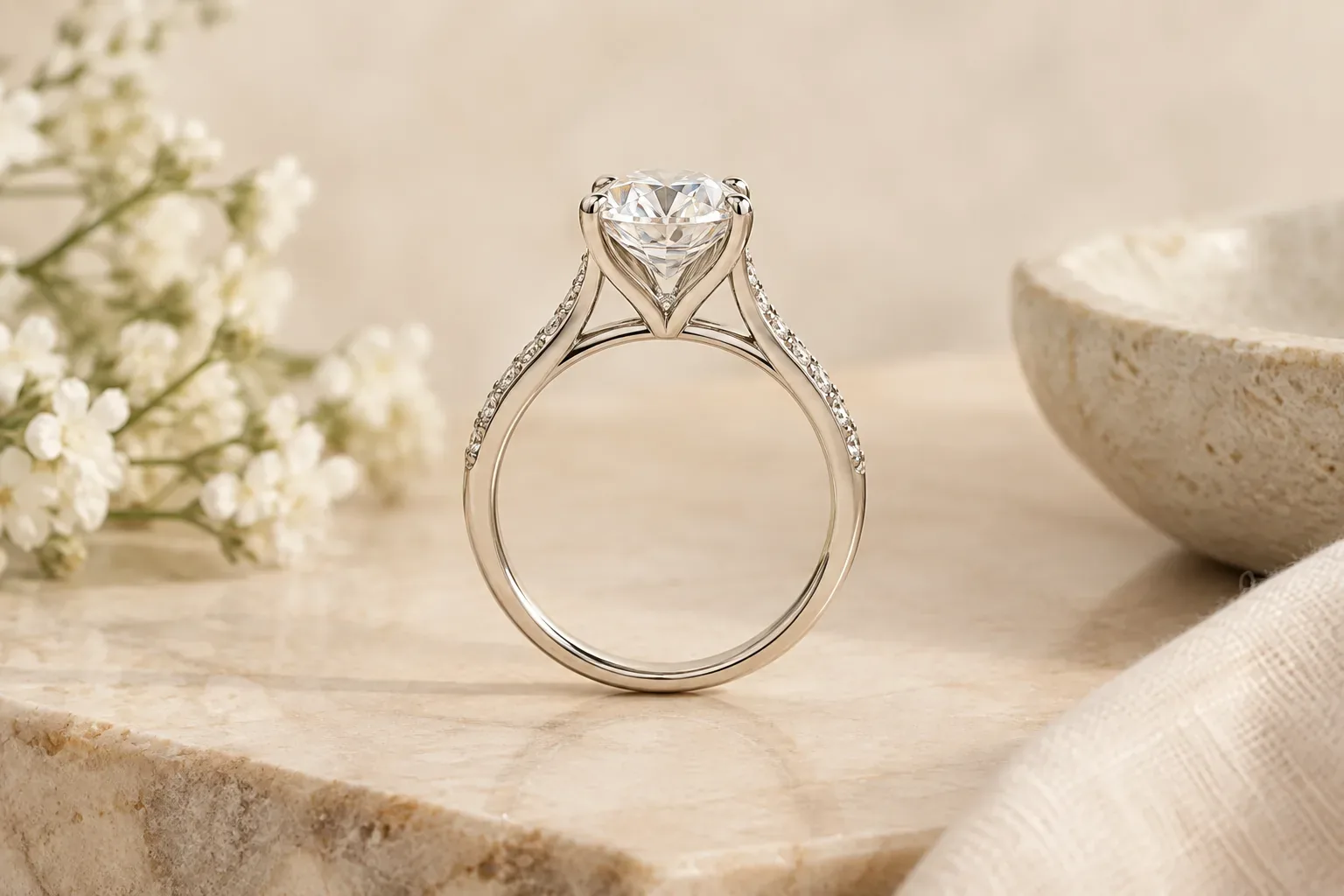
Meaning at a glance
Cathedral setting engagement rings are generally durable when well made, but their raised profile and arched galleries increase snag and repair risk compared with low‑profile designs; evaluate metal, prong construction, stone hardness, lifestyle, and documented disclosures, and have a qualified jeweler or gem lab verify structural integrity and any gemstone treatments.
Direct answer — short and practical
A cathedral setting engagement ring can be a durable choice for everyday wear if it is engineered and maintained for that purpose, but its raised arches and higher profile make it more prone to catching on fabrics and to prong damage than lower or fully enclosed settings. Assess durability by checking the metal and prong construction, the mounted gemstone’s inherent toughness and treatments, and how the ring will be used in daily life. For definitive verification of structural soundness, metal condition, or any gemstone treatments you cannot see, you will need a qualified jeweler’s inspection or a gemological laboratory report.
What the documented evidence in our approved sources shows about history and trends
Within the approved reference set for this article there is no primary historical record that pinpoints a single culture or exact date of origin for the cathedral setting as a named style. Contemporary industry analysis and trend reporting in our sources emphasize modern consumer preferences rather than original historical attributions. Imaginaire Digital and Jewelers Mutual both report current market demand and stylistic trends rather than detailed origins, with Jewelers Mutual noting contemporary centers of demand for craftsmanship, versatility and elevated motifs and Imaginaire Digital reporting search demand patterns for engagement rings and related styles.
Because the verified sources here are focused on modern market behaviour and on consumer protections and gemology rather than historic fashion scholarship, any precise historical claims about which culture or period first used the structural motif called a cathedral setting would fall outside the approved evidence for this piece. That means documented, attributable historical meanings for the cathedral setting are not available in the approved source set and must be distinguished from later or popular attributions.
Documented meanings versus modern personal interpretations
Documented meanings: the approved sources do not provide specific historical symbolism tied to the cathedral setting itself. Because our source set includes contemporary trade and consumer-protection references rather than historical iconography, we cannot assert a verified historic symbolic meaning for the cathedral setting.
Modern personal interpretations: many wearers and retailers describe raised or arched settings as conveying prominence, elevation of the stone, or architectural elegance. Those are modern, subjective interpretations rather than historically documented meanings in the sources used here. Treat such symbolic claims as personal or marketing-driven rather than universally documented fact.
How the cathedral motif and gemstones appear in jewelry and why that matters for durability
The cathedral setting is characterized by the shank rising into arched shoulders or rails that support the stone’s mounting above the finger plane. That visual lift can make a center stone appear larger and can allow light to reach the girdle and pavilion from more angles. In practice, cathedral settings are frequently used with solitaire diamonds but are also applied to colored gemstones and hybrid designs that include halos or pavé shoulders.
From a durability perspective, the raised profile and exposed galleries change how impact forces are transmitted to the setting and stone. The higher the stone sits and the more exposed its pavilion or girdle, the more vulnerable the prongs and the stone edges are to knocks. The Gemological Institute of America (GIA) explains how gemstone toughness, hardness, treatments and required special care affect long‑term durability, so the choice of center stone and whether it has received any treatments are directly relevant to how well a cathedral‑style ring tolerates daily wear.
Metal choice and craftsmanship influence outcomes as well. Well-executed prongs with sufficient mass, secure soldering where the rails meet the shank, and attention to metallurgy and finish can reduce repair risk. Jewelers Mutual comments on the contemporary emphasis on craftsmanship and versatility, which implies that buyers seeking a cathedral setting should prioritise reputable fabrication and finish to achieve durable performance during everyday use.
Practical selection and gifting guidance
Match the setting to the wearer’s lifestyle. If the recipient frequently uses their hands for manual work, sports, or tasks that catch fabric or rub against surfaces, consider a lower-profile alternative or a cathedral that has been deliberately engineered with lower lift and reinforced rails. If a higher profile is desired for aesthetics, ask the jeweler about design choices that preserve that look while increasing security, such as thicker prongs, reinforced galleries, or a protective halo.
Ask for and read written disclosures about the gemstone. The Federal Trade Commission (FTC) stresses clear distinctions among natural, lab-created, treated, cultured and imitation materials and the need for written seller disclosure. Before purchase or gifting, request documentation that states whether the center stone has been treated, whether it is lab-created, and any grading or lab report available.
Request proof of craftsmanship and post‑sale services. Jewelers Mutual highlights consumer interest in craftsmanship and practical versatility; ask the seller about warranty coverage, routine maintenance plans, prong re-tipping or sizing policies, and whether the shop performs regular inspections. For more comprehensive protection, ask about insurance options that cover accidental damage and loss.
Daily care, snagging risk and repair realities
Expect a cathedral setting to be more likely to catch on fabrics or edges than a flush or bezel setting because the raised arches and prongs create points that can hook. Minimize snag risk by removing the ring for heavy work, gardening, or tasks where your hands encounter rough or fibrous materials. Routine at‑home checks for loose prongs or bent rails can reduce chances of sudden stone loss, but such checks are not a substitute for professional inspection.
Get professional inspections and cleanings. The GIA advises that treatments and durability considerations create distinct care questions for gemstones; professional cleanings and inspections allow an experienced jeweler to detect worn prongs, solder fatigue at the shank‑gallery junction, and early signs of stress. Repairs such as prong re-tipping, re-soldering rails, repolishing, and resetting the stone are commonly performed, but costs and feasibility depend on metal type, the extent of damage, and whether the original design allows secure restoration.
Know the limits of what you can verify yourself. You can visually check for obvious bent prongs, chips in the stone, and unusual looseness, but confirming the presence of certain treatments, detecting internal fractures that affect toughness, or reliably diagnosing sub-surface metal fatigue requires a qualified jeweler and, in some cases, a gemological laboratory analysis. The FTC and GIA emphasize that some attributes cannot be conclusively determined without laboratory tests or a professional evaluation.
Decision checklist and trade-offs
A cathedral setting offers visual elevation and architectural elegance in exchange for a higher profile and greater exposure to snagging and impact. If you prioritise daily durability over maximum visual lift, choose a lower-profile bezel or a cathedral variant with reinforced rails and a modest lift. If you prioritise appearance but still want reasonable durability, insist on thicker prongs, one or two years of included maintenance or a documented inspection schedule, and full disclosure of gem treatments and origin.
Finally, when buying or gifting, verify three things you cannot determine from pictures alone: a qualified jeweler’s assessment of the setting’s construction and prong mass, any laboratory reports about the stone (if available), and the seller’s written disclosure of treatments and material origin as recommended by the FTC and GIA. For many buyers, protecting the piece with insurance through a specialist provider is a prudent step if the ring will be worn daily.
Closing summary
Cathedral setting engagement ring durability depends on design execution, the mounted gemstone’s toughness and treatments, the metal and prong construction, and the wearer’s lifestyle. The style can be durable for everyday wear when thoughtfully specified and maintained, but it carries a higher snagging and repair risk than fully enclosed or low‑profile settings. Use the decision criteria and care guidance above, obtain written disclosures, and rely on qualified jewelers or gem labs for definitive verification.
Frequently asked questions
Is a cathedral setting a bad choice for everyday wear?
Not inherently. A cathedral setting can be suitable for daily wear if it is well made, uses secure prongs, and the wearer avoids high‑risk activities. Expect a higher snag and impact exposure compared with low‑profile or bezel settings, and plan for regular inspections and maintenance.
How can I reduce snagging risk with a cathedral ring?
Choose reinforced rails and thicker prongs, ask the jeweler to lower the overall lift if possible, remove the ring for manual tasks, and schedule routine professional inspections so small issues are corrected before they become major problems.
What repairs are common with cathedral settings?
Common repairs include prong re-tipping, re-soldering or reinforcing gallery rails, repolishing, and occasional resetting if a stone becomes loose. The feasibility and cost depend on metal type, the original construction, and how much work the piece requires.
Can I tell if a gemstone has been treated just by looking?
No. The Gemological Institute of America (GIA) notes that some treatments affect durability and require special care, but many treatments are not visibly detectable. Written disclosure from the seller and a laboratory report are the reliable ways to confirm treatments.
What should I ask a jeweler before buying a cathedral setting engagement ring?
Ask about the prong thickness and how the rails are joined to the shank, request any available lab reports for the stone, demand written disclosure of treatments or whether the stone is lab‑created, and confirm what maintenance or warranty is included.
When do I need a gemological laboratory report?
Obtain a laboratory report when you need independent verification of a stone’s identity, origin, treatments, or grading details that are critical to value or care decisions. For structural concerns about the setting, a qualified jeweler’s inspection is the appropriate first step.
Sources and further reading
- Imaginaire Digital — Imaginaire Digital
- Jewelers Mutual — Jewelers Mutual
- Gemological Institute of America — Gemological Institute of America
- Federal Trade Commission — Federal Trade Commission