Meaning at a glance
Pair a hidden halo engagement ring to a wedding band by first defining your pairing goals (flush look vs stacked contrast), then choosing complementary shapes, planning for an appropriate gap or contouring band, and matching metals for durability and style; rely on a qualified jeweler for fit adjustments and a gemological laboratory for verifying treatments or origin, and follow GIA and FTC guidance on disclosure and care.
What a hidden halo setting is and how it affects pairing
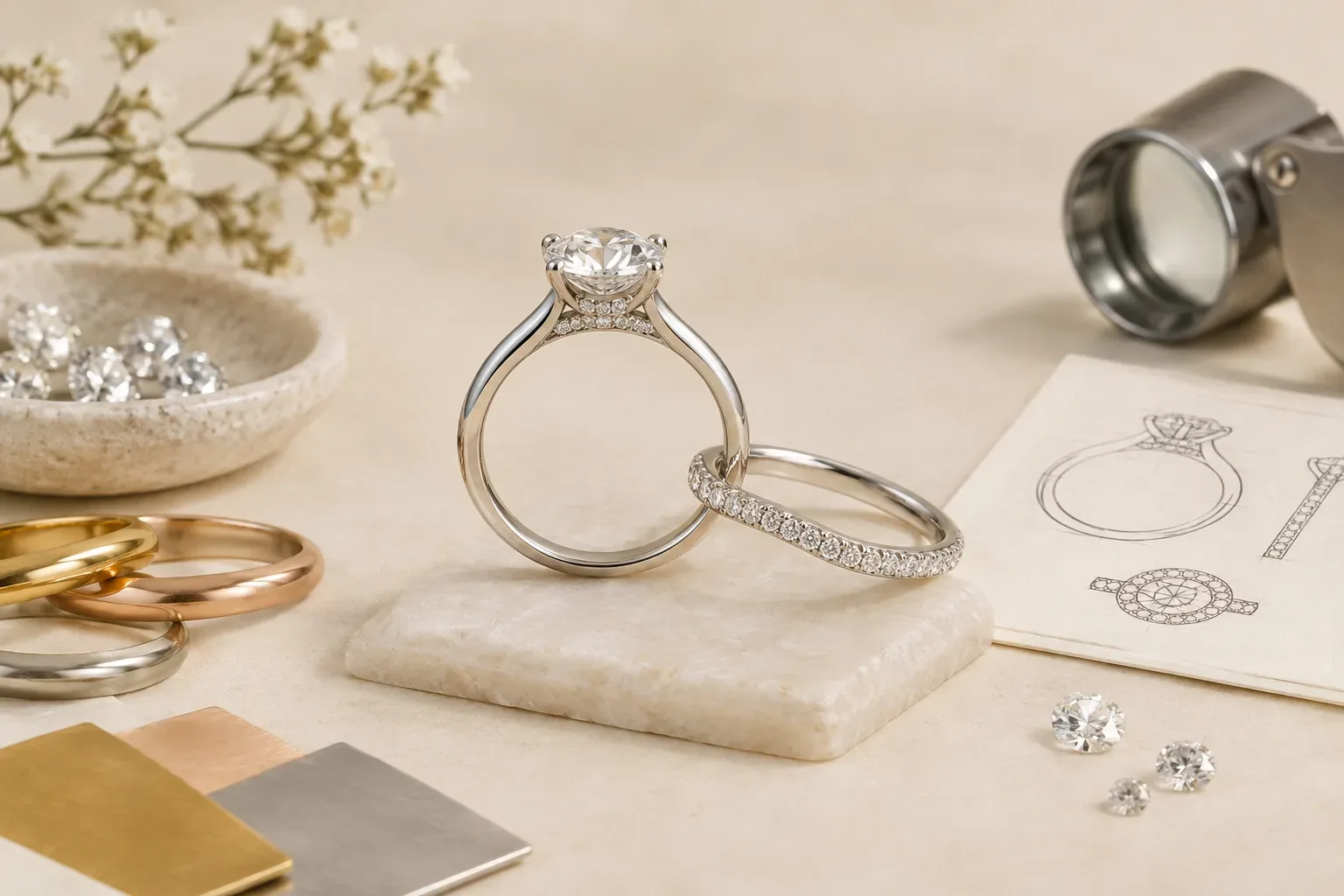
A hidden halo setting places a small ring of accent stones or a decorative metal flange under the center stone, visible only from certain angles. The visible profile of the engagement ring—height of the center stone, shoulder curve, and shank thickness—determines how a wedding band will sit. A hidden halo often increases the head’s spread and can slightly raise contact points, so a wedding band that appears to fit beside a plain solitaire may catch on the halo if it is too thin or sharply edged.
Because the halo is beneath the main stone, pairing decisions emphasize the wedding band’s topography and edge shape more than when pairing with a standard halo that encircles the top of the center stone. Expect to manage small gaps to preserve the hidden halo’s effect while maintaining comfort and long-term wearability.
Historical evidence and modern origins (what the record shows)
There is no clear historical record in the approved industry sources that identifies a specific period or culture as the origin of the hidden halo as a named jewelry technique. Contemporary industry reporting and trend analysis instead locate the hidden halo within recent design trends emphasizing stacking, subtle detailing, and versatile engagement ring profiles. Jewelers Mutual, reporting on current marketplace preferences, lists modern stacking and versatility among 2026 trends, which helps explain why settings that read differently from the top and the side—like hidden halos—have gained popularity.
Similarly, UK search and retail visibility data tracked by Imaginaire Digital show strong ongoing consumer demand for particular engagement ring silhouettes, including oval and other shapes commonly paired with complementary bands. Those sources together suggest the hidden halo is best understood as a recent design evolution rather than a discrete historical tradition tied to a single culture or long-standing ritual.
Documented historical meanings versus modern personal interpretation
Because our approved sources focus on current trends and consumer protection rather than historical symbology, we cannot attribute a documented, culture-specific meaning to the hidden halo setting. Older ring motifs—clusters, halos and signet forms—carry distinct historical backstories in specialist historical literature, but those are outside the sources permitted here.
Modern wearers, designers and gift-givers often apply personal meanings (for example, "hidden" as a metaphor for private devotion or a halo as protection). Those are valid personal interpretations but should be distinguished from documented cultural meaning. If you value historically verified symbolism, ask sellers for provenance and consult specialist historical references or museum catalogues; for verification of gemstone treatment or origin, follow the GIA and FTC guidance described below.
How the motif, gemstones, and traditions appear in jewelry today
In contemporary designs the hidden halo appears as a small ring of diamonds or gemstones set beneath the center stone, frequently used with modern cuts and lower-profile pavé shoulders to create the visual effect of sparkle without increasing the top silhouette dramatically. Jewelers use a range of gemstones in hidden halos, including diamonds and colored stones, reflecting the 2026 trend toward colored gemstones and versatility reported by Jewelers Mutual.
Because colored and treated gemstones are more common in modern designs, consumers should be aware of treatment and disclosure issues. The Gemological Institute of America explains that treatments, their detectability, and their impact on durability differ across gem materials. The Federal Trade Commission emphasizes that consumers need clear written distinctions among natural, lab-created, treated, cultured and imitation materials. Ask the seller for written disclosures and any available lab reports when the composition, treatment or origin of the hidden halo stones matters to you.
Pairing decisions: shape, gap, and metal choices
Shape: Match the band’s profile to the engagement ring’s visible silhouette. Straight bands are the easiest to match with round, oval and princess-center rings. For rings with angled shoulders, tapered shanks or cathedral settings, consider a contoured or notched band designed to follow the metal curve so the pair reads as one unit. If you prefer contrast, a thin, rounded stacking band provides separation without excessive bulk.
Gap management: With a hidden halo your goal is usually to keep the halo visually hidden while allowing access for cleaning and preventing rubbing against prongs or bezel edges. A small intentional gap preserves the halo and prevents wear on accent stones. When you want a flush look, a jeweler can mill or shape a contour band to sit literally edge-to-edge with the engagement ring, but this often requires a precise measurement and sometimes compromises ease of future resizing.
Metal color and alloy choices: Matching metal color and purity produces the most seamless look and simplifies future resizing or soldering repairs. However, mixed-metal pairings are an accepted contemporary aesthetic—Jewelers Mutual lists gender-neutral and versatile styling among current trends—so choosing a contrasting metal is a style choice, not a technical fault. Consider metal durability: harder alloys such as platinum and palladium are more scratch-resistant than some yellow or rose gold alloys, but all metals require periodic maintenance.
Width and profile trade-offs: Narrow bands are subtle and show more of the hidden halo, while wider bands can hide or crowd the halo. Very thin bands can be delicate and more prone to bending around contact points, especially if the engagement ring has a raised head. If durability is important for daily wear, choose a band with a comfortable thickness and a rounded inner profile (comfort-fit) to reduce stress on the shank.
Practical and respectful selection or gifting guidance
Ask about lifestyle and wear patterns before choosing a wedding band to pair with a hidden halo. A partner who works with their hands will generally need a more durable metal, a lower-profile pairing, or a design that reduces protrusions. For surprise gifts, consider a temporary or thin spacer band that can be exchanged for a custom-contoured band after the recipient has tried the engagement ring on in daily life.
Get an accurate ring size from a current, comfortable-wear measurement. If you anticipate resizing, discuss how profile changes or a contoured fit might affect that ability. Request written disclosures for the gemstones and any available lab reports for center and accent stones; the Federal Trade Commission advises consumers to insist on clear written distinctions for natural, lab-created and treated materials.
If personalization matters to you, engraving or symbolic details on the inside of the wedding band preserve outward aesthetics while adding private meaning. If you are buying vintage or previously owned rings, verify the stones’ condition and any past repairs with a qualified jeweler.
Care, verification, and limits on what shoppers can check
Routine care: Because hidden halos have accent stones under the center, they can trap dirt and require regular professional cleanings or careful at-home cleaning to maintain sparkle and inspect prongs. Avoid ultrasonic cleaners if the setting or stones are unstable; ask a jeweler for guidance specific to the materials used.
Verification limits: The Gemological Institute of America notes that treatments, their detectability and durability create distinct consumer questions. The Federal Trade Commission requires clear seller disclosures for gemstone origin and treatment categories. In practice, only a qualified jeweler with appropriate equipment or an accredited gemological laboratory can reliably verify treatments, origin, and certain attributes (for example, whether a diamond is lab-grown or natural in certain cases). Do not rely solely on verbal assurances; obtain written documentation for items where composition or treatment materially affects value.
Inspection and insurance: Have a trusted jeweler inspect the setting periodically for loose stones or worn prongs, and consider insurance or a jewelry protection plan that covers accidental damage and loss. Jewelers Mutual recommends regular inspections and notes that craftsmanship and repairability are factors consumers increasingly weigh.
Final checklist before buying or engraving
Confirm your pairing goal: flush profile or visibly stacked band. Try sample bands in the exact metal and width where possible. Request written disclosures and any available lab reports for center and accent stones. Ask the jeweler whether a contour or notched band is advisable and whether sizing or future resizing will be affected. Schedule a post-purchase inspection and cleaning plan, and consider insurance covering loss and damage. When in doubt about any claim about treatment or origin, seek verification from an accredited gemological laboratory.
Frequently asked questions
Can a wedding band sit flush with a hidden halo engagement ring?
Yes, but achieving a truly flush fit often requires a contoured or milled band made to the engagement ring’s profile. A jeweler can measure and create a notched or curved band to sit edge-to-edge; note that a flush fit can complicate future resizing.
How much gap should I leave so the hidden halo stays effective?
Most shoppers intentionally leave a very small gap so the hidden halo remains visible from the side and to allow cleaning access. The exact gap depends on the ring profiles; consult a jeweler for a trial fit to balance visual concealment with comfort and maintenance.
Should the wedding band metal match the engagement ring?
Matching metal color and alloy simplifies repairs and creates a seamless look, but mixed metals are an accepted contemporary style. Consider durability and your partner’s preference; if metal purity or composition matters for value, request written disclosures.
Can a hidden halo be resized or repaired easily?
Resizing can be done for most rings, but extensive contouring, intricate pavé or flush-fitted designs may complicate resizing. Repairs to accent stones under a hidden halo require professional work. Ask the jeweler about repairability before purchase.
How do I verify whether the halo stones are treated or lab-grown?
The Federal Trade Commission requires sellers to provide clear written distinctions among natural, lab-created and treated materials. For independent verification of treatments or origin, an accredited gemological laboratory or qualified jeweler with appropriate testing equipment is necessary, per the Gemological Institute of America.
Sources and further reading
- Imaginaire Digital — Imaginaire Digital
- Jewelers Mutual — Jewelers Mutual
- Gemological Institute of America — Gemological Institute of America
- Federal Trade Commission — Federal Trade Commission