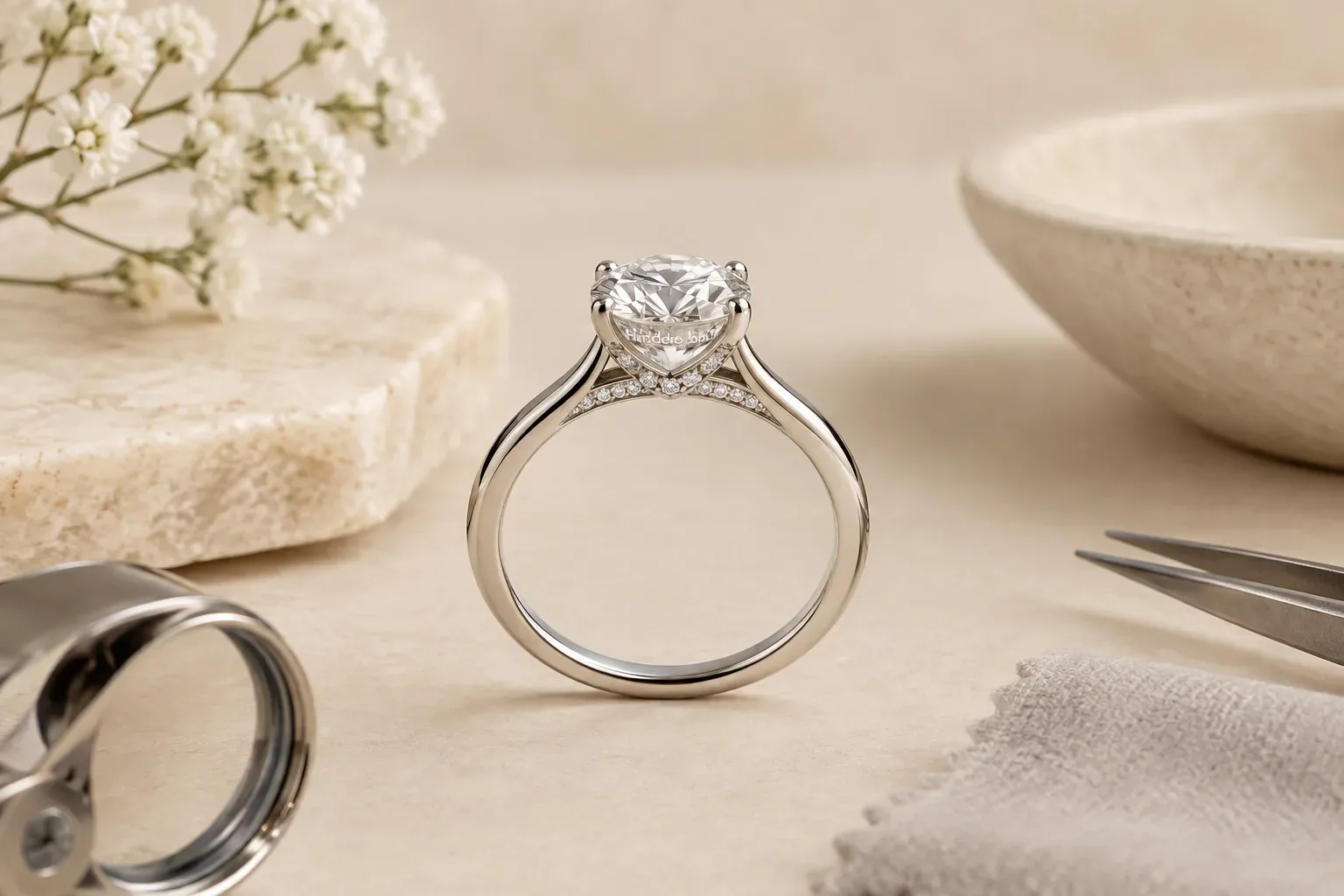
Meaning at a glance
Hidden halo setting engagement ring durability balances extra sparkle and perceived size against modestly higher snag and maintenance risk; evaluate mounting height, metal, prong work, and gemstone treatment disclosures, and plan for periodic inspection and possible repairs.
What the historical record shows (and what it does not)
There is no specific, dated historical record in the approved sources tying the hidden halo motif to a distinct ancient culture or historical period. Modern search and retail data point to demand for contemporary design features rather than a revival of a single historical practice. Imaginaire Digital documents current UK search patterns and shows strong consumer interest in engagement ring varieties in the 2020s, indicating that buyers are seeking a range of styles and effects rather than a single traditional motif.
Professional trade commentary from Jewelers Mutual describes 2026 demand focusing on fluid forms, modern stacking, and craftsmanship, which helps explain why designers create subtle features such as hidden halos: these elements add versatility and sparkle while remaining compatible with modern layered looks. Because these sources treat the hidden halo as a contemporary design response to current tastes, we cannot attribute the style to a specific earlier culture or historical meaning without other primary historical sources.
Documented history versus modern interpretation
Documented evidence from the approved sources frames the hidden halo as a modern stylistic choice rather than a historic symbol with established cultural meanings. Jewelers Mutual and Imaginaire Digital present the hidden halo as part of recent design trends connected to stacking and versatility, not as a recovered ceremonial motif with a fixed symbolic history.
Modern personal interpretations—what wearers believe a hidden halo signifies—are separate from documented history. Some buyers interpret the hidden halo as a private flourish, a nod to a personal secret or inner radiance, or simply an aesthetic detail chosen for its visual effect. Those meanings are individual and contemporary rather than historically documented in the provided sources.
How the hidden halo motif appears in jewelry
A hidden halo usually places a ring of small accent stones beneath the center gemstone so the halo is visible only at angles or from the side rather than from the top view. Designers use the hidden halo to increase light return around the center stone, to make the center appear larger, or to add a flash of color that is subtly concealed when the ring is viewed straight-on.
In practice, jewelers execute hidden halos in several ways: a recessed gallery with pavé or bead-set accents under the head, a split or cathedral-style gallery that hides a row of stones, or a low collar that cradles the center gem. The exact construction affects durability: a tightly seated hidden halo with secure bead or channel settings is less prone to stone loss but may be harder to clean, while more open galleries are easier to service but can catch on fabrics more readily.
Durability factors: daily wear, snagging, and repair risk
Daily wear durability depends first on the center stone type and any treatments. The Gemological Institute of America notes that treatments affect detectability, durability, and care requirements for gemstones, so a treated center or accent stone may need gentler handling or special cleaning. Harder stones like diamonds are resilient, but accent stones in a hidden halo might be smaller and more exposed to knocks in the gallery or bezel cavity.
Snagging risk is typically higher than for a smooth low-profile band because the hidden halo requires an internal rim or gallery where metal edges or tiny stone settings project inward or outward slightly. If the setting includes open prongs or a raised gallery, it can catch thin fabrics, straps, or hair. Rings designed with a low, enclosed hidden halo and smooth metal edges reduce snagging, while high crowns and exposed bead-set accent stones increase it.
Repair risk increases modestly because hidden halos are composed of multiple small stones and fine metalwork. Common repairs include tightening or replacing lost accent stones, reflowing solder in the gallery after a knock, and re-rhodium plating for white gold if the ring has been polished. Routine professional inspection every six to twelve months lowers the chance of catastrophic center-stone loss by identifying issues early.
Decision criteria and practical trade-offs
When weighing a hidden halo against other settings, examine mounting height, the type and thickness of prongs, and whether accents are bead-set, channel-set, or flush. A lower-profile hidden halo with thicker prongs and a protective bezel for the center stone favors durability. A high gallery with numerous bead-set accents favors sparkle and aesthetic complexity but carries more snag and maintenance risk.
Metal choice affects both durability and service needs. Platinum is more resistant to metal loss and wearing down than 14k or 18k gold and can be preferable where tight settings need long-term stability. White gold requires periodic rhodium plating to maintain its bright finish, and that replating is a routine service to budget for. Jewelers Mutual's market commentary on craftsmanship and longevity underscores the value buyers place on well-executed construction when selecting contemporary designs.
Safe care guidance and what you can verify
For everyday care, remove your ring for manual tasks, avoid exposure to household chemicals, and use a soft brush with warm soapy water to clean accessible crevices. Steams and ultrasonic cleaners can dislodge small accent stones depending on set type, so consult a jeweler before using those tools. The Gemological Institute of America advises consumers that treatments and material types create different care needs, so follow guidance specific to the stones in your ring.
Before purchase or acceptance as a gift, ask the seller for written disclosures in line with Federal Trade Commission guidance about whether stones are natural, lab-created, treated, or imitations. Request a condition inspection and a demonstration of cleaning access so you can see how easily lint, oil, or debris accumulates. For diamonds or valuable colored stones, consider asking for a laboratory report that identifies treatments and provides objective information you cannot confirm visually at home.
Selection and gifting guidance
If gifting a hidden halo ring and durability is a priority, choose a design with a modest gallery, substantial prongs, and either a protective bezel or a low-profile head. Prefer platinum or a hard gold alloy and opt for bead- or channel-set accents that are flush with the metal rather than exposed bead points. Ask the retailer to show you how the ring sits against a wedding band if stacked wear is intended, since some hidden halos can make flush stacking more difficult.
Be explicit about service expectations with the recipient. Give a written note recommending periodic inspection and disclose any known treatments. If you are unsure about geological or treatment claims, obtain a lab report for the center stone and request clear seller disclosures consistent with FTC guidance. For buyers who want low maintenance, consider alternative designs such as a low bezel or a plain band with accent side stones rather than a gallery-style hidden halo.
Limits on verification without a professional
There are clear limits to what a shopper can verify without a qualified jeweler or a gemological laboratory: you cannot reliably determine certain stone treatments, the precise carat weight of small accents, microscopic structural flaws, or the internal setting integrity by eye alone. The Gemological Institute of America explains that treatments can be detectable only with specialized equipment and professional analysis.
For durability assertions about metal thickness, solder quality, or internal repairs, a jeweler’s inspection is necessary. If the ring’s construction is a central concern, ask for an independent appraisal and a laboratory report where appropriate. Jewelers Mutual’s emphasis on craftsmanship and inspection supports making these verifications part of the buying process for a ring intended for daily wear.
Frequently asked questions
Will a hidden halo increase the chance my ring will snag on clothing?
Yes; a hidden halo typically increases snag risk compared with a smooth, low-profile band because it adds gallery features and small accent settings where fabric or hair can catch. Choosing a low-profile gallery, enclosed settings, and thicker prongs reduces snagging.
How often should a hidden halo ring be inspected or serviced?
Plan for a professional inspection every six to twelve months, and sooner if you notice loose stones or a change in how the ring sits. Regular inspections catch loose accent stones and worn prongs before a more costly repair is needed.
Can I verify if the stones in a hidden halo are treated or lab-created at home?
Not reliably. The Federal Trade Commission requires disclosures, but detecting treatments or distinguishing lab-grown from natural stones often requires a qualified jeweler or a gemological laboratory report, as noted by the Gemological Institute of America.
Is platinum always better than gold for a hidden halo?
Platinum offers higher resistance to metal loss and can be more durable for fine settings, but it is heavier and more costly. Well-made gold settings also perform well, especially in 14k alloys; expect white gold to need periodic rhodium replating if you want a bright white finish.
Are ultrasonic cleaners safe for hidden halo rings?
Ultrasonic cleaners can dislodge small accent stones if the setting is loose or delicate. Consult your jeweler before using ultrasonic cleaning; many jewelers recommend gentle hand cleaning for complex gallery work.
What should I ask a jeweler before buying a hidden halo engagement ring?
Ask for written disclosures about stone origin and treatments, request a description of the setting construction and metal purity, ask how accessible the hidden halo is for cleaning, and request information about warranty, inspection services, and insurance recommendations.
Sources and further reading
- Imaginaire Digital — Imaginaire Digital
- Jewelers Mutual — Jewelers Mutual
- Gemological Institute of America — Gemological Institute of America
- Federal Trade Commission — Federal Trade Commission