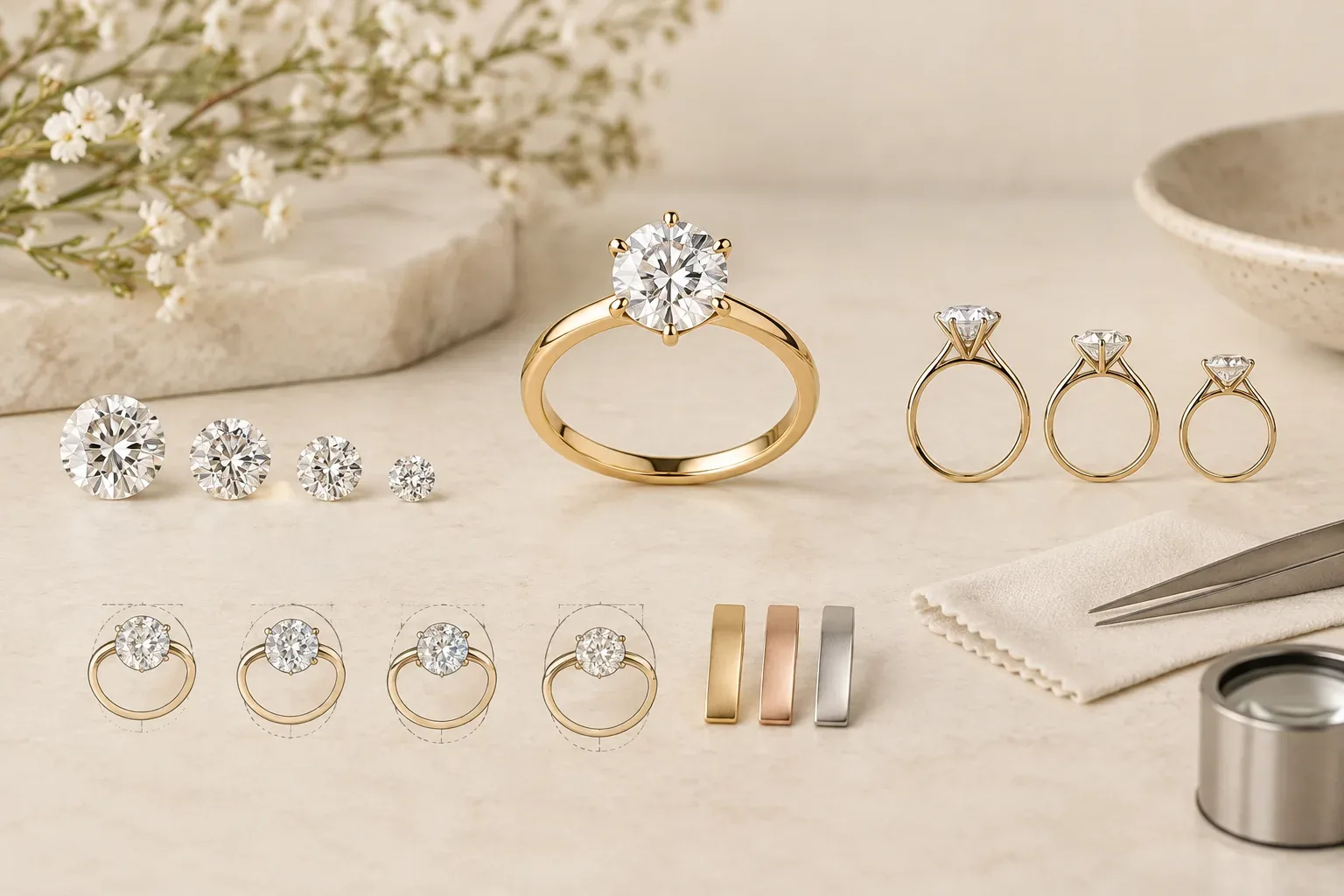
Meaning at a glance
Choose a solitaire that visually balances the stone face with the visible finger width, select a setting and band width to match lifestyle and stacking plans, ask sellers for written disclosures and lab reports, and understand that verification of treatments or origin requires a qualified jeweler or gemological laboratory.
Quick answer
For solitaire setting engagement ring styling, aim for a visible stone face that balances with the wearer's finger width and overall hand proportions rather than maximizing carat alone. Match band width and setting profile to lifestyle and stacking plans: a low-profile bezel or thin band improves daily wearability, while taller prongs and a slimmer band increase perceived stone size. Always request written disclosure and any available gemological reports; treatments and origin often require a qualified jeweler or a gemological laboratory to confirm.
What we mean by ‘solitaire setting’ and ‘styling’
A solitaire setting places a single primary gemstone at the visual center of the ring. Styling in this context means the combined choices that determine how much of the finger the ring appears to cover and how proportioned it looks: stone face diameter, setting type (for example prong, bezel, or tension), setting height, band width and the relationship to other rings when stacked.
This guide addresses styling decisions and trade-offs: visual proportion, durability, comfort, and compatibility with wedding bands or stackable jewelry. The goal is to give shoppers clear decision criteria and practical trade-offs while clarifying the verification limits that require professional testing.
Historical evidence and how to read provenance responsibly
Documented historical evidence for ring types, meanings and manufacturing methods is the domain of specialists, museum catalogues and academic jewelry scholarship. This article does not present new archival claims but does describe how to evaluate historical or vintage assertions offered by a seller.
When a seller claims a ring is period or vintage, ask for provenance: maker’s marks, hallmarks, dated paperwork, previous ownership records and independent condition reports. A qualified appraiser or museum curator is the right professional to attribute a piece to a specific period or culture; consumers should treat seller statements as marketing until confirmed by an expert.
Separating documented historical meanings from modern personal interpretation
Documented historical meanings—those supported by archives, museum catalogues or peer-reviewed studies—are distinct from the private or contemporary meanings buyers and wearers assign. The same ring form (a single stone set alone) can have different social or symbolic connotations in different eras and cultures; therefore, avoid assuming a single universal meaning.
If historical symbolism matters for your purchase, request supporting documentation and consult specialists. If you value the personal symbolism of a solitaire—simplicity, commitment, a focus on craftsmanship—recognize that this is a modern, subjective interpretation and perfectly valid as a personal meaning, but not the same as documentary provenance.
How the solitaire motif appears in jewelry: settings and visual effects
Solitaire motifs appear in several common setting types that change appearance, protection and perceived size. Prong settings (often four or six prongs) lift the stone to maximize light and perceived size. Bezel settings surround the stone with a metal rim, reducing exposure and making a ring appear more compact. Tension settings clamp the stone between bands for a modern look but require precise manufacture and may limit stone choices.
The band interacts with the stone face to change perceived coverage. A narrow band visually increases the relative size of the stone face, while a wider band reduces it. Setting height affects how the stone sits on the finger: low profiles are less likely to catch and are better for active wear, while higher settings increase visual prominence but also the risk of snagging.
Sizing for finger coverage and proportion — practical guidelines
Rather than focusing solely on carat weight, consider the stone face in relation to the visible finger width. As a rule of thumb, many stylists aim for the stone face to occupy roughly one third to one half of the visible width of the finger when the hand is relaxed; this provides a balanced look without overwhelming or appearing too small. Exact preference varies with hand shape and personal taste.
Band width should be chosen in harmony with the stone size: narrow bands (1.5–2.5 mm) tend to make the stone look larger and are popular for delicate styling and stacking, while mid to wider bands (3–5 mm and above) offer bolder proportion and a steadier feel on the finger. If stacking or pairing with a wedding band is important, plan both rings together to ensure complementary proportions and seat.
Practical trade-offs to consider
Maximizing visual size often requires trade-offs with durability and comfort. A high prong setting and a slim band may make a small stone look larger but increases vulnerability to catching and bending. Conversely, a bezel and wider band improve protection and comfort but can make a given stone appear smaller.
Another trade-off is between sparkle and practical wear. Prong settings expose more of the stone to light and cleaning needs; they also show the pavilion and allow more light return. Bezel settings hide facets and reduce maintenance frequency but can slightly mute brightness. Think about daily activities and how often you are willing to clean and check settings.
Selection and respectful gifting guidance
Match the ring’s physical proportions to the recipient’s lifestyle and wardrobe. For people with active hands or professions that require frequent manual tasks, favor low-profile settings and secure bezels or sturdy prongs. For a person who enjoys layered jewelry, prioritize thin bands and lower profiles that allow comfortable stacking.
When gifting, ask clear questions about material disclosures, treatments, and any available certification. The Federal Trade Commission requires written distinctions among natural, lab-created, treated and imitation materials; request those disclosures in writing and keep purchase receipts and reports. For diamonds and many colored gemstones, a gemological report from a recognized laboratory provides independent information on characteristics that sellers cannot verify by eye alone.
Care, treatments and what a shopper can realistically verify
Gemstone treatments affect appearance and care needs. The Gemological Institute of America explains that treatments vary in detectability, durability and care requirements; always ask whether a stone has undergone enhancement and what that implies for cleaning and longevity. Some treatments reduce durability or require gentler cleaning.
There are limits to what a shopper can verify visually. Only a qualified jeweler or a gemological laboratory can reliably confirm treatments, confirm whether a stone is natural or lab-grown, or determine geographic origin. For high-value purchases, insist on independent laboratory reports and, when appropriate, an independent appraisal. Also review seller return policies and repair warranties before purchase.
Trends and what today’s market shows
Market research and industry analysis indicate strong consumer interest in versatility, modern stacking and gender-neutral styling. Imaginaire Digital’s 2026 UK search data shows sustained demand for classic engagement categories and particular interest in shapes like oval engagement rings, while Jewelers Mutual’s 2026 trend commentary highlights consumer priorities for craftsmanship, versatility and modern stacking options.
These trends suggest that many buyers are choosing solitaire designs that are easy to pair with other jewelry and that prioritize wearability and adaptability over purely maximalist stone size.
Summary and next steps
For solitaire setting engagement ring styling, aim for a balanced stone-to-finger relationship, choose a setting and band to match lifestyle and stacking goals, and request clear written disclosures and laboratory reports where applicable. Use the visual proportions described here as starting points, but confirm comfort and appearance by trying rings on in person or by working with a jeweler who can show mock-ups.
If historical provenance or specialist documentary meaning matters to you, seek independent appraisal from a qualified specialist and treat seller statements as starting points for verification rather than proof.
Frequently asked questions
How much of my finger should a solitaire stone cover?
Aim for the stone face to occupy roughly one third to one half of the visible finger width when the hand is relaxed; personal taste and hand shape vary, so try options on to confirm visual balance.
Does a bezel make a solitaire look smaller than a prong setting?
Yes: bezels enclose the stone and generally present a more compact profile, which can make a given stone appear smaller than when set in tall prongs designed to maximize visible face and light entry.
What should I ask the seller when buying a solitaire engagement ring?
Request written disclosure on whether the gemstone is natural, lab-created or treated; ask for any available laboratory report; get clear return and repair policies; and keep receipts and any certificates.
Can I tell if a gemstone is treated or lab-grown by looking?
No. Many treatments and lab-grown origins cannot be reliably identified by eye. Only a qualified jeweler using proper instruments or an accredited gemological laboratory can confirm treatments or origin.
Which setting is best for everyday wear?
For daily wear, low-profile bezels or secure prong settings with sturdy prongs and moderate band widths are practical; prioritize security and comfort over maximal visual height if your daily activities are hands-on.
How should I plan for stacking with a solitaire?
Decide whether you want a flush fit with a wedding band before purchase: thinner bands and low-profile settings stack more easily. If you plan ornate bands, consider trying sample pairings or asking the jeweler to show stack mock-ups.
Sources and further reading
- Imaginaire Digital — Imaginaire Digital
- Jewelers Mutual — Jewelers Mutual
- Gemological Institute of America — Gemological Institute of America
- Federal Trade Commission — Federal Trade Commission