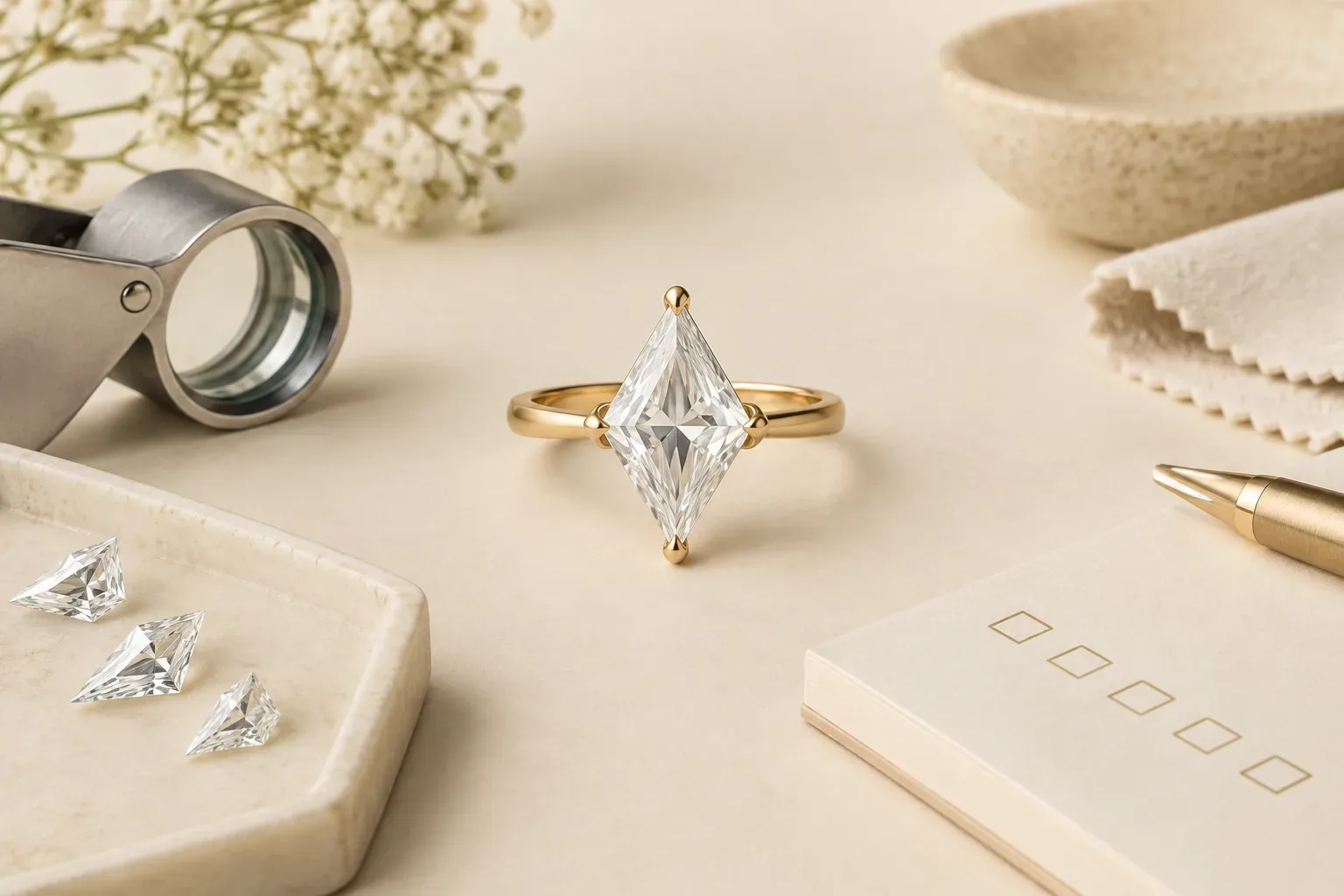
Meaning at a glance
A kite cut engagement ring checklist helps buyers prioritize cut quality, gemstone identity and treatments, durability and setting compatibility, certifications and seller disclosures, lifestyle fit, and aftercare; many authenticity and treatment questions require a qualified jeweler or gemological laboratory to verify.
Direct answer — what this checklist is for
Use this kite cut engagement ring checklist to answer three buyer questions: (1) Is the stone the material and quality the seller claims? (2) Will the kite cut and setting suit the wearer’s style and daily life? (3) What trade-offs (appearance, cost, durability, certification) are acceptable to you? Many useful checks—visual symmetry, setting security, and seller paperwork—can be done by a careful shopper, but formal identification of treatments, origin, or natural-versus-lab-grown status generally requires a qualified jeweler or a gemological laboratory for definitive verification.
What the historical evidence shows (and what it doesn't)
Among mainstream industry and consumer references we reviewed, there is no authoritative, dated record linking a named "kite cut" as a historically documented cut tied to a specific culture or archaeological period. The sources informing this article (Imaginaire Digital, Jewelers Mutual, the Gemological Institute of America and the U.S. Federal Trade Commission) address modern market trends, treatment disclosure and consumer protection rather than the deep provenance of niche modern cuts.
Because those sources do not provide discrete cultural or period attributions for a kite-shaped gem cut, treat historical narratives about the kite cut with caution: they are typically modern design histories or retailer marketing rather than peer-reviewed archaeological or gemological documentation. In other words, documented historical meanings for a kite cut are not established in the professional references cited here, so any historical claim beyond noting a contemporary design lineage should be treated as interpretive rather than documented fact.
Separate documented facts from modern interpretation
Documented: Contemporary market data and trade guidance show strong ongoing interest in engagement rings and evolving preferences for modern, fluid and gender-neutral styles. Industry summaries indicate 2026 demand centers on fluid forms, stacking-friendly designs and colored gemstones, trends that create space for unusual shapes such as kite cuts in engagement rings (Jewelers Mutual; Imaginaire Digital).
Interpretive: Symbolic meanings attributed to a kite cut—such as flight, freedom, uniqueness or directional emphasis—are modern, subjective interpretations used by designers and buyers. These symbolic associations are personal or marketing-driven and are not established as universal cultural meanings in the professional references used for this article. If symbolic meaning matters to you, document the giver’s or recipient’s intended meaning and record it with the ring as a personal provenance note.
How the kite motif appears in jewelry
In contemporary jewellery design, a kite cut typically describes a faceted outline that resembles a kite: a pointed, elongated four-sided shape with two acute and two obtuse angles. Designers use the kite silhouette as a center stone cut, as accent stones in halos and side-stone arrangements, and as a geometric motif in settings, metalwork and mixed gemstone compositions.
Practical reasons designers choose kite shapes include a distinctive visual elongation, the ability to create directional lines that complement finger shape or ring styling, and a compatibility with modern, minimalist and stackable settings that trend reports say consumers favor (Jewelers Mutual; Imaginaire Digital). The choice of gemstone—diamond, sapphire, emerald or a colored gem—affects optical properties, hardness and care needs, so the same kite cut in different materials will behave and require different handling.
Kite cut engagement ring checklist: decision criteria and trade-offs
Material and identity: Ask whether the stone is natural, lab-grown, treated or an imitation. The U.S. Federal Trade Commission requires clear distinctions among these categories and written seller disclosures; get this in writing. For any claim about treatments (e.g., clarity enhancement, diffusion), request details and supporting documentation (FTC; GIA).
Certification and lab reports: For diamonds and many important colored gems, insist on a current, reputable laboratory report when the seller claims grade or origin. Lab reports document measurements, proportions and detected treatments. Remember that conclusive statements about origin or some treatments may still require specialized analysis beyond a retail appraisal—only a gemological laboratory can give an authoritative report for many questions (GIA; FTC).
Cut quality and visual performance: Examine the kite cut for symmetry, facet alignment and how the stone sits in its setting. Symmetry affects sparkle and perceived size; kite cuts with poor symmetry can look unbalanced. Because kite cuts are less common than rounds or ovals, ask for closeup photos or videos from multiple angles and, if possible, see the stone in person.
Durability and material trade-offs: Different gems have different hardness and cleavage. GIA guidance on treatments and durability warns that some treatments can change a gemstone’s toughness and require special care. Choose a gemstone and setting that match the wearer’s lifestyle: active wearers need low-profile, protective settings and harder stones; those preferring statement pieces may accept higher-care gemstones.
Setting and engineering: Confirm the setting secures the pointed ends of a kite cut. V-prongs, bezels or protective galleries can reduce the risk of chipping. Ask whether the ring’s design will accommodate a wedding band later or if a custom matching band is necessary.
Budget and visual trade-offs: Kite cuts can maximize perceived length and finger coverage; they may allow a lower carat weight to achieve a dramatic look. Balance visual impact against budget by comparing carat weight, millimeter measurements and face-up appearance rather than relying on carat alone.
Seller reputation and return policy: Buy from sellers who provide transparent disclosures, clear return policies, and written warranties. Industry guidance emphasizes the importance of documentation and full disclosure when buying gemstones and diamonds (FTC).
Practical buying and respectful gifting guidance
Talk to the recipient if possible about lifestyle and style preferences, or consult close contacts for guidance. Confirm ring size or buy a flexible sizing option, and consider an insurance appraisal or a purchase option that includes resizing or return within a reasonable timeframe.
Respect cultural and personal meanings by asking whether particular shapes or materials have importance to the recipient’s background. Because documented historical meanings for the kite cut are not established in the references used here, assume any symbolic interpretation is personal, and record the giver’s intent in writing if that provenance matters.
When gifting, provide all documentation—from lab reports to purchase receipts and care instructions—so the recipient can maintain, insure and, if desired, obtain an independent assessment of the stone later. Clear documentation is also key if the recipient wishes to resell or insure the piece.
Care, maintenance and what you cannot verify without a lab
Care and maintenance: The Gemological Institute of America notes that treatments affect detectability, durability and special care needs. Routine precautions include avoiding striking the ring against hard surfaces, removing it for heavy manual tasks, and having the setting checked periodically by a qualified jeweler. For gemstones that may have been treated, follow the seller’s care recommendations and ask the seller to disclose any heat, clarity enhancement or coating treatments which can change cleaning methods (GIA).
Verification limits: Simple visual inspections and written paperwork can detect many issues such as mismatched measurements, improper settings, or absent disclosures. However, definitive identification of treatments, natural origin versus lab-grown origin, and some types of enhancement requires laboratory-grade equipment and analysis. The FTC advises buyers to obtain written seller disclosures and, when in doubt, an independent laboratory report for material claims. If you need a conclusive answer about treatment or origin, obtain a qualified gemological laboratory report or consult a certified gemologist.
Final checklist to use at the counter or online
Before you buy, confirm the following in writing: the exact material designation (natural, lab-grown, treated, imitation), any treatments and their disclosure, whether a recognized laboratory report accompanies the stone, the seller’s return and repair policy, and the ring’s measurements in millimetres. Inspect (or request) clear images showing symmetry and setting security, and ask specifically how the pointed ends are protected.
If buying online, verify the seller’s reputation, request live video or multiple-angle photos, and ensure the purchase includes a return window and insured shipping. If you need verification beyond the seller’s documents, budget for a third-party laboratory report or an independent jeweler’s appraisal.
Frequently asked questions
What exactly is a kite cut?
A kite cut is a modern descriptive term for a four-sided faceted stone that resembles an elongated kite shape; usage and exact facet patterns vary by maker, and the shape is best judged by photos, millimetre measurements and in-person inspection.
Can I verify treatments or origin myself?
No; while you can request written disclosures and look for obvious signs of enhancement, definitive identification of many treatments or of natural versus lab-grown origin typically requires a qualified jeweler and laboratory analysis.
What paperwork should I insist on when buying a kite cut engagement ring?
Ask for written disclosure of material type (natural, lab-grown, treated, imitation), any known treatments, a lab report or certificate when available, the seller’s return policy and warranty, and clear measurements and photos of the ring.
Is a kite cut durable for everyday wear?
Durability depends on the gemstone material and the setting. Harder stones in protective settings are better for daily wear; ask the seller about protective prongs or bezels for pointed ends and follow any special-care guidance for treated stones (GIA).
Should I get insurance or an independent appraisal?
Yes—after purchase obtain an independent appraisal for insurance purposes and consider a laboratory report if the seller’s documentation is incomplete or you need definitive confirmation of treatment or origin.
Sources and further reading
- Imaginaire Digital — Imaginaire Digital
- Jewelers Mutual — Jewelers Mutual
- Gemological Institute of America — Gemological Institute of America
- Federal Trade Commission — Federal Trade Commission