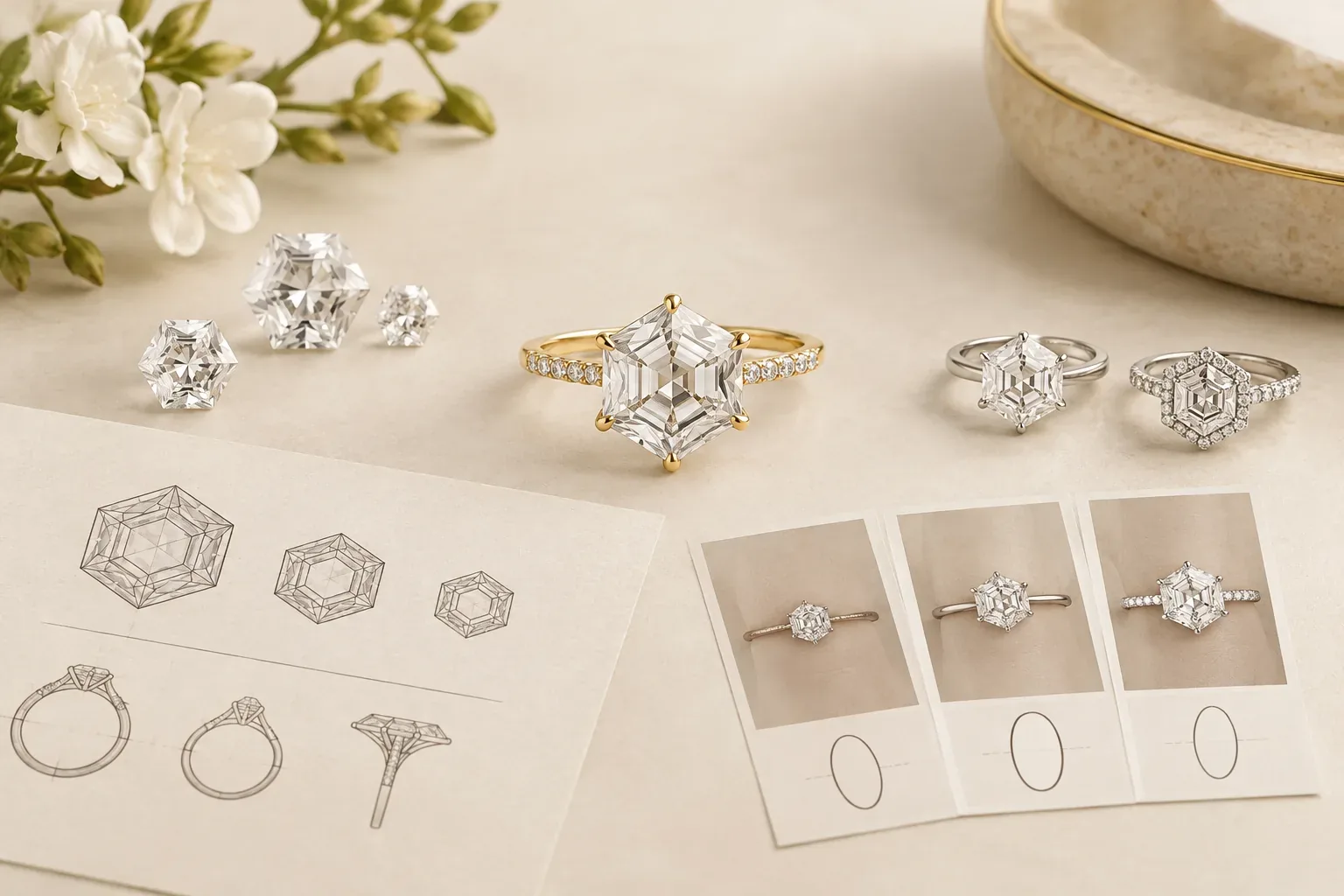
Meaning at a glance
Hexagon cut engagement ring styling focuses on balancing the flat-edged geometry of the stone with band width and setting to control finger coverage and visual scale; choose settings that protect corners, match proportion to finger width, and verify treatments, origin and precise measurements only through a qualified jeweler or gemological laboratory.
Quick answer
Styling a hexagon cut engagement ring is about proportion and protection: select a girdle-to-girdle diameter that visually matches your finger width, prefer settings that shield the stone's six corners, and choose band widths and shoulder designs that balance the hexagon's flat facets to avoid a top-heavy or stumpy appearance. Confirming durability, treatments and exact origin requires a qualified jeweler or an accredited gemological laboratory; general care and disclosure practices follow standard gemstone guidance.
What the hexagon cut is and how this guide answers your search intent
The hexagon cut is a six-sided faceted shape (a regular or slightly elongated hexagon) used for diamonds and colored gemstones. As a fancy cut, its appeal lies in geometric clarity and modern symmetry. This guide aims to answer the distinct search intent behind 'hexagon cut engagement ring styling' by offering clear definitions, decision criteria for proportion, practical trade-offs among settings and bands, safe care guidance, and explicit limits on what shoppers can verify without professional testing, consistent with the editorial thesis.
Historical evidence and cultural associations
Among the approved sources used in this article there is no documented historical record tying the hexagon cut specifically to a named ancient culture, dynasty or period. Modern trade and industry reports focus on current cuts, consumer demand and design trends rather than supplying archaeological or ethnographic evidence connecting hexagonal gemstone cuts to past civilizations.
Because the available professional and industry sources emphasize contemporary trends, when people attribute symbolic or historical meaning to a hexagon cut it is typically a modern interpretation rather than a claim grounded in primary historical texts or museum catalogues. If a precise historical association is important to you, request provenance and documentation from the seller and consult published museum or archival sources beyond the trade literature cited here.
Documented meanings versus modern personal interpretations
Documented meanings for specific gemstone cuts are rare in the source material available to jewelry professionals and consumers. The approved industry references do not record an established, universal symbolic meaning for the hexagon cut. Instead, most meanings attached to modern cuts are personal or stylistic: wearers and designers often choose geometric cuts to evoke modernity, minimalism, architecture, or a preference for clean symmetry.
Separate those personal or cultural attributions from documented facts. If someone presents a hexagon cut as an authentic historical talisman or as having a long-standing ritual meaning, ask for primary evidence: provenance paperwork, museum references, or peer-reviewed historical research. Otherwise, treat such meanings as contemporary symbolism chosen by wearer or giver.
How the hexagon motif and hexagon-cut gemstones appear in jewelry
Designers use the hexagon motif both as a stand-alone center stone and as a repeated pattern in settings, halos, or band inlays. Hexagon-cut stones can be faceted like diamonds or fashioned from colored gems; the straight edges and six corners create a more architectural silhouette than round or oval cuts.
Common contemporary applications include solitaire hexagon centers set in bezel or prong mountings, hexagon clusters that echo the shape in smaller side stones, and mixed-shape designs where a hexagon stone pairs with tapered baguettes or round melee to soften the geometry. Industry trend reports note strong demand for versatile, gender-neutral styling and modern stacking—contexts where crisp geometric cuts like the hexagon are increasingly popular.
Finger coverage and proportion: practical rules
Finger coverage refers to how much of the finger’s top surface the ring’s visible stone or head occupies. For hexagon cuts this is governed by the stone’s maximum width (girdle-to-girdle measurement), its table shape, and how the setting sits above the finger. A useful starting principle is to visualize the hexagon’s width relative to the soft pad of the finger: on average, a stone that occupies about one-third to one-half of the visible finger width creates balance—smaller for slender fingers, larger for broader fingers.
Because hexagons present flat sides rather than a continuous curve, they can read visually wider at the same millimeter measurement than an equivalent round cut. To avoid a stone appearing too broad, consider either a slightly narrower hexagon or a tapered shank that creates the illusion of length. Conversely, to avoid a stumpy look on a short finger, choose a slightly elongated hexagon or pair the hexagon with a thin, low-profile band to stretch the finger visually.
Measure your finger at the widest visible point and compare it to the stone diameter to estimate coverage. For example, on a finger with a visible top width of 14 mm, a hexagon stone around 5 to 7 mm wide will fall into the one-third to one-half coverage range. These are styling rules of thumb rather than strict standards; personal comfort and aesthetic preference should guide final selection.
Setting choices and practical trade-offs
Prong settings, especially those with six prongs positioned near each corner, protect the hexagon’s angles while maximizing light return. Bezel settings offer the strongest physical protection by surrounding the stone edge-to-edge, but a full bezel reduces visible table area and can make a stone read smaller. Half-bezel or partial bezel designs can be a compromise that shields vulnerable corners while keeping more table visible.
Band width, shoulder treatment and halo choices change perceived proportion. Wider bands or substantial cathedral shoulders can compete with the geometric center and make the hexagon feel smaller. Thin, tapered bands emphasize the stone and lengthen the finger silhouette. Halo settings with a circular halo will soften the hexagon’s angularity, making it blend into rounder rings, while a hexagon-shaped halo will amplify the geometry.
Durability, treatments, and safe care
Treatments and durability create important practical considerations for hexagon cut stones. The Gemological Institute of America (GIA) explains that some gemstones routinely receive treatments that affect appearance and durability, and those treatments influence care needs and resale considerations. Harder stones such as diamond and sapphire tolerate everyday wear better; softer gems need more protective settings and gentler handling.
Follow basic care rules: avoid impact that could chip corners, remove rings when heavy manual work or contact sports are expected, and clean according to the specific gem’s tolerance for ultrasonic or chemical cleaners. For any questions about treatment stability or the appropriate cleaning method for a specific gem, consult the seller’s full disclosure and the GIA guidance on gem treatment and care.
What you can and cannot verify without a jeweler or laboratory
There are clear limits on what a shopper can confirm unaided. The Federal Trade Commission (FTC) advises that distinctions among natural, lab-created, treated, cultured and imitation materials require written disclosures and may not be reliably determined by sight alone. Verify seller documentation and written disclosures before purchase.
Only a qualified jeweler or an accredited gemological laboratory can accurately measure carat weight, verify treatments, confirm origin, and authenticate whether a stone is natural or lab-created. If you require guarantees about durability, treatment status, or origin for insurance or resale purposes, request a laboratory report from a recognized lab and a full disclosure statement from the seller prior to completing a purchase.
Practical and respectful selection or gifting guidance
When selecting or gifting a hexagon cut engagement ring, prioritize the wearer’s lifestyle and aesthetic preferences over novelty alone. For people who use their hands extensively, choose durable stones and protective settings. For those who favor modern design, emphasize clean lines, symmetrical settings and metal choices that complement the hexagon’s edges.
Respect cultural meanings and personal symbolism by asking open questions rather than assuming significance. If the recipient values sustainability, ask about lab-created options and request written disclosures per FTC guidance. For surprise gifts, coordinate sizing strategies that allow safe return or resize options, and include documentation from an accredited appraiser or laboratory report if authenticity or treatment disclosure is important to the recipient.
When to consult a professional
Consult a qualified jeweler for custom proportions, mounting advice, and a hands-on assessment of finger coverage before purchase. Bring or request exact measurements, and ask to view ring try-ons or mockups to confirm visual scale. For any question about gemstone treatments, origin or precise grading, obtain a report from an accredited gemological laboratory.
A professional will also advise on insurance valuation and local resizing limits. If you plan to inscribe, alter, or design a very low-profile mount for comfort, seek the jeweler’s guidance because structural changes affect both appearance and long-term durability.
Final practical checklist
Match hexagon width to the visible finger width and use the one-third to one-half coverage guideline as a starting point. Protect corners with prongs or bezels, choose band proportions that balance the stone rather than compete with it, and select a setting shape (circular or hex halo) depending on whether you want to soften or emphasize the geometry. Request written disclosures and lab reports for treatment, origin and authenticity, and consult a qualified jeweler for any verification beyond visual inspection.
Frequently asked questions
How wide should a hexagon cut be for my finger?
A practical rule of thumb is for the stone’s maximum width to occupy about one-third to one-half of the visible finger width. For a finger with a visible top width around 14 mm, a hexagon of roughly 5 to 7 mm will typically read balanced; adjust toward the smaller end for slender fingers and toward the larger end for broader fingers.
Are hexagon cuts more prone to chipping than round cuts?
Cornered cuts have more exposed angles that can be vulnerable to impact. A secure setting—six prongs placed near each corner or a bezel—reduces the risk. The relative hardness of the gemstone also matters: diamonds and sapphires resist abrasion better than softer stones. For specific durability questions, consult the seller’s disclosures and a qualified jeweler.
Will a hexagon look wider than a round of the same millimeter size?
Yes. Because flat sides and straight edges present visual breadth differently than a continuous curve, a hexagon can appear wider at the same millimeter measurement compared with a round cut. This is why proportioning to the finger and trying on samples is useful.
Can I trust the seller to disclose treatments or origin?
Sellers should provide written disclosures about treatments, whether a stone is natural or lab-created, and other material facts. The Federal Trade Commission advises consumers to seek these written disclosures. For independent verification, request a laboratory report from an accredited gem lab.
What settings best complement a hexagon cut for everyday wear?
For everyday wear, settings that offer physical protection—such as bezels, partial bezels, or well-placed prongs—are recommended. A lower-profile mount reduces snagging. Band styles that taper away from the head help balance the hexagon and make maintenance simpler.
How should I clean and care for a hexagon cut stone?
Cleaning depends on the gem. Hard, stable stones tolerate warm soapy water and soft brushes; some treatments or softer gems need gentler care. Check the Gemological Institute of America’s guidance on treatments and care, follow seller recommendations, and avoid ultrasonic or steam cleaning unless explicitly approved for that stone.
When should I ask for a lab report?
Ask for a lab report when you need verification of carat weight, grading, treatment status, or origin—especially for higher-value purchases, insurance, or resale. Accredited gemological laboratories provide objective assessments that sellers’ descriptions alone cannot fully replace.
Sources and further reading
- Imaginaire Digital — Imaginaire Digital
- Jewelers Mutual — Jewelers Mutual
- Gemological Institute of America — Gemological Institute of America
- Federal Trade Commission — Federal Trade Commission