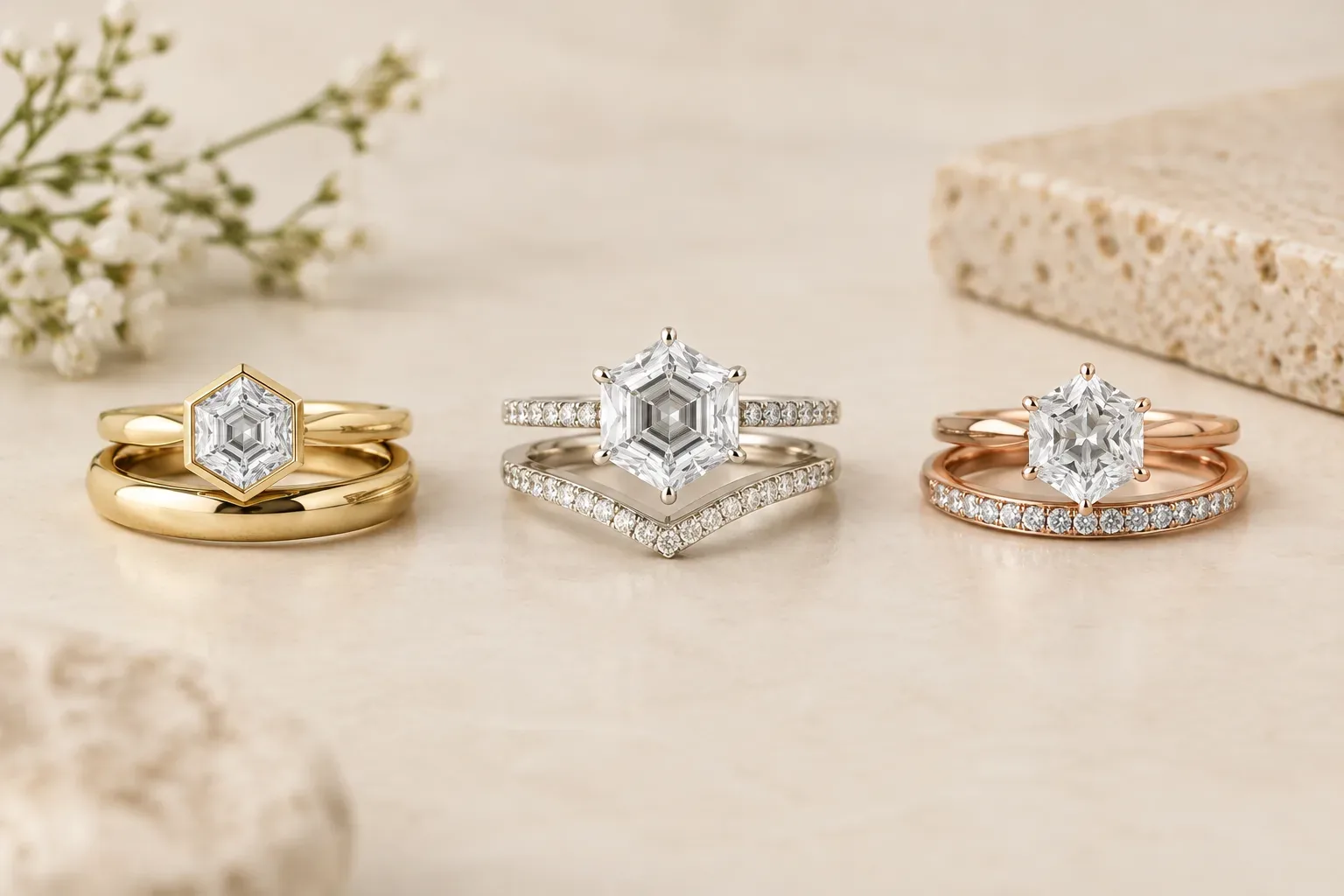
Meaning at a glance
Pairing a hexagon-cut wedding band means choosing a compatible profile (full-hexagon, contoured, or flat), planning for the gap between the engagement ring and band, and selecting a metal with the right trade-offs in durability and color. Follow seller disclosure and lab-report guidance for gemstones, and rely on a qualified jeweler or gemological laboratory to verify treatments or origin.
Direct answer — what 'hexagon cut wedding band pairing' means
Concise answer: hexagon cut wedding band pairing refers to the design decisions needed to make a hexagon-shaped band sit, look and perform well with an engagement ring. The practical decision criteria are threefold: the band’s shape/profile (full hexagon edge, rounded face, or contoured to an engagement ring), the gap or contact line created when rings are stacked, and the metal choice that balances color, hardness and maintenance. Evidence-led shoppers must also confirm any gemstone treatments and material disclosures with sellers and seek lab reports or a qualified jeweler for tests a consumer cannot do at home.
Historical evidence and what’s documented
There is no specific, documented historical tradition for a 'hexagon cut wedding band' in the professional sources used for this guide. Modern industry reporting and trend surveys emphasize current consumer interest in geometric or gender-neutral shapes rather than documenting ancient cultural meanings for hexagonal cuts. For example, industry trend reporting identifies demand for modern stacking and gender-neutral styling but does not tie the hexagon specifically to a historical ritual or cultural period (Jewelers Mutual, Imaginaire Digital).
Because authoritative jewelry and consumer-protection sources used here focus on contemporary trends, disclosure and gem treatment rather than ancient symbolism, any claim that hexagon-cut bands carried a particular historical meaning in a named culture would require primary historical evidence not provided in the sources cited for this guide.
Separating documented history from modern interpretation
Documented history (per the approved sources) is limited to market and consumer trends: geometric, stacked and versatile rings are rising in popularity in recent years (Imaginaire Digital; Jewelers Mutual). Modern interpretations that assign symbolic meanings—such as seeing the six sides as signifying six promises, six virtues, or other personal narratives—are contemporary, personal or marketing-driven and are not documented as universal or historical facts in the sources cited.
When selecting or gifting, treat symbolic attributions to geometric shapes as intentional personal meanings rather than established cultural facts. If you want a band to carry a specific traditional meaning, choose a motif and supplier that can document that meaning from reputable cultural or historical sources.
How the hexagon motif and cut appear in jewelry today
In modern jewelry, the hexagon appears in two overlapping ways: as a shape used in metalwork—hexagonal cross-sections, faceted edges, bezel shapes and ring profiles—and as a gemstone cut or setting style that emphasizes six-sided symmetry. Trend analysis notes a broader shift toward geometric and fluid forms, versatility, and stacking-friendly designs; hexagons fit these trends because the shape reads as contemporary and architectural (Jewelers Mutual; Imaginaire Digital).
Gemstones set in hexagonal bezels or cut to highlight sixfold symmetry require the same disclosure and care considerations as any other cut. The Gemological Institute of America highlights that treatments and durability vary by material and that buyers should be informed about any treatment or enhancement a stone has received (GIA). The Federal Trade Commission requires clear seller disclosures distinguishing natural, lab-created, treated or imitation materials (FTC).
Shape and profile: choosing the right hexagon form
Decide whether you want the hexagon to be a design language or a literal cross-section. A literal hexagon profile (flat facets meeting at angled edges) creates a strong geometric look but can feel angular and may catch on clothing. A rounded or partially beveled hexagon softens the effect and is often more comfortable for daily wear. For rings intended to stack with an existing engagement ring, consider a contoured hexagon band that has a notch or gentle curve to reduce gaps.
Take into account finger anatomy and ring width. Narrow hexagon bands accentuate the faceted motif without dominating an engagement ring, while wider bands emphasize the shape and will make any gap more visible. Try prototypes or model rings when possible to see how flat facets and edges contact an engagement ring.
Managing the gap: contouring, shaping, and tolerances
A common pairing issue is the visible or tactile gap between the engagement ring and the hexagon wedding band. A flush fit requires either an engagement ring with a complementary profile or a wedding band with a custom contour. Jewelers often create a small flat or scalloped area in the band to eliminate gaps while maintaining the hexagon silhouette.
Keep realistic tolerances in mind: microscopic gaps and tiny misalignments are normal due to manufacturing tolerances and finger movement. If a perfect flush fit is essential, discuss a custom solution with a jeweler and plan for measuring both rings on the same day, because temperature and swelling can change fit slightly.
Metal choices and trade-offs
Select a metal based on color preference, durability, scratch resistance and cost. Platinum is highly durable, hypoallergenic for many people, and holds shapes and edges well, making it attractive for crisp hexagon facets. Yellow and rose gold are warmer visually and easier to resize; white gold will match white metals but typically needs rhodium plating that can wear over time. Each metal has practical trade-offs: softer alloys scratch more easily, while harder alloys can be more difficult to resize.
Think about surface finish. High polish emphasizes the geometric planes with strong reflections, while brushed or hammered finishes reduce visible scratches and create a softer visual effect. Mixed-metal combinations—for example, a hexagon ring in yellow gold worn with a white-metal engagement ring—are a modern styling choice that aligns with current consumer trends toward versatility and gender-neutral styling (Jewelers Mutual; Imaginaire Digital).
Care, maintenance, and what labs or jewelers must verify
Routine care for a hexagon band is the same as for other rings: avoid harsh chemicals, remove rings for heavy manual work, and clean with mild soap and a soft brush. For gemstone settings, follow material-specific guidance because some gems and treatments require special care. The Gemological Institute of America explains that treatments affect durability and care, and that sellers should disclose treatments to consumers (GIA).
What you cannot reliably verify at home includes a gemstone’s treatment history, whether a stone is natural or lab-created, and exact origin. The Federal Trade Commission requires sellers to disclose these facts in writing, but independent verification requires a qualified jeweler or a gemological laboratory examination. Obtain written disclosures and, when necessary for high-value pieces, a recognized lab report before purchase.
Practical and respectful selection or gifting guidance
When buying or gifting, ask open questions about style preferences rather than assuming. If the recipient’s ring preferences are unknown, consider a neutral or reversible option: choose a softer hexagon profile, a medium width, and a classic metal such as platinum or 14k–18k gold that can be resized or adjusted. Keep receipts and ensure the seller provides material disclosures and a reasonable return policy.
For surprise gifts where fit matters, use a temporary band, measure an existing ring covertly, or choose to gift a ring with an exchange or resizing allowance. If you want the band to carry a specific symbolic meaning, communicate that intention—engraving personal text or adding a meaningful gemstone are modern, personal interpretations rather than historically documented symbols. Finally, consult a reputable jeweler early if you need a contoured or custom-fit piece to avoid costly remakes.
Limits, verification and final checklist
Before you finalize a purchase, confirm these points: obtain written disclosure about whether gemstones are natural, lab-created, or treated (FTC); request any available lab report for stones; ask about metal composition and plating; try or review prototypes for how the hexagon profile stacks with your engagement ring; and ask a jeweler about resizability and long-term maintenance. For any claim about a gemstone’s treatment or origin that matters to you, secure an independent laboratory report or an evaluation from a qualified gemologist because those are the only reliable ways to verify such claims.
In short: treat the hexagon as a contemporary geometric choice with practical considerations for comfort, gap management and metal properties. Use seller disclosures and lab testing for facts you cannot confirm visually, and prioritize communication with the jeweler when planning custom contours or snug stackable fits.
Frequently asked questions
Can a hexagon-cut wedding band be resized easily?
Resizability depends on metal and profile. Solid gold and platinum bands are generally resizable but faceted hexagon profiles may require a jeweler experienced in reshaping angular edges to preserve the look. If the band has complex facets or an inlaid pattern, resizing can be more difficult and may change the appearance. Ask the jeweler about resizability before purchase and keep the receipt in case professional adjustments are needed.
Will a hexagon band create uncomfortable pressure against an engagement ring?
A strong, literal hexagon profile with sharp edges can feel more angular against a companion ring than a rounded band. Many makers soften edges or bevel facets to increase comfort. If comfort is a top priority, try on similar profiles or request a mock-up. A contoured band that matches the engagement ring’s curve is the best solution for a flush, comfortable stack.
How can I verify whether a gemstone in a hexagon bezel is treated or lab-created?
The Federal Trade Commission requires sellers to disclose whether a gemstone is natural, lab-created, treated or imitation. For independent verification, ask for a laboratory report from a recognized gemological laboratory or arrange an assessment with a qualified jeweler. The Gemological Institute of America explains that treatments affect care and durability, and laboratory testing is the reliable method to confirm such claims (GIA).
Is a hexagon band a current trend or a timeless choice?
Industry reporting shows geometric, stacking-friendly and gender-neutral designs are currently in demand, which makes hexagon motifs well-aligned with modern trends (Jewelers Mutual; Imaginaire Digital). Whether it feels timeless depends on personal taste; if you want a design likely to remain versatile, opt for a softer profile and classic metal that can adapt to changing styles.
What should I get in writing when buying a hexagon wedding band?
Request written disclosures about metal composition, gemstone status (natural, lab-created, treated or imitation), warranties, return or exchange policies, and any available laboratory reports. This protects you and makes it easier to obtain independent verification if questions arise later (FTC).
Sources and further reading
- Imaginaire Digital — Imaginaire Digital
- Jewelers Mutual — Jewelers Mutual
- Gemological Institute of America — Gemological Institute of America
- Federal Trade Commission — Federal Trade Commission