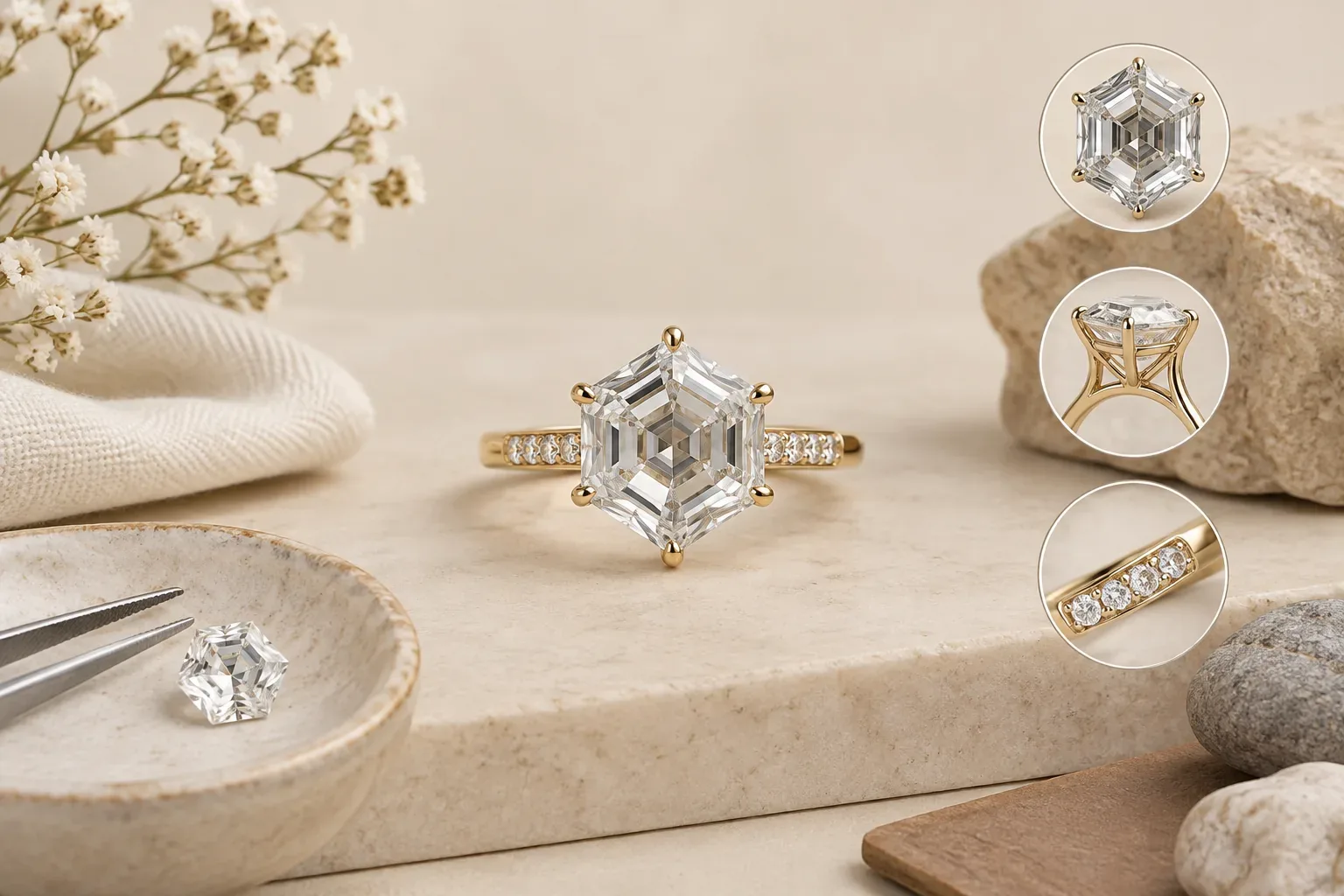
Meaning at a glance
Hexagon-cut engagement ring durability depends more on the chosen gemstone, facet geometry, and setting than on the outline alone; consumers should weigh hardness, cleavage, setting protection, and disclosure, and consult a qualified jeweler or gemological lab for verification.
Quick answer
Short answer: hexagon cut engagement ring durability is not a single, fixed property of the shape itself but the result of at least four interacting factors — the gemstone's intrinsic toughness and hardness, how the hexagon's facets and corners are cut, the type of setting that protects—or leaves exposed—those edges, and whether the material has been treated. An evidence-led approach identifies these decision criteria, describes the everyday trade-offs (snagging versus display of facets), and makes clear what you can only confirm with a qualified jeweler or gemological laboratory.
What the historical record shows
Documented historical meanings tied specifically to a hexagon-shaped cut are scarce in the technical literature and mainstream jewelry histories available to consumers. Modern market analysis and trade commentary indicate that geometric and modern silhouette choices are primarily a contemporary fashion and design phenomenon rather than a historically codified symbol. For example, Jewelers Mutual notes 2026 demand centers on fluid forms, modern stacking, colored gemstones, craftsmanship and versatility, which explains why unusual cuts such as hexagons are popular today rather than rooted in a long, specific symbolic tradition.
Market and search-analysis reporting from Imaginaire Digital shows strong current consumer interest in a range of engagement-ring styles and shapes, reflecting contemporary search and visibility rather than documented historical ritual use. Because the primary published sources available for shoppers emphasize modern trends and disclosure rather than ancient symbolism, it is accurate to say that the hexagon cut is principally a modern design choice rather than a shape with widely documented, culture-specific historical meanings.
Documented meanings versus modern personal interpretation
Separate the very limited documented history from modern personal meanings. The existing, accessible references do not establish a universal historical symbolism for hexagonal cuts. Modern wearers and designers assign personal or cultural meanings to geometric shapes; these are valid as personal or local traditions but should not be presented as historically universal facts. The Gemological Institute of America (GIA) and consumer protection guidance emphasize that buyer questions often relate to treatments, disclosure and durability rather than symbolic lineage, which supports treating symbolic interpretation as a personal or contemporary layer layered onto a primarily design-driven choice.
How the hexagon motif and cut appear in jewelry
In jewelry, 'hexagon cut' refers to a gemstone outline and the way its facets are arranged to create a six-sided silhouette. Jewelers produce hexagon cuts across colored gems and diamonds, sometimes with faceting patterns aimed at maximizing brilliance, or with simpler step cuts to emphasize color. The hexagon appears in single-stone rings, halo settings, and as repeated motifs in bands and accent stones where geometric styling is part of the design language favored by contemporary consumers.
Durability factors: what actually matters
Three technical properties of the material determine how well any cut will stand up to daily wear: hardness, cleavage and toughness. Hardness measures resistance to surface scratching, cleavage describes how likely a gem is to split along planes under force, and toughness reflects resistance to chipping and fracturing. The GIA explains why treatments, disclosure and detectability matter for these durability questions: some treatments affect toughness or require special care, and detecting such treatments may need laboratory equipment.
Beyond the gem itself, geometry and setting are critical. A hexagon has six corners; corners concentrate stress and are typical places for chips if they are exposed. The faceting style—whether the cut rounds or blunts the corners, or emphasizes sharp points—changes the vulnerability. A protective setting such as a bezel or a halo with prongs that cover corner points reduces the chance of chipping and snagging. Conversely, a low-profile, open prong setting that leaves corners exposed increases risk during routine knocks and catches.
Daily wear and snagging risk
Snagging occurs when a stone's edge, corner or a prong catches on fabric, hair or other materials. Geometry that emphasizes sharp angles, including many hexagon silhouettes, can raise the likelihood of catching, particularly in settings that do not shield the stone's perimeter. Practical factors such as how often you use your hands for physical tasks, whether you wear gloves, and the kind of clothing you commonly wear all affect the real-world snag risk.
Design choices can reduce snagging without abandoning the hexagon look. A bezel or partial bezel setting that follows the six-sided outline will present a smoother interface to fabrics. Lower-profile settings that sit closer to the finger minimize leverage that pries at corners. Alternatively, mounting the hexagon as a center stone surrounded by a halo of small stones increases visual coverage of the edges and gives additional mechanical protection.
Repair risk and typical repair considerations
Repair risk falls into two categories: routine maintenance and damage repair. Routine maintenance includes prong re-tipping, checking for loose stones, and cleaning; designs with more exposed corners may require prong work more frequently. Damage repair, such as fixing a chipped corner, depends on the gem's material and the severity of the chip. Hard stones like sapphire and diamond can often be re-polished or re-cut, sometimes requiring removal from the mounting, while softer or cleaving-prone gems might need replacement.
Expect variability in repair cost and feasibility. The Federal Trade Commission reminds buyers to seek written disclosure for treatments and material type because these factors affect repair options and costs. Significant repairs or re-cutting should be handled by an experienced jeweler, and in some situations a gemological laboratory report is the right step to document origin and treatments before repair or insurance claims.
Decision criteria and practical trade-offs
If your priority is daily durability with minimal maintenance, you should prioritize stones with high hardness and good toughness, protective settings, and conservative corner treatments. If visual uniqueness or a strong geometric look is the priority, accept that you may trade some increased snagging and occasional prong or corner work for that aesthetic. The market commentary from Jewelers Mutual and Imaginaire Digital shows that modern buyers value both distinctive shapes and versatility, so many designs try to balance aesthetics with protection.
Before purchase, ask the seller specific, verifiable questions: what is the gem material and hardness, has it been treated, what setting style is used, and is there a written disclosure of treatments and origin? The FTC guidance supports insisting on clear written disclosures for natural versus lab-created stones, treated materials, and any stabilizing procedures that could affect care and longevity.
What you can and cannot verify without a jeweler or lab
You can verify visible setting style, mounting height, prong count, and how sharply corners are presented simply by inspecting the ring or asking for detailed photographs. You can also confirm whether the seller provides standard documentation and return policies. However, you cannot reliably verify certain material properties or treatments by eye. Identifying subtle treatments, internal stability issues, or precise origin typically requires testing from a qualified jeweler or a gemological laboratory. The GIA explains that treatment detectability and the implications for durability make laboratory reports valuable where doubt exists.
If durability or treatment is a decisive factor for you, budget for a pre-purchase inspection by a reputable jeweler and request laboratory certification for higher-value stones. This step gives you the documented baseline that insurance companies and repairers prefer, and it complies with the disclosure emphasis in FTC guidance.
Care and everyday handling
Handle a hexagon-cut engagement ring like any ring with vulnerable edges: remove it for heavy manual work, avoid sharp impacts, and store it separately to prevent knocks against other jewelry. Regularly inspect prongs and settings and have a jeweler re-tip prongs or tighten settings as needed. Cleaning should follow material-appropriate methods; if the stone has been treated, follow any special care instructions disclosed by the seller. These practical steps reduce the cumulative wear that leads to repairs.
Selection and gifting guidance
For buyers and gifters: first decide whether style or durability is the priority, then match the stone and setting to that priority. If the recipient leads an active lifestyle, prefer a protective setting and choose a stone known for toughness. If the visual statement of a hexagon is the key reason for choosing the ring, consider a halo or bezel variant that preserves the geometric look while reducing exposed corners. Ask the seller for written disclosures on treatments and origin and, when in doubt, request a pre-purchase appraisal or lab report. Provide the recipient with care advice and, where available, professional maintenance options such as an annual check-up.
When gifting, be explicit about return, resizing and service policies. Contemporary consumer research cited by Imaginaire Digital and trend notes from Jewelers Mutual indicate that many buyers combine modern styling with expectations for aftercare and repair support, so a clear plan for maintenance and documentation will make a hexagon-cut engagement ring a more sustainable and confidence-inspiring gift.
Final takeaways
Hexagon cut engagement ring durability is a function of gem material, cut execution, and setting protection rather than the six-sided outline alone. Modern trade reporting shows the hexagon’s popularity stems from current design trends, while authoritative institutions emphasize careful disclosure and lab testing where durability concerns exist. Use visible inspection to assess exposure and setting, insist on clear written disclosure for material and treatments, and consult a qualified jeweler or gemological laboratory when you need definitive verification.
Frequently asked questions
Is a hexagon cut more likely to chip than a round or oval cut?
A hexagon cut can have more exposed corners than round or oval cuts, which may increase the likelihood of chipping if the corners are sharp and unprotected; however, actual risk depends primarily on the gem's hardness and toughness and the setting used. Protective settings like bezels or halos reduce chip risk regardless of outline.
Can I tell if a hexagon-cut stone has been treated without lab testing?
You cannot reliably identify many treatments by eye. The Gemological Institute of America recommends laboratory testing for detecting and documenting treatments that affect durability and care, and the FTC advises requesting written disclosure from sellers.
Which setting is best for daily wear with a hexagon-cut center stone?
For daily wear, a setting that protects corners—such as a bezel, partial bezel, or a halo with prongs covering corner points—is generally best. Low-profile mountings and securely tipped prongs also reduce snagging and mechanical stress.
How often should I have the setting checked?
Have a reputable jeweler check prongs, bezels and overall setting integrity at least once a year or more often if you notice looseness, excessive movement, or after a significant impact. Regular checks help prevent stone loss and costly repairs.
If a corner chips, can it be repaired?
Repair options depend on the gem. Hard stones like diamonds and sapphires can sometimes be re-polished or re-cut, but softer or cleavage-prone gems may require replacement. A qualified jeweler can assess feasibility; laboratory documentation of the stone helps guide repair and insurance decisions.
What should I ask the seller when buying a hexagon-cut engagement ring?
Ask for the gem's material, any treatments or enhancements, whether the stone is natural or lab-created, written disclosure of origin or treatment, return and service policies, and available lab reports or appraisals. The FTC recommends clear written disclosures for these facts.
Sources and further reading
- Imaginaire Digital — Imaginaire Digital
- Jewelers Mutual — Jewelers Mutual
- Gemological Institute of America — Gemological Institute of America
- Federal Trade Commission — Federal Trade Commission