Meaning at a glance
Old mine cut engagement rings can be suitable for daily wear but present specific trade-offs: the diamond’s cut geometry and older settings can raise snag and repair risk, and certain durability or provenance questions require inspection by a jeweler or laboratory; buyers should prioritize documented disclosures, secure settings, conservative wear habits, and insurance.
What we mean by durability and the practical trade-offs
Durability in this context covers three related questions: the diamond’s resistance to chipping and surface wear, the vulnerability of the ring’s metal and setting to deformation or loss of the stone, and how often normal activities will produce snags or incidental damage. For old mine cut engagement rings, each element can behave differently. The cut itself—often described in trade literature as having larger facets and a smaller table than a modern brilliant—affects how light is returned but also how force distributes across the stone during impact. The setting is equally important: period mounts may use thinner shanks, older prong styles, or closed backs that need evaluation before daily wear.
How historical evidence is established and what it can tell you
Accurately dating and attributing an antique ring to a specific culture or period depends on a cluster of documentary and physical clues rather than a single visible trait. Provenance documents such as invoices, auction catalog entries, or museum records are the strongest historical evidence. Hallmarks and assay marks on the metal can identify the workshop, city, and sometimes the year of manufacture. Technical inspection—microscopic study of cut geometry, solder joints, and tool marks—helps specialists place a piece within an approximate historical window.
Because the approved source set for this article does not include primary antique‑jewelry catalogs or museum studies, I am not presenting new period identifications here; instead, I’m describing the types of evidence that trained historians, auction houses, and qualified jewelers use to identify culture and date precisely. If you need a firm period attribution (for insurance, resale, or scholarly reasons), a qualified jewellery historian, an accredited appraiser, or a conservation lab that documents hallmarks and materials is the correct route.
Documented historical meanings versus modern personal interpretations
Documented historical meanings—what an engagement ring signified to people in a particular time and place—must come from period texts, domestic account books, or contemporary descriptions. Those materials are not part of the approved evidence for this piece, so this article does not claim a universal historical symbolism for old mine cuts.
Modern personal interpretations are common and legitimate: many buyers value old mine cut diamonds for their antique appearance, patina, and the sense of continuity they suggest. Those meanings are private and contemporary; they coexist with, but are not the same as, historically documented symbolism.
How the old mine cut appears in jewelry and what that means for wear
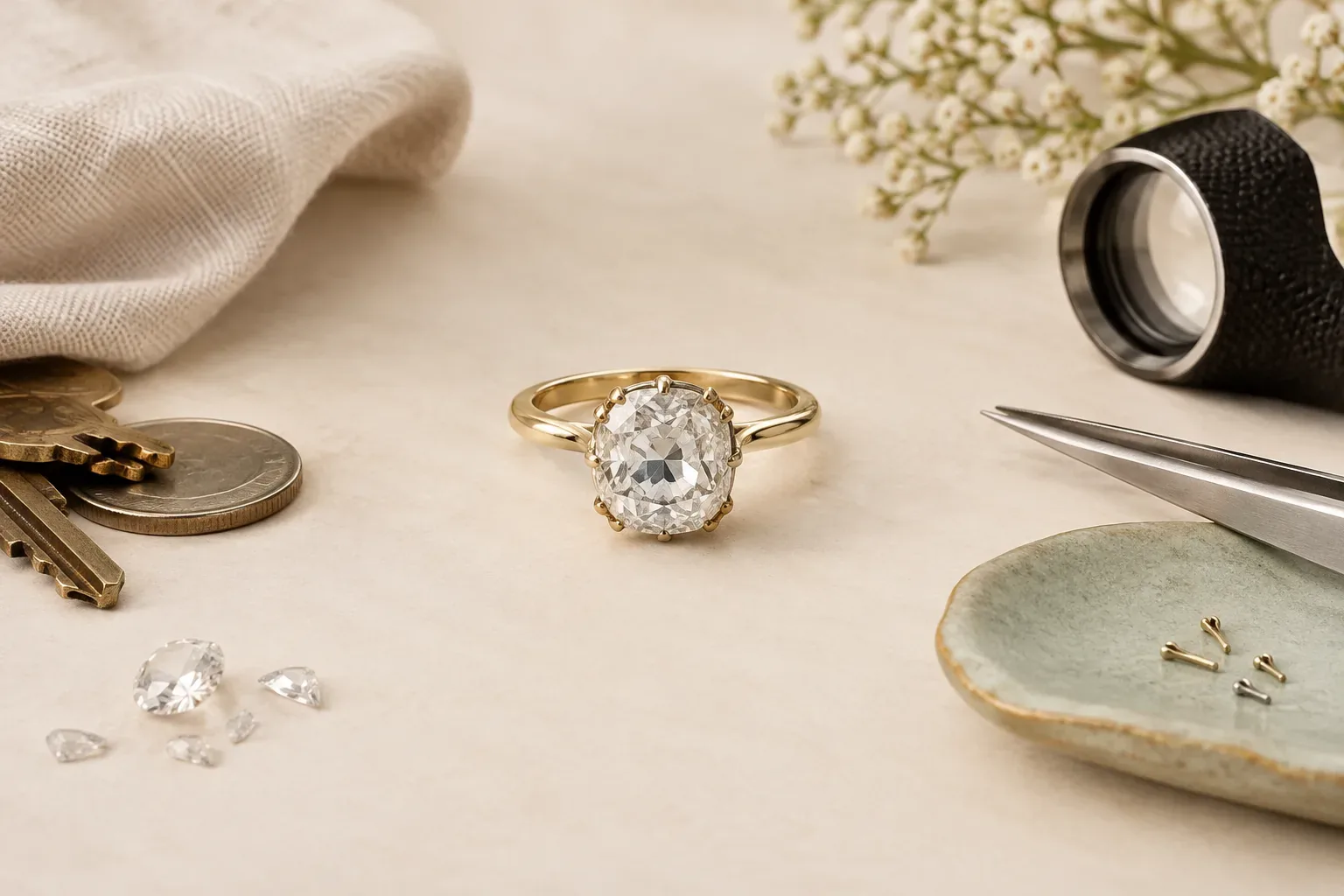
In practice you will encounter old mine cuts as center stones in antique and vintage engagement rings and in contemporary rings made to look antique. Jewelers and sellers often describe them by their visible character—higher crowns, smaller tables, chunkier facets, and sometimes a visible culet—features that affect both appearance and mechanical behaviour under impact. When set in period mountings, these diamonds are sometimes placed in settings that reflect older construction methods. Modern jewelers may re-mount old mine cut stones into contemporary low‑profile or bezel settings to improve daily wearability.
The trade context for engagement rings is relevant here. Imaginaire Digital’s recent search analysis shows ongoing high consumer demand for many engagement styles, and Jewelers Mutual reports consumer interest in craftsmanship and versatile design. Those marketplace forces mean sellers commonly offer a mix of untouched antiques and professionally reconditioned pieces, so you should confirm whether the setting is original or has been reinforced before assuming a ring is ready for daily wear.
Common mechanical risks: snagging, prong wear, and chip risk
Snagging happens when the mount or the stone’s edge contacts textiles and catches. Older prong styles or settings with raised galleries are more likely to catch. Prong wear and thinning shanks are the most common repair risks on antique rings: repeated use and previous repairs can introduce stress points where the metal will fail. An old mine cut’s facet arrangement does not make a diamond intrinsically fragile the way some softer gems are, but chips and iridescent fractures remain possible if an edge takes a direct blow—especially on girdles or culets that were left large in some antique cuts.
Routine inspection of prongs, galleries and the shank can greatly reduce the risk of loss. Jewelers Mutual emphasises craftsmanship and maintenance in its consumer guidance; buyers who plan heavy daily wear should factor periodic professional checks into ownership costs.
Safe care guidance and maintenance best practices
Before you wear an antique ring every day, have a qualified jeweler perform a safety check. Ask the jeweler to assess prongs, solder joints, the shank’s thickness, and whether any previous repairs were done with modern alloys. If you want lower snag risk, consider remounting the old mine cut into a protective setting such as a low-profile bezel or a halo with secure prongs, understanding that any re-mounting can affect provenance and value.
Follow industry guidance about gemstone treatments and special care. The Gemological Institute of America notes that treatments, disclosures, detectability and special care are important for consumers. Clean the ring gently with a soft brush and mild soapy water, avoid ultrasonic cleaners unless a professional confirms they are safe for that particular piece, remove the ring during heavy manual tasks and when using harsh chemicals, and have the piece professionally inspected annually or more often if you sleep, exercise, or shower with it on.
Selection and gifting guidance: practical, respectful steps
If you are buying or gifting an old mine cut engagement ring, start by asking the seller for written disclosures. The Federal Trade Commission requires clear distinctions among natural, lab-created, treated, cultured and imitation materials and written seller disclosures; insist on documentation showing whether the diamond and setting have been treated, recut, or otherwise altered. If provenance is important to you, request any available invoices, auction records, or appraisals.
Consider the recipient’s lifestyle when choosing a setting. For someone who does heavy manual work or values a very low maintenance ring, a modern protective mounting may be a better choice than a historically original setting. If authenticity matters more than convenience, be honest about the trade-offs and agree on a plan for conservation and repair. Finally, factor in insurance and appraisal: Jewelers Mutual and professional insurer guidance make clear that some vintage pieces require specialist valuation for coverage and replacement cost estimates.
Repair risks and restoration choices
Repair risks fall into two buckets: those that arise from wear (thinning prongs, loose stones, solder fatigue) and those introduced by restoration (loss of original metal, incorrect solder, or over-polishing that erases maker’s marks). Skilled conservational repair aims to stabilise the piece while preserving as much original material as possible; full restoration that changes the mounting or re-cuts the stone affects historical integrity and resale expectations.
Decide in advance whether your priority is wearable reliability or historical authenticity. If you prioritise daily durability, a conservational re-mount with documentation of the change is a reasonable compromise. If authenticity is the priority, accept higher maintenance and insure accordingly. For both paths, rely on qualified professionals and ask for before-and-after documentation of any intervention.
What you cannot verify without specialists
Several important questions cannot be definitively answered by inspection alone. Whether a diamond was treated or whether a stone is natural or lab-grown may require gemological testing; the Gemological Institute of America points to the role of laboratory testing and disclosure in resolving these questions. Exact manufacturing date, original maker, and certain aspects of provenance often require documentary evidence or hallmark analysis by an expert. Finally, accurate, written valuation for insurance typically requires an accredited appraiser or insurer’s representative.
Decision checklist for buyers who want daily wear
Before committing to daily wear with an old mine cut engagement ring, ask for written disclosure of material and treatment history, request a safety inspection from a qualified jeweler, verify or obtain an up-to-date appraisal for insurance, and consider a protective mounting if the current setting is raised or fragile. Treat conservation work as an expected cost of ownership if you favour originality, and expect to schedule periodic maintenance checks. Marketplace demand for varied engagement styles continues—Imaginaire Digital and Jewelers Mutual show consumers balancing authenticity and versatility—so both untouched antiques and professionally reconditioned pieces are commonly available.
Final considerations
An old mine cut engagement ring can be a durable, beautiful daily companion if chosen with knowledge and cared for deliberately. The key is not to assume the piece is 'ready' simply because it looks intact. Rely on documented disclosures, professional inspections, and a clear plan for maintenance, and be realistic about what you can verify without laboratory or archival intervention.
Frequently asked questions
Is an old mine cut diamond more likely to chip than a modern brilliant?
Not categorically. Diamond hardness is the same, but older cuts can present larger culets or different facet junctions that, if struck, may chip at vulnerable edges; a professional inspection will better assess chipping risk than visual inspection alone.
Can I remount an old mine cut stone to reduce snagging?
Yes, remounting into a protective or low-profile setting reduces snag risk, but it can change the ring’s originality and provenance; ask for documentation of the change and use a qualified jeweler.
How often should I have an antique engagement ring checked?
Have a qualified jeweler inspect prongs, shank and solder joints at least once a year and after any hard impact; more frequent checks make sense for daily wear or if you notice looseness.
Can a jeweler tell if an old mine cut diamond is treated or lab-grown?
A qualified jeweler can suggest tests, but definitive answers often require gemological laboratory analysis; the Gemological Institute of America emphasises lab testing for treatment and origin issues.
Do I need special insurance for a vintage engagement ring?
Yes—because vintage pieces may have special replacement or conservation needs, get an up-to-date professional appraisal and speak with your insurer about coverage options; Jewelers Mutual and other professionals recommend specialist valuation for vintage jewelry.
Sources and further reading
- Imaginaire Digital — Imaginaire Digital
- Jewelers Mutual — Jewelers Mutual
- Gemological Institute of America — Gemological Institute of America
- Federal Trade Commission — Federal Trade Commission