Meaning at a glance
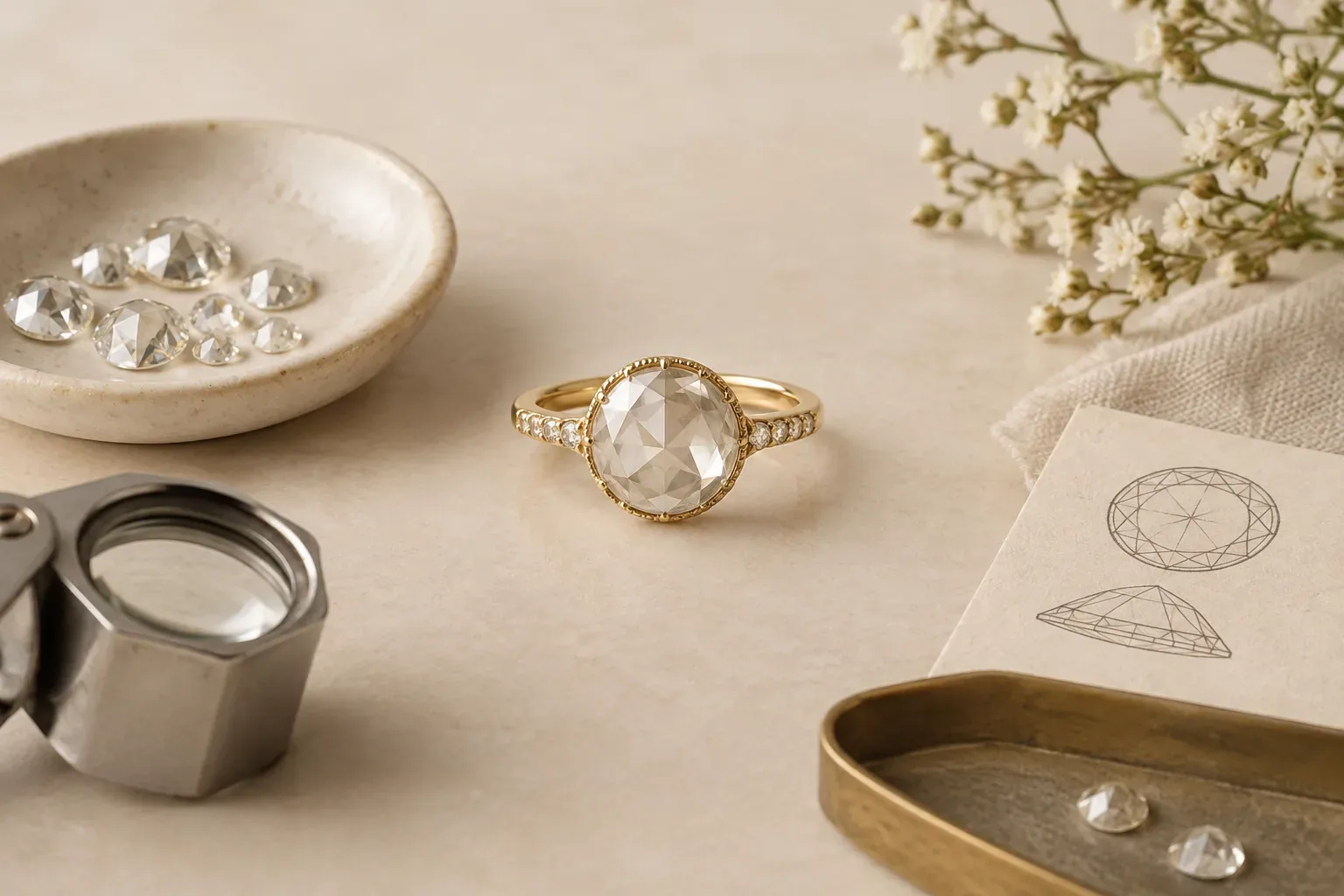
A rose cut engagement ring is an antique-style choice characterized by a flat back and faceted dome; choose it for vintage look, lower-profile wear, or perceived face-up size, but expect different sparkle, specialist care, and limits on what you can verify without a jeweler or gem lab. This guide gives clear decision criteria, practical trade-offs, care advice, and what to request from sellers.
Quick, direct answer
A rose cut engagement ring is a valid, design-forward choice for buyers who prioritize period style, a low-profile setting, and the soft, old-world brilliance of a domed faceted stone. This buying guide explains what the cut is, how it behaves in jewelry, the trade-offs you accept (brightness vs. vintage appeal), sensible questions to ask sellers, safe care, and the clear verification limits that require a qualified jeweler or gemological laboratory—so you can make a confident purchase.
What a rose cut is (definition and observable features)
The rose cut is defined by a flat or nearly flat pavilion (back) and a domed crown made of triangular or kite-shaped facets that meet at a central point, producing a petal-like pattern when seen from above. The visual effect is softer, lower in scintillation (flashy sparkle), and often shows larger apparent surface area for a given carat weight compared with modern brilliant cuts.
You can verify the basic cut features yourself by looking for a flat back and a domed crown with facet lines that converge toward a point. Exact facet counts and angles vary because rose cuts were historically hand-faceted and modern makers repeat or reinterpret the motif.
Historical evidence and how to verify period or cultural attribution
Rose cut stones appear in antique and antique-style jewelry; museums, auction catalogs, and specialist dealers commonly identify pieces as having rose cuts. However, precise period or cultural attribution requires more than a visual check: reliable evidence comes from provenance records, maker’s marks, hallmarks on the metal, archival catalogs, or laboratory reports that document when a stone was cut or a setting was made.
This guide does not attempt to supply primary historical dating. If you need an exact culture or manufacturing period for a purported antique rose cut, ask the seller for provenance documentation and consider an independent evaluation by a qualified appraiser or a museum jewelry specialist. For modern market demand context, industry reports show strong interest in both vintage and gender-neutral engagement styles (see Jewelers Mutual and Imaginaire Digital in the sources).
Documented historical meanings versus modern personal interpretations
Documented historical meanings for specific cuts are rarely definitive because gemstone cuts are technical and were often driven by available cutting tools and fashion rather than singular symbolic intent. When historical meanings are claimed for the rose cut, those claims typically come from jewelry historians and dealers referencing the piece’s age, provenance, or the symbolic fashions of a particular period; such claims should be supported by provenance or specialist citation.
By contrast, modern personal interpretations—such as viewing the rose cut as an emblem of romanticism, nostalgia, or ‘authenticity’—are contemporary meanings buyers assign today. These personal meanings are valid for gifting and personal expression but are not historical facts unless documented by period sources or cited scholarship.
How the rose cut motif appears in jewelry today
Designers and vintage dealers use the rose cut primarily with diamonds but also with colored gemstones. You will commonly see rose-cut stones set in closed-back or low-profile open-back settings to show the cut’s dome and table. Settings that protect the delicate pavilion—such as bezels, closed-back gold cups, or low-prong mounts—are frequent because many rose-cut stones are older or cut from thinner material.
The rose cut is also used in rings paired with halos, side stones, or mixed-cut clusters to balance its lower scintillation. Contemporary makers often reinterpret the motif with modern facet symmetry, while reproductions that mimic antique cutting will intentionally retain irregularities for an old-world look.
Pros and cons (practical trade-offs)
Pros: Rose-cut stones often appear larger face-up for their carat weight because of the broad table; they sit low and comfortably in rings, reducing snagging; their soft, glimmering look suits vintage, bohemian, or gender-neutral styles; and lower apparent carat weight can save budget while maintaining presence.
Cons: Rose cuts show less brilliance and fire than modern brilliant or ideal cuts, so they will not sparkle as much in direct light. Older rose-cut stones may have surface wear, nicks, or internal inclusions visible through the broad table. Because many rose cuts are closed back or mounted in protective settings, color can look different than under laboratory lighting. Some buyers may find the look too subdued if they expect modern diamond brilliance.
Who a rose cut engagement ring suits
A rose cut engagement ring suits someone who values vintage aesthetics, understated elegance, comfort (low profile), and a stone that reads larger than its carat alone. It is also a good match for buyers who prioritize craftsmanship and uniqueness over maximum brilliance.
It is less suitable for buyers who expect the high, scintillating sparkle of modern brilliant cuts, or who want a stone whose optical performance is easily compared by the standardized metrics used in modern grading reports.
How to select and gift a rose cut engagement ring—practical and respectful guidance
Ask the seller for clear photos from multiple angles (table, crown, profile, and back) and for any provenance documents if the piece is advertised as antique. Request written disclosures for whether the stone is natural, lab-grown, treated, or an imitation; the Federal Trade Commission requires clear distinctions among these categories, so reputable sellers will provide them.
If the ring is vintage or antique, ask about repairs, replaced mounts, and whether the setting has been altered. Consider the wearer’s lifestyle: choose a brushed or bezel setting for active wearers to minimize catching, and prefer lower-set mounts if the wearer uses their hands a lot.
When gifting, respect the recipient’s style and comfort: consider a temporary sizing option or a gift receipt that allows return or resizing. If symbolic meaning is important, explain whether the ring was chosen for historical connection, aesthetic preference, or a modern personal meaning you assign.
Care, treatments, and what only a qualified jeweler or lab can verify
Care: because rose cuts often have large tables and may be older, protect the ring from hard knocks, avoid exposure to household chemicals, and remove it for vigorous activity. For cleaning, choose gentle soap and a soft brush and avoid ultrasonic cleaners if the stone shows cracks or if it is set in a closed-back mount where trapped debris could cause damage.
Treatments and disclosures: ask the seller to disclose treatments and whether the stone is natural or lab-grown. The Gemological Institute of America emphasizes that treatments, detectability, and durability affect consumer questions and care needs. Some treatments can change how you clean or wear a stone, and some require laboratory testing to detect definitively.
Verification limits: without a qualified jeweler’s inspection or a laboratory report you cannot reliably verify origin, hidden treatments, or whether a stone is antique or a modern reproduction. Request a gemological report if accurate grading information—or confirmation of natural vs. treated vs. lab-grown status—is material to your decision. For legal and consumer-protection practices, the Federal Trade Commission recommends obtaining written seller disclosures about the stone’s nature.
A short decision checklist before you buy
Confirm whether the stone is natural, lab-grown, or treated and ask for written disclosure. Request clear photos and provenance if the piece is claimed as antique. Consider the wearer’s style and daily activities when choosing setting type and profile. Ask about repairs or replaced parts for vintage pieces and whether resizing is possible. Finally, if you require independent confirmation of any claim (antiquity, treatment, grade), obtain a report from a qualified jeweler or gemological laboratory.
Frequently asked questions
Will a rose cut sparkle as much as a modern brilliant cut?
No. Rose cuts have a different optical character: they emphasize broad, old-world glimmer over the strong scintillation and dispersion of modern brilliant cuts. If maximum sparkle is your priority, a modern brilliant cut is more suitable.
Can I clean a rose cut engagement ring in an ultrasonic cleaner?
Avoid ultrasonic cleaning if the stone is antique, shows surface wear, or has visible cracks; ultrasonic cleaners can worsen damage. For most rose-cut jewelry, gentle soap, water and a soft brush are safer. If in doubt, ask a qualified jeweler.
How can I verify that a rose-cut stone is antique?
Visual inspection alone is insufficient to confirm age. Ask for provenance, maker’s marks, hallmarks, documentation from the seller, and consider an independent appraisal or a lab report to corroborate claims about antiquity.
Should I request a lab report for a rose cut diamond?
Yes if the stone’s origin, treatments, or grade materially affect your decision. A reputable gemological laboratory can detect treatments and confirm whether a diamond is natural or lab-grown—information not reliably determined without testing.
Are rose cuts cheaper than modern cuts?
Often they can be less expensive on a per-carat basis because they trade brilliance for antique character and because many are smaller carat weights. Market pricing varies with rarity, cut quality, color, clarity, and whether the piece is truly antique or a modern reproduction.
Sources and further reading
- Imaginaire Digital — Imaginaire Digital
- Jewelers Mutual — Jewelers Mutual
- Gemological Institute of America — Gemological Institute of America
- Federal Trade Commission — Federal Trade Commission