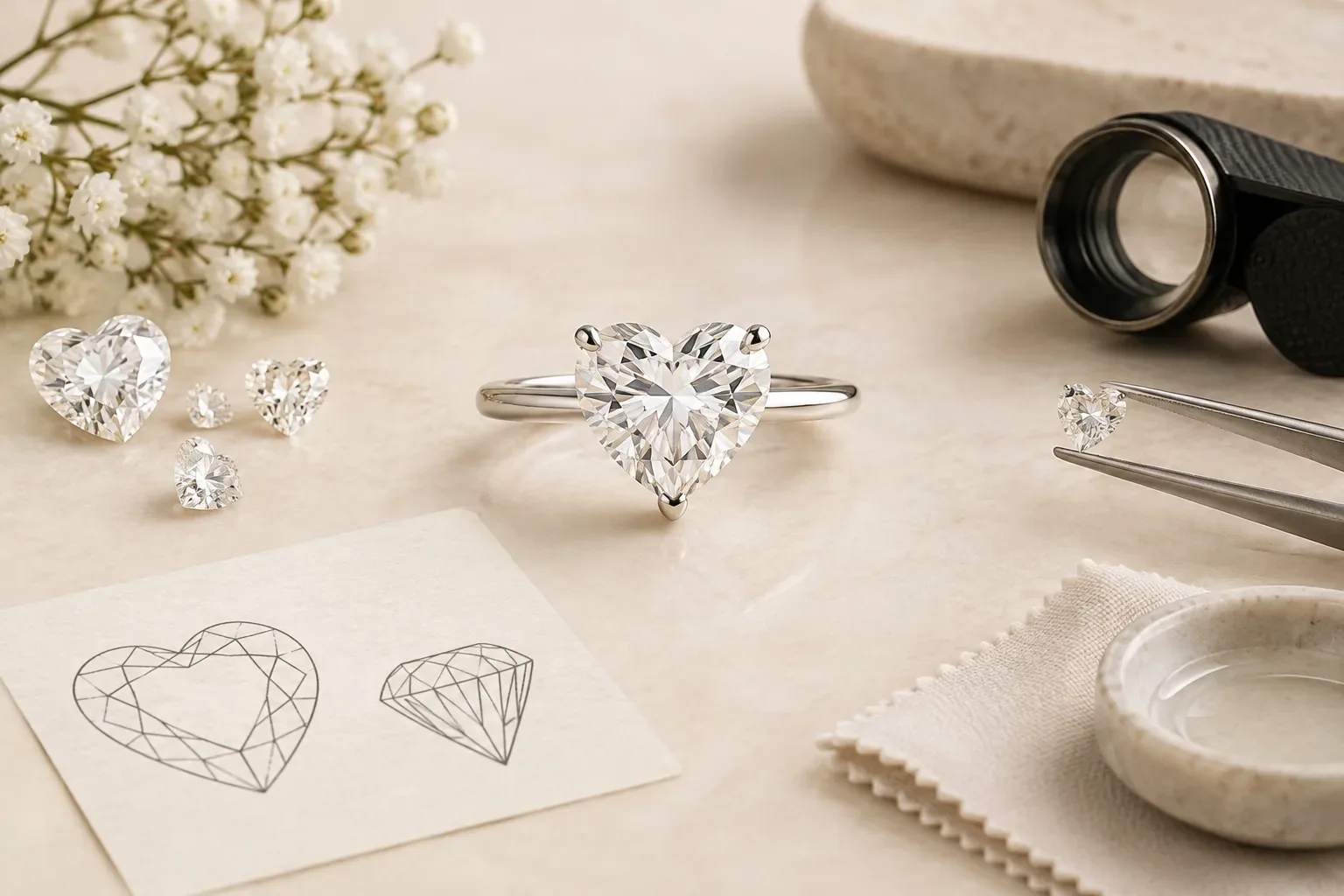
Meaning at a glance
A heart cut engagement ring suits someone who values a literal heart silhouette and a distinctive, romantic look, but buyers should weigh symmetry, protective settings and verification limits; use this guide to compare trade-offs, learn safe care, and know what requires a qualified jeweler or a gemological laboratory.
Quick answer
Short answer: A heart cut engagement ring is a very literal, romantic silhouette that works well for someone who wants a distinct, recognizable heart shape and is comfortable with the shape's demands on symmetry, protection and sometimes higher cost per apparent size. Before buying, focus on symmetry, choose a setting that shields the cleft and the point, and insist on clear written disclosure of origin and treatments. Expect some things you can check yourself—measurements, visible symmetry, and written certificates—and other things you cannot verify without a qualified jeweler or a gemological laboratory.
Historical evidence: what the approved sources show (and what they do not)
The sources approved for this guide do not provide a documented historical timeline or specific cultural attributions for the heart-shaped gemstone cut as an engagement token. That means, based on the approved evidence, we cannot attribute the heart cut to a particular culture, workshop, or historical period with precision.
Because the approved sources focus on contemporary market trends, consumer protections and gem treatment disclosure rather than jewelry iconography history, readers who need a detailed provenance of the heart motif in different cultures should consult specialized jewelry history scholarship or museum catalogues. This article therefore keeps historical claims separate from modern marketplace facts and consumer guidance.
Documented meanings versus modern personal interpretations
Documented meanings in the approved sources center on how consumers use and search for jewelry today, not on long-standing symbolic claims about the heart motif. Recent market analyses and trend reports emphasize what buyers are choosing now rather than historic symbolic attributions.
Modern personal interpretations are common: many wearers and givers choose a heart cut because it reads explicitly as an emblem of love or affection to them. These contemporary meanings vary by individual and community and are personal rather than universal. Treat the heart shape as a meaningful personal or cultural choice rather than a historically fixed signifier unless you have specific historical documentation from recognized scholarship.
How the heart motif and heart-shaped stones appear in jewelry today
In modern jewellery, a heart motif appears in several ways: as a true heart-shaped faceted cut (the 'heart cut'), as carved heart motifs on metalwork, or as heart-shaped settings and bezels that frame round or oval stones. The heart cut is a modified brilliant-style cut with a lobed top, a cleft in the middle, and a pointed base; its visual success depends heavily on precise symmetry and proportion.
Designers also use hearts as pendants, accent stones, and halo outlines. Current market trends emphasize fluid forms and versatility in styling, meaning manufacturers may combine a heart silhouette with contemporary settings or with colored gemstones to fit wearable, gender-neutral, or stackable styles, as noted in current trend reporting.
Pros of choosing a heart cut engagement ring
The heart cut delivers a highly recognizable, sentimental silhouette that reads quickly as a symbol of love; for many buyers this direct symbolism is the main attraction. When expertly cut, it can still produce strong brilliance and a distinct face-up appearance that stands out from more common rounds or ovals.
Because heart cuts are less common than rounds or ovals, they can feel unique or bespoke. They also pair well with certain settings—such as halo or bezel styles—that can amplify perceived size or frame the shape while contributing visual balance.
Cons and practical trade-offs
The heart cut demands excellent symmetry and proportion. Small asymmetries in the lobes or an off-center cleft are much easier to notice than with more forgiving shapes. Buyers trading on appearance should inspect the stone in person or request high-quality images and measurements.
The pointed base and the cleft at the top create vulnerable spots. The point can chip if left exposed; the cleft may be prone to abrasion. Settings that leave the point or cleft unprotected increase the risk of damage. Heart cuts can also show less predictable light performance than round brilliants, and they tend to require greater carat weight to achieve the same face-up visual size as some other shapes.
Because the heart is a specialty cut, price per carat can be higher relative to the visual size offered, and comparing prices requires careful attention to measurements and quality rather than carat weight alone.
How to evaluate a heart cut: decision criteria
Start with symmetry: view the stone from the face (table) and examine lobe balance, cleft alignment and the evenness of the pointed base. Ask the seller for exact measurements and, when available, ideal-proportion notes from the cutter. Viewability in images and in person is crucial because tiny asymmetries read quickly.
Consider the setting early in the decision. A protective v-prong at the point, a bezel or partial bezel, and a halo or raised gallery can protect vulnerable areas and balance the design visually. Think about everyday wear: active lifestyles usually need more protective settings.
Decide on material and budget trade-offs. Colored gemstones and lab-grown diamonds are increasingly popular; current trade reporting notes a growing interest in colored stones and gender-neutral styling. The cost and durability differences among diamond, lab-grown diamond, moissanite and traditional colored gems should influence material choice.
What you can verify without a gemological laboratory (and what you cannot)
As a shopper, you can check several things yourself: confirm the stone's measurements (length, width, depth), evaluate visible symmetry and finish from good images or in-person inspection, confirm the setting type and its protective features, and obtain written documentation from the seller about the stone's origin and any disclosed treatments.
You cannot reliably detect many treatments, differentiations between natural and some lab-created stones, or subtle durability-affecting enhancements without a qualified jeweler's equipment or a gemological laboratory report. Federal Trade Commission guidance requires sellers to provide written disclosures about whether a stone is natural, lab-created, treated or imitation, but independent laboratory testing is the only way to fully verify those claims. For durability and treatment notes that affect care, refer to gemological guidance on treatments and detectability.
Care, maintenance and safe handling
Treatments and special-care requirements vary by material. The Gemological Institute of America (GIA) explains that many gemstones undergo treatments and that detectability, durability and care needs differ by treatment. Follow the GIA's guidance on cleaning and avoid ultrasonic or steam cleaning for stones or treatments that the laboratory advises against.
Routine inspection is important. Have prongs and protective elements checked by a qualified jeweler at least once a year, or more frequently if the ring is worn daily. For highly sentimental or high-value pieces, consider professional insurance and documented appraisals; current industry trend reporting highlights increased attention to craftsmanship and protection in modern buying decisions.
Practical and respectful selection or gifting guidance
Begin by considering the wearer’s aesthetic: do they prefer literal symbols, minimalist silhouettes, or something more subtle? A heart cut reads as an explicit symbol and may not fit someone who dislikes overt motifs. If you want a surprise, look for clues in their existing jewelry or consult close friends or family to confirm preferences.
Respect cultural and individual differences. A heart may mean different things to different people; do not assume it conveys the same sentiment across cultures or individuals. When in doubt, choose a design or setting that allows future modification—a removable halo or a design that can be re-set—so the wearer can adapt the piece later.
Ask for written disclosures and certification when buying. The Federal Trade Commission requires clear seller disclosure of whether a gem is natural, lab-created, treated, cultured or imitation. If a seller cannot provide clear written information, pause the purchase until you have satisfactory documentation.
Bottom line
A heart cut engagement ring is an intentional stylistic choice that signals a literal heart motif and stands out within current market tastes for distinctive, versatile pieces. Use the decision criteria above to balance visual priority, protection and budget, and rely on qualified jewelers and gemological laboratories when you need definitive verification of origin or treatment. Treat modern personal meanings as personal choices and seek specialist historical sources if you need authoritative cultural or period attributions.
Frequently asked questions
Are heart-cut diamonds less sparkly than round brilliants?
Heart cuts can be brilliant and lively when well cut, but they are generally less forgiving than round brilliants. The heart’s lobes, cleft and point require exact symmetry; small deviations are more noticeable and can affect light performance. Inspect face-up images or the stone in person and request measurements to evaluate sparkle.
How should a heart cut ring be set to reduce risk of damage?
Choose settings that protect the pointed base (for example, a v-prong, bezel, or halo) and consider reinforced prongs around the lobes and cleft. Regularly inspect prongs and have a qualified jeweler check the setting at least annually. Protective settings both reduce risk and help maintain resale value.
Can lab-grown diamonds and other simulated stones be heart-cut?
Yes. Lab-grown diamonds, moissanite and some other simulants are available in heart cuts. The Federal Trade Commission requires sellers to disclose whether a stone is natural, lab-created, treated or an imitation, so always seek written disclosure. Independent laboratory reports are the most reliable way to verify origin and treatment.
What should I look for on a certificate for a heart-cut stone?
Look for clear statements about origin (natural or lab-grown), any treatments, measurements (length, width, depth), weight, and grading details if the laboratory provides them. Certificates do not replace a physical inspection for symmetry and setting quality, and some treatments require specialist testing to detect.
Do heart-cut rings hold resale value as well as other cuts?
Resale value depends on demand, quality, material and market conditions rather than shape alone. Heart cuts are less common, which can make them sought-after by some buyers and niche for others. If long-term value is a concern, prioritize documented origin, quality cutting, and durable settings.
Sources and further reading
- Imaginaire Digital — Imaginaire Digital
- Jewelers Mutual — Jewelers Mutual
- Gemological Institute of America — Gemological Institute of America
- Federal Trade Commission — Federal Trade Commission