Meaning at a glance
This checklist defines the emerald cut and its practical trade-offs, lists the questions to ask about cut, clarity, color, treatments, origin and paperwork, offers care and setting guidance, and clarifies which claims require a qualified jeweler or a gemological laboratory to verify.
Quick answer
Answer thesis: Use an evidence-led approach that defines the emerald cut and the practical decision criteria you care about, balances common trade-offs (appearance versus durability and cost), follows safe care guidance, and recognizes clear limits on what a consumer can verify without a qualified jeweler or an accredited gemological laboratory.
What we mean by "emerald cut" and why definitions matter
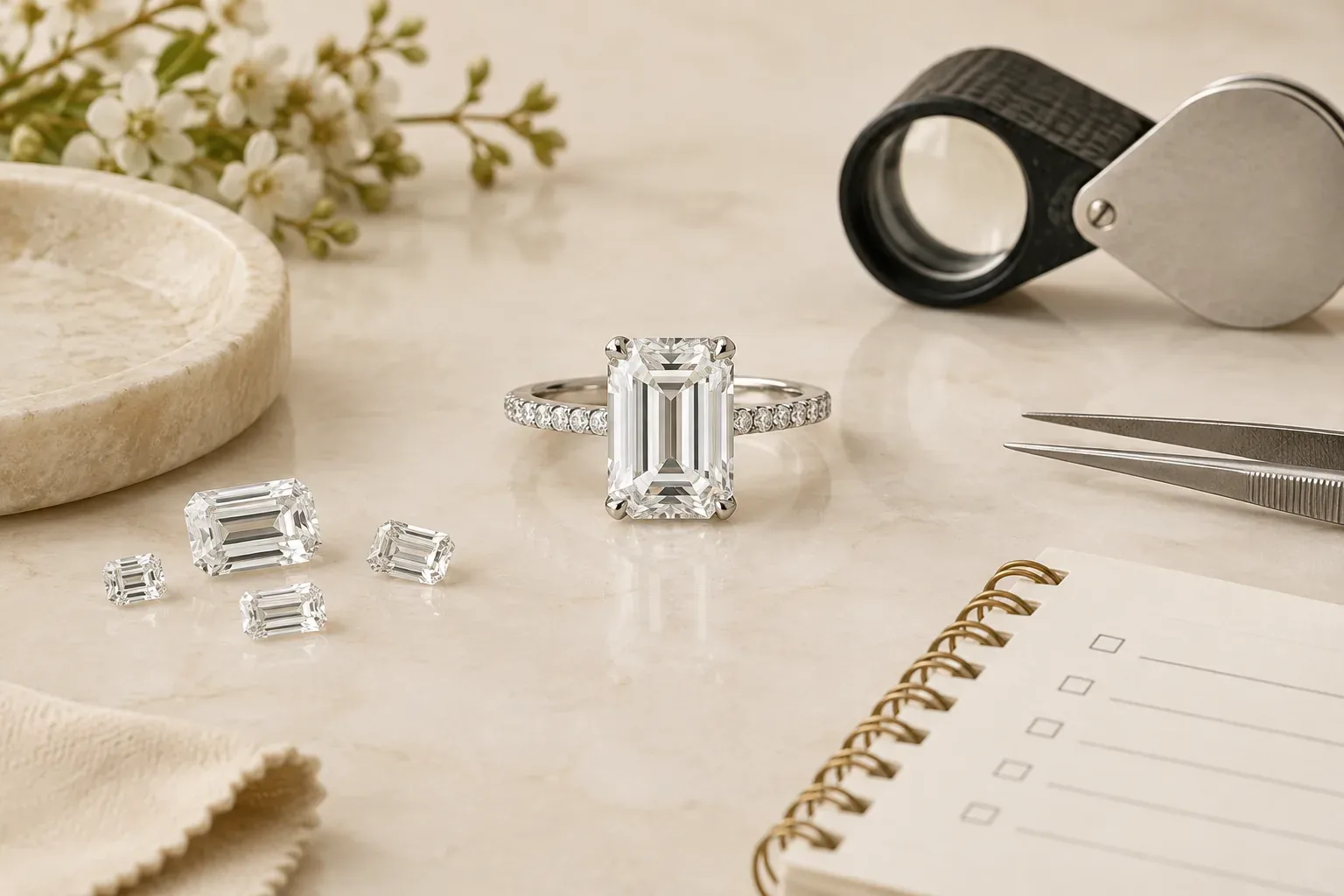
When shoppers say "emerald cut" they are usually referring to a rectangular step-cut with trimmed corners and long, flat facets that emphasize clarity and a hall-of-mirrors look rather than the brilliant sparkle of a brilliant cut. Defining the cut you want is the starting point for every question that follows: different cuts show color and inclusions differently, fit different settings and finger shapes differently, and carry different trade-offs in price and perceived size.
Historical evidence and cultural context
Available professional and industry sources consulted for this checklist do not provide extensive documentary evidence tying the "emerald cut" to a single historical meaning or to distinct symbolic uses across named cultures. Modern consumer interest in particular ring shapes and gemstones is, however, well documented in trade analysis and professional trend reports. For example, a recent U.K. search analysis notes strong ongoing demand for engagement-related styles (Imaginaire Digital), and a professional insurer and trade resource reports 2026 trends that emphasize fluid forms, colored gemstones, craftsmanship and versatility (Jewelers Mutual). These sources describe consumer behavior and market trends rather than historic symbolic uses tied to a particular culture or period.
Documented history versus modern personal interpretation
Because the approved industry and consumer-protection sources do not record a clear, historically documented symbolic meaning for the emerald cut tied to a specific culture or era, any symbolic meaning attached to an emerald cut engagement ring today should be treated as a modern, personal interpretation rather than an established historical fact. Shoppers may choose the emerald cut for its clean geometry, vintage resonance, or perceived elegance; these are personal or stylistic reasons, not universally documented historical meanings in the sources used here.
When you gift or select an emerald cut, explain what the ring means to you and the recipient, and avoid asserting that a single "universal" symbolism has a specific cultural pedigree unless you can cite reliable historical research beyond the industry and trend reports referenced in this checklist.
How the emerald cut appears in jewellery
The emerald cut appears across engagement rings in a variety of settings: solitaire rings that show the stone's step facets, three-stone rings where side stones complement the long profile, halo settings that add visual brilliance around the step-cut center, and modern designs that pair an emerald-cut center with mixed metals or geometric bands. Jewelers and designers often use the emerald cut to emphasize optical clarity and an understated, linear aesthetic rather than maximal sparkle (Jewelers Mutual).
Because its broad facets reflect light differently than brilliant cuts, an emerald-cut center is frequently chosen to showcase gemstone color and internal characteristics. That makes the choice of clarity grade and color grade particularly consequential for emerald-cut stones.
Questions to ask: the shopper's emerald cut engagement ring checklist
Cut and proportions: Ask for details about the cut and the stone's proportions or an image from multiple angles. The way the stone is cut affects how it reflects light, how color shows, and how inclusions appear. Request close-up photos or videos if buying online, and ask whether the seller provides a proportion diagram or a grading lab report when relevant.
Clarity and color: For step-cut stones, ask specifically how visible inclusions and color are at the size you want. Step facets make internal features more noticeable, so many shoppers prefer higher clarity and color to keep the stone looking clean and bright under normal wear.
Carat and perceived size: Ask how the stone's dimensions translate to a perceived size on the finger. Rectangular step cuts can appear larger or longer compared with round stones of the same carat weight, so ask for actual millimeter dimensions in addition to carat weight.
Treatments and origin: Ask whether the gemstone is natural, treated, lab-created, or an imitation. The Federal Trade Commission requires clear disclosure about treated and lab-created gemstones; insist on written disclosure and read it carefully (Federal Trade Commission).
Certification and grading reports: Ask whether the stone comes with a report from an accredited gemological laboratory, and if so, which lab. A report from a recognized lab will state treatments, confirm identity, and document quality attributes; however, only a gemological laboratory can produce independent documentation of origin and certain treatments (Gemological Institute of America).
Setting, metal, and security: Ask about the recommended setting to protect the stone's corners and to suit the recipient's lifestyle. Discuss prong type, bezel options, and whether additional protective details are available for active wearers. Also ask about the metal type and any karat or alloy disclosures.
Return policy, warranty, and service: Ask about return windows, resizing policies, routine maintenance like prong tightening and stone checks, and any warranty coverage. Jewelers Mutual highlights craftsmanship and aftercare as part of what often matters most to modern buyers.
Price drivers and trade-offs: Ask the seller to explain how they priced the ring. For emerald cuts, clarity and color often drive price more than for brilliant cuts because the step facets reveal inclusions and color more readily. Ask the seller to show trade-offs by comparing stones at different clarity and color levels so you can decide what matters most to you.
Sourcing and ethical questions: If origin and ethical sourcing matter to you, ask how the seller documents supply-chain claims and whether they provide supporting certifications or supplier statements. The FTC guidance on disclosures encourages sellers to be specific and written about material origins and treatments.
Practical and respectful guidance for selecting or gifting
Start by figuring out what the recipient values: visual style, durability, sustainability, or a particular budget. Ask sensitive questions about daily activities and preferred jewelry styles rather than assuming. If the ring is a surprise, consult close friends or family who understand the recipient's taste.
Prioritize what you cannot easily change. For example, size can often be adjusted, but the stone's clarity and color are fixed. If the recipient values low-maintenance jewelry, choose a protective setting and a durable metal that resists scratches and wear.
When discussing price and trade-offs with a seller, be explicit about your priorities and ask them to show comparable options that illustrate those trade-offs. Respectfully request written disclosures about treatments, lab reports, return policies, and any guarantees so you have a record of what was promised at purchase.
If you intend to propose with the ring present, consider the possibility of resizing or minor adjustments after the proposal. Ask the seller about typical resizing costs and whether those costs are included or separate from the purchase price.
Care guidance and durability considerations
Emerald-cut stones are not inherently less durable than other cuts in terms of the gem's hardiness, but the long, broad facets and trimmed corners mean chips or scratches may be more visible on the surface or along the edges. Protective settings, careful daily habits and routine inspections are practical precautions. Jewelers Mutual highlights the importance of craftsmanship and good settings for long-term wear.
Follow care guidance appropriate to the gemstone's identity and any treatments. The Gemological Institute of America explains that treatments can affect durability and care requirements; always follow the care instructions the seller or lab report provides. For routine cleaning, many shoppers safely use a mild soap and a soft brush, but avoid ultrasonic or steam cleaners if the stone or its treatment makes those methods unsafe; confirm the specific recommendations for your stone.
Have prongs and settings checked periodically by a qualified jeweler to prevent loss, and ask your seller about recommended maintenance intervals and any service plans they offer.
What you can and cannot verify without a qualified jeweler or gemological laboratory
You can visually inspect a stone, request high-resolution images and videos, compare millimetre dimensions and ask for written disclosures about treatment and origin. You can also confirm the seller's return policy, warranty and any available grading reports at the point of sale.
You cannot reliably verify claims about natural origin, certain treatments, or subtle enhancements without a qualified gemological laboratory report. The Gemological Institute of America explains that detectability and documentation of treatments vary and that independent laboratory testing is the standard for confirming many such claims. Likewise, the Federal Trade Commission requires sellers to disclose treatments and synthetic origins but a laboratory report is the consumer's best route to independent confirmation.
If authenticity, treatment status or country of origin is material to your purchase decision, insist on a current report from an accredited lab or have an independent appraisal performed by a qualified professional before finalizing the purchase.
Final steps before buying
Before you complete the purchase, review all written disclosures and make sure any oral promises are also included in writing. Confirm return, resizing and service policies in writing, get the grading report or lab documentation if available, and schedule an independent inspection or appraisal if you need laboratory-level verification.
Keep in mind market trends and style preferences reported by industry observers—demand for certain cuts and colored gemstones can change (Imaginaire Digital; Jewelers Mutual)—but choose the ring that fits the recipient's style and your priorities rather than following trends alone.
Frequently asked questions
Do I need a gemological lab report for an emerald cut engagement ring?
If questions of origin, treatment, or independent grading matter to you, obtain a report from an accredited gemological laboratory. A lab report is the standard way to confirm treatments or to document identity and quality attributes that a seller's sales materials cannot independently verify; the Gemological Institute of America explains that detectability and documentation of treatments vary and often require laboratory testing.
What should a seller disclose about treatments or lab-created stones?
The Federal Trade Commission requires clear, written disclosure about whether a stone is natural, lab-created, treated or an imitation. Ask the seller for explicit written statements and any supporting documentation before purchase.
Are emerald cut rings harder to maintain than other cuts?
Emerald cuts are not intrinsically less hard than the gemstone itself, but their broad flat facets and cropped corners can make surface marks or inclusions more visible. Protective settings and routine checks are practical precautions; discuss care and cleaning recommendations with your seller, and follow any lab guidance if the stone is treated (Gemological Institute of America; Jewelers Mutual).
What trade-offs should I expect with an emerald cut?
Common trade-offs include greater visibility of inclusions and color because of step facets, versus an elegant, linear look and perceived length on the finger. Clarity and color often become more important for step cuts, and prices reflect those priorities. Ask sellers to illustrate those trade-offs with comparable stones.
Can I verify a seller's claims myself when buying online?
You can verify written disclosures, request high-resolution photos and videos, confirm return and warranty policies, and ask for lab reports if available. However, only a qualified jeweler or an accredited gemological laboratory can reliably confirm certain claims about treatments or origin; the FTC recommends seeking written disclosures and laboratory documentation where material to the purchase.
What setting is best for protecting an emerald cut?
Many shoppers choose settings that protect the corners—such as well-placed prongs or partial bezels—especially if the wearer is active. Discuss the recipient's lifestyle with the seller and ask for recommendations for secure settings and long-term maintenance.
Sources and further reading
- Imaginaire Digital — Imaginaire Digital
- Jewelers Mutual — Jewelers Mutual
- Gemological Institute of America — Gemological Institute of America
- Federal Trade Commission — Federal Trade Commission