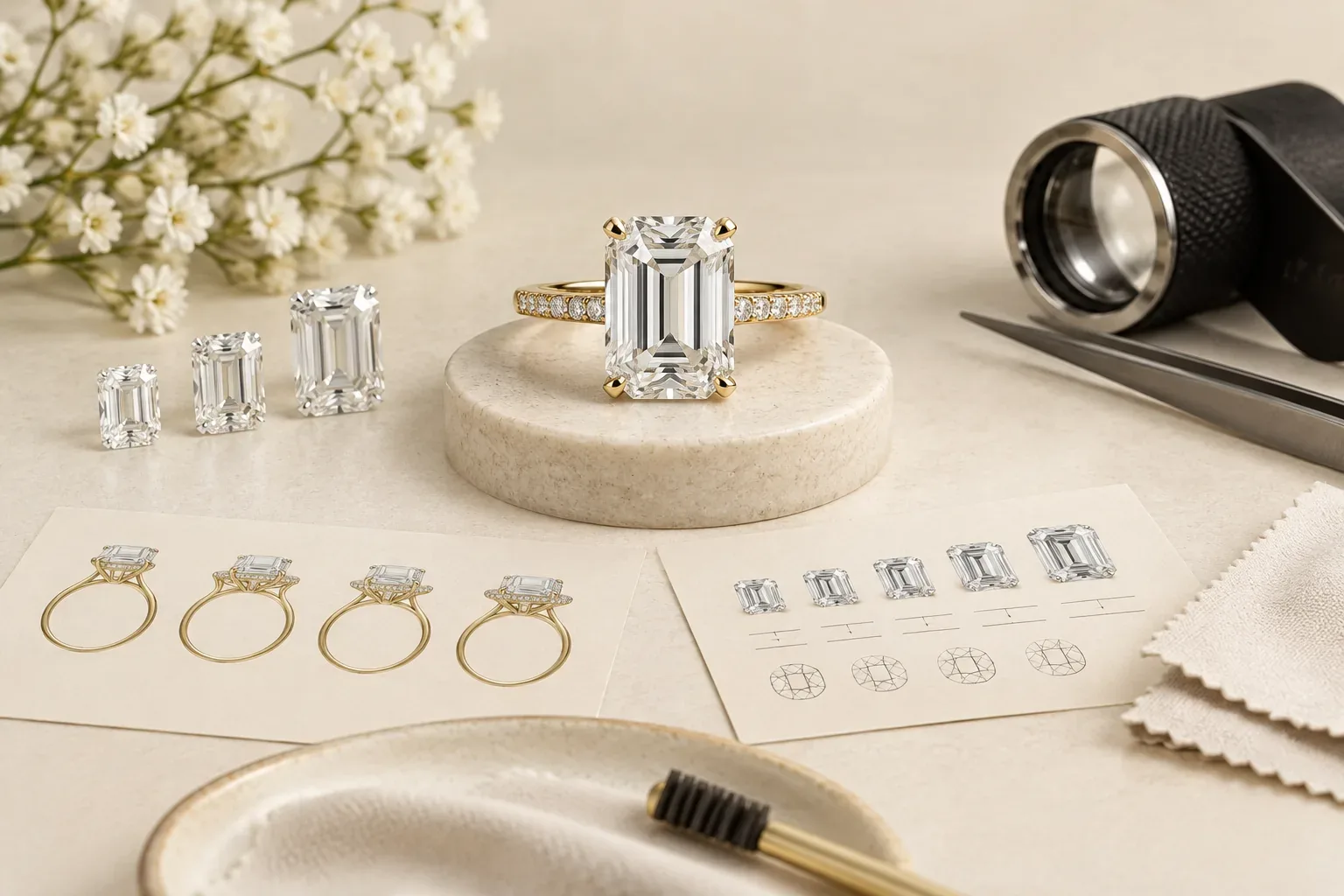
Meaning at a glance
Emerald cut engagement ring styling balances the stone’s rectangular, step-cut profile with setting choices and band proportions to control perceived finger coverage: long, narrow emerald cuts tend to elongate a finger while squarer proportions and wider settings increase lateral coverage; choose settings and band widths to match finger proportions and lifestyle, verify material and treatments with seller disclosure and, for certainty, a qualified jeweler or gem lab.
What the sources say about modern trends and consumer priorities
Recent industry reporting shows demand patterns that affect how people style engagement rings. Imaginaire Digital’s 2026 UK search analysis documents strong consumer interest in classic and modern engagement ring shapes, including engagement rings and oval cuts, which reflects broader investment in distinctive center stones and visible ring styling. Jewelers Mutual’s 2026 trends guidance highlights consumer preferences for fluid forms, modern stacking, colored gemstones, craftsmanship, versatility and gender-neutral styling—factors that influence choices such as slimmer bands for stackability or more substantial settings for stand-alone statement rings. Use these trend signals as context when choosing proportions: many buyers now value rings that work with other jewelry and everyday wear, not just single-appearance moments.
Historical evidence and what is documented
Among the approved sources there is no detailed historical record of a single, culturally universal symbolic meaning tied specifically to the emerald cut. The primary evidence provided in our source set concerns contemporary market trends, consumer expectations, and seller responsibilities rather than a century-by-century history of cut symbolism.
Because the supplied references do not document historical meanings for the emerald cut across distinct cultures or periods, any statement that attributes a specific symbolic role to the emerald cut in a named culture or era would exceed the evidence in those sources. In practice, historical meanings for cuts and shapes are often reconstructed from period jewelry surveys or museum catalogs; those resources were not part of the evidence set available for this guide.
Documented meanings versus modern personal interpretations
Documented meanings: Within the scope of our approved sources, what is documented are contemporary consumer priorities (craftsmanship, versatility, colored stones, stacking) and the regulatory expectation that sellers disclose treatments and material origins. The Gemological Institute of America explains how treatments and disclosures affect durability and care. The U.S. Federal Trade Commission emphasizes the need for clear distinctions among natural, lab-created, treated and imitation materials and for written seller disclosures.
Modern personal interpretations: Many wearers and designers ascribe stylistic or emotional meanings to an emerald cut—associations such as refinement, clarity or understated elegance are modern, personal, or brand-created interpretations rather than documented cultural meanings in the sources we used. These modern meanings are valid at the level of individual intent and gifting etiquette, but they are not universal and should be presented as personal symbolism rather than historical fact.
How the emerald cut appears in jewelry and how that affects perceived finger coverage
The emerald cut is a rectangular step-cut with broad facets and an open table; that geometry creates a distinct visual effect compared with brilliant cuts. In styling terms, that effect is central: the stone’s length and width relationship and the size of its table influence how much of the finger the ring appears to cover. A longer, narrower stone draws the eye lengthwise and can create an elongating appearance; a stone closer to square in proportion increases lateral visual coverage.
Setting choices alter perceived coverage. A halo of small stones around an emerald cut increases the apparent size and lateral spread of the ring face. Bezel settings add metal around the stone’s perimeter and can reduce visible gemstone surface area, making the ring read smaller; prong settings expose more of the gem and reflect more light into the stone, which can make it look larger. Side stones, cathedral profiles, and the band’s thickness also change how much of the finger the ring appears to occupy.
Design decision criteria and practical trade-offs
Intent: Decide whether you want the ring to elongate the finger, emphasize lateral coverage, or balance with accompanying rings. Choose a longer emerald cut and slimmer band to elongate. Choose a squarer cut shape, halo, or wider band to increase lateral coverage.
Visibility versus wearability: A larger table or halo increases visual presence but can catch on clothing or be less suitable for heavy manual work. Jewelers Mutual’s trend guidance on craftsmanship and versatility highlights that many buyers prefer pieces that transition comfortably between occasions, so weigh daily wear needs against maximizing presence.
Setting security versus apparent size: Bezels offer excellent protection and a clean profile but reduce visible stone surface. Prongs maximize visible table area and brilliance but can be snag-prone and may need periodic tightening. Consider lifestyle when selecting between these trade-offs.
Stacking and coordination: If you plan to stack wedding bands or fashion rings, thinner bands and low-profile settings are easier to combine. Conversely, a more sculptural or high-set emerald cut can be the central statement piece.
Selection and gifting guidance (practical and respectful)
Respect the recipient’s style, daily activities and cultural preferences. If you are unsure about proportions, opt for modular choices that are easier to adapt—low-profile settings, classic prong mounts, or settings that accommodate later changes by a jeweler. If the recipient wears multiple rings, consider a lower-profile emerald cut or a band width that complements existing jewelry rather than overpowering it.
Ask for written disclosures and documentation at purchase. The Federal Trade Commission advises consumers to seek clear, written distinctions among natural, lab-created, treated, and imitation materials; request any available certification information. The Gemological Institute of America emphasizes that treatments, detectability and durability matter for care and resale value. For high-value purchases you and the recipient should be prepared to involve a qualified jeweler or send the stone to an accredited lab for verification if authenticity or treatments are a primary concern.
Gift presentation: If symbolism matters to the giver or recipient, state that meaning explicitly rather than assuming it is universally understood. Offer the option of a return or resizing because finger coverage and personal comfort are subjective, and proper fit can change how a ring looks and feels.
Safe care guidance tied to treatments and verification limits
Treatments and durability: Some gemstones (including colored gems sometimes set in fashion versions of emerald-cut rings) can be treated to improve color or clarity. The Gemological Institute of America notes that treatment disclosure affects care and durability guidance. Where treatments or bonding agents are present, cleaning and repair protocols may differ from untreated natural stones.
Cleaning and routine care: For everyday wearers, basic precautions reduce risk—avoid strong chemicals, high-impact activities, and ultrasonic cleaners for materials that may be fracture-filled or treated unless the seller confirms the stone is safe for such cleaning. For definitive care instructions, rely on the seller’s disclosure and the advice of a qualified jeweler.
What you cannot verify at the counter: Without a qualified jeweler or an accredited gemological laboratory, consumers cannot conclusively verify some claims such as natural versus lab-grown origin in all cases, the presence of certain treatments, or the precise grading of clarity and color. The FTC recommends written disclosures; the GIA explains which treatments require laboratory detection, and both recommend formal documentation when material origin affects value.
Practical tips for in-person and online buying
Try before you commit when possible. How a particular emerald cut reads on a finger depends on finger length and width, lighting and setting. Use try-on sessions or high-quality online try-on tools, and consider photographing the ring on the intended finger to check proportion against other worn jewelry.
Ask for measurable specs. Request the stone’s dimensions, the ring head’s total length and width, table percentage, carat weight, and band width. These numbers let you compare options and discuss trade-offs with a jeweler. Remember that numerical specs alone don’t fully describe perceived size; setting, facet structure and ring profile affect the visual outcome.
Insure and document. Given the prominence and value of engagement rings, follow Jewelers Mutual’s recommendation to consider insurance coverage and to keep seller documentation, treatment disclosures and any independent lab reports together in a secure place.
Final limits and next steps
Emerald cut styling is best approached as a set of adjustable choices: stone proportions, setting style and band width. Use the design levers described here to reach the desired balance of elongation versus lateral coverage, and treat any emotional meaning as personal unless you have specific historical evidence for a culture or period. For anything that affects value or long-term care—treatment status, origin, or grading—obtain written disclosure and, when necessary, verification from a qualified jeweler or accredited gemological laboratory.
Frequently asked questions
Does an emerald cut make a finger look longer or wider?
An elongated, narrow emerald cut generally draws the eye lengthwise and can create an elongating effect on a finger, while a squarer emerald cut and wider settings increase lateral coverage. These are visual tendencies rather than guarantees; individual perception depends on finger shape, ring proportions and setting.
How do settings change perceived stone size for emerald cuts?
Halos and side stones increase perceived lateral spread; prong settings show more table and can make a stone look larger; bezel settings protect the gem and often reduce visible surface area. Choose settings based on the balance you want between protection, perceived size and snag risk.
Can I verify if an emerald-cut stone is natural or treated at purchase?
You should receive written disclosures from the seller about whether a stone is natural, lab-created or treated, as the Federal Trade Commission recommends. For conclusive verification of origin or certain treatments, an accredited gemological laboratory or qualified jeweler is required; the Gemological Institute of America explains that some treatments are detectable only with specialized testing.
What band width works best with emerald cut engagement rings?
There is no single correct band width; choose a thickness that balances the ring face and your comfort. Thinner bands emphasize the center stone and stack more easily, while wider bands increase the ring’s overall presence. Try on combinations to see how the band and emerald cut work together on the actual finger.
Are emerald cut rings suitable for everyday wear?
Yes, many emerald cut rings are suitable for everyday wear, but durability depends on the setting, gemstone type and any treatments. Bezel settings offer added protection; prongs expose more of the stone and may require maintenance. Follow seller care guidance and consult a jeweler for cleaning and repair recommendations, especially for treated gems.
What should I request from a seller before buying?
Ask for measurable specifications (stone dimensions, carat weight, band width), written disclosure of origin and any treatments, and any available grading or certification documents. Consider arranging an independent appraisal or lab report for high-value purchases.
Sources and further reading
- Imaginaire Digital — Imaginaire Digital
- Jewelers Mutual — Jewelers Mutual
- Gemological Institute of America — Gemological Institute of America
- Federal Trade Commission — Federal Trade Commission