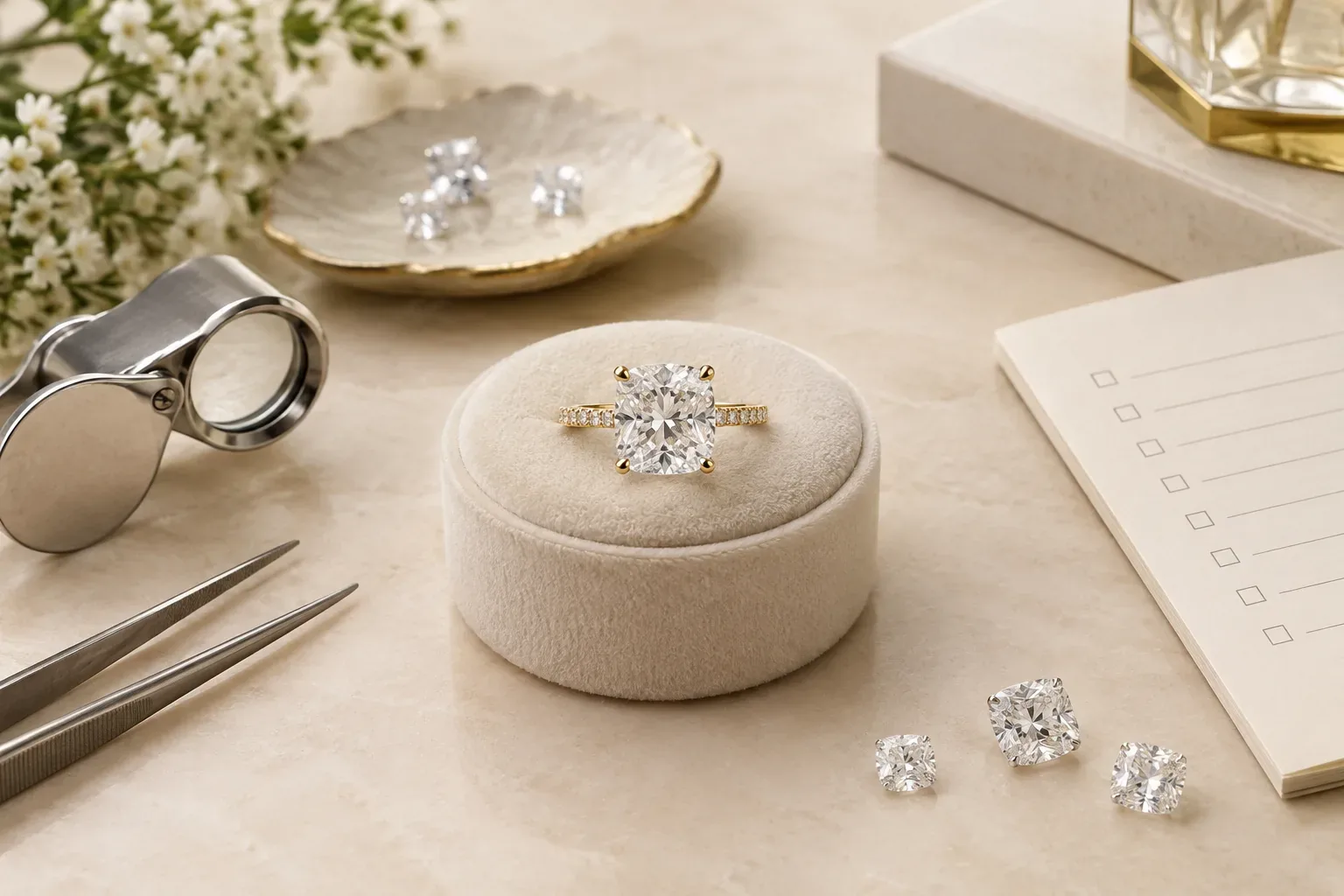
Meaning at a glance
Ask about certification, material and treatment disclosures, cut and setting details, return and resizing policies, and what only a lab or qualified jeweler can confirm.
Why a focused checklist matters
Cushion cut engagement rings combine a specific faceting profile with many choices about center gemstone type, treatments, metal, and setting. Contemporary industry and market research shows strong ongoing demand for engagement rings alongside shifting preferences for colored gemstones, craftsmanship, and versatile styling, all of which affect what you should ask and verify when buying. The buyer protections and treatment disclosure principles from the Federal Trade Commission and the Gemological Institute of America shape which questions are essential and which answers are reliable without specialized testing.
A checklist cuts through marketing language and helps you get written evidence for the claims that matter: whether a stone is natural or lab-created, whether it has been treated and how durable those treatments are, and whether the mount and design meet your daily-wear needs.
Historical evidence and cultural notes
The approved sources for this article focus on consumer guidance, gem treatment detection, and 2026 jewelry trends rather than documented historical symbolism of specific cuts. The Gemological Institute of America discusses treatments and their detectability rather than social meanings, the Federal Trade Commission emphasizes disclosure and consumer rights, and industry reports such as Jewelers Mutual and Imaginaire Digital summarize trends and demand patterns in recent years.
Because the available evidence used here does not include primary historical archives about the origin or cultural symbolism of the cushion cut, this article does not assert historical symbolic meanings for particular cultures or periods. If you are researching historical symbolism, consult primary historical sources or specialist jewelry history scholarship for period- and culture-specific claims; those are outside the scope of the sources cited for this checklist.
Documented historical meanings versus modern personal interpretation
Documented historical meanings require primary historical evidence or specialist scholarship. The four approved sources used for this checklist do not document historical cultural meanings attached to the cushion cut. Therefore any suggestion that a cushion cut historically symbolized a particular idea in a precise culture or period would be speculation when based only on those sources.
Modern personal and cultural interpretations are common and legitimate, but they are contemporary and subjective. Current market trends reported by Jewelers Mutual and Imaginaire Digital show that buyers are interested in craftsmanship, versatility, and colored gemstones, and many purchasers choose a cut like the cushion for aesthetic reasons or for personal symbolism. Distinguish between private meaning you attach and documented historical claims.
How the cushion cut appears in jewelry
In practice, the cushion cut describes a rounded-square or pillow-shaped outline with a faceting style that can range from a vintage, chunkier facet pattern to modern brilliant variations intended to maximize sparkle. This shape appears as center stones in solitaire, halo, three‑stone, and mixed-style engagement rings and is used with both diamonds and colored gemstones. Design choices such as the number of prongs, bezel versus open setting, and the presence of side stones influence both the look and the stone’s protection in everyday wear.
The material and any treatments applied to the gemstone change how the cushion cut performs and how it should be cared for. The Gemological Institute of America explains that treatments affect durability and detectability, which means treatment disclosure and care instructions are practical parts of how the motif appears and functions in finished jewelry.
Cushion cut engagement ring checklist: Questions to ask the seller
Ask for written certification or an independent lab report and inspect it closely. A certificate from an established laboratory will list key properties and any detected treatments; if the seller cannot or will not provide documentation, treat that as a red flag. The Federal Trade Commission emphasizes that consumers should get clear distinctions in writing about natural, lab-created, treated, and imitation materials.
Ask whether the central gemstone is natural, lab-grown, treated, or imitation and request written disclosure. If the stone is treated, ask for details about the treatment, expected durability, and special care. The Gemological Institute of America explains why treatment disclosure and detectability are essential consumer questions.
Confirm the cut style and proportions and ask how those trade off between face-up size and brilliance. With cushion cuts, some faceting patterns emphasize larger apparent size and softer sparkle while others prioritize brilliance; request photos showing the stone in comparable lighting.
Request magnified photos or a video and ask about visible inclusions or color zoning. If you can inspect the ring in person, use a 10x loupe or ask to see the stone under magnification; note that only specialized testing can determine certain treatments and origin.
Verify metal type and hallmark, setting security (number and style of prongs, bezel presence), ring size, return, resizing, warranty, and insurance options. Jewelers Mutual’s 2026 trends also highlight buyer interest in craftsmanship and versatility, which means practical questions about build quality and long-term wearability are important.
Get clear terms in writing about return windows, resizing policies, appraisal or replacement value, and whether you will receive a boxed piece with documentation. Confirm who bears the cost of resizing and what happens if the ring cannot be resized without damaging the design.
Ask about aftercare and recommended cleaning, and whether the seller will provide or recommend local qualified care. Jewelers Mutual’s guidance on modern trends and reliability highlights that warranties and recommended maintenance are central to the ownership experience.
What you can verify yourself and what requires a lab or qualified jeweler
You can verify several important claims yourself or with a retail jeweler: whether the seller provides written documentation, whether the metal is hallmarked and matches the stated karat, whether the setting appears secure, and how the stone looks in person or in high-resolution images. You can test basic size and compare face-up appearance and sparkle in different lighting to assess cut style trade-offs without specialist equipment.
You cannot reliably verify certain claims without instruments or a gemological laboratory: whether a stone’s origin is natural versus lab-grown in some cases, whether specific clarity-enhancement treatments have been invisibly applied, and precise grading of color, cut quality, and durability under certain treatments. The Gemological Institute of America explains that treatments, disclosure, detectability, and durability create distinct consumer questions requiring laboratory methods for definitive answers. For these items, a qualified independent lab report or appraisal is the trustworthy route.
Practical and respectful selection or gifting guidance
Discuss preferences and practical lifestyle needs with the recipient before buying if you plan to choose a ring you will both wear daily. Ask about comfort, ring profile, whether they work with their hands, and whether they prefer low-profile protection or high sparkle. Jewelers Mutual’s trend guidance indicates buyers increasingly value versatility and comfortable wear, so consider settings that balance protection with the look you want.
If the ring is a surprise, discreetly ask close friends or family about size and style cues, and choose a seller with a reasonable return and resizing policy. Obtain written documentation and photos to make resizing or exchanges easier if needed. Make sure you have a clear plan for insurance; many insurers and jewelers recommend getting a professional appraisal and discussing coverage before gifting.
Be transparent about materials and provenance if you want the ring to carry a particular ethical or personal meaning. The Federal Trade Commission recommends written disclosure and clarity about whether a gem is natural, lab-created, treated, or imitation; if ethical sourcing is important to you, request written statements from the seller and any vendor chain documentation they can provide.
Care guidance and everyday maintenance
Follow any specific care instructions the seller or stone laboratory provides; treatments can change cleaning recommendations. The Gemological Institute of America’s guidance on treatments and durability underscores that certain treatments reduce resistance to heat, chemicals, or ultrasonic cleaning, and that the appropriate cleaning method depends on the stone and any enhancements.
For everyday protection, check prongs and setting security regularly, avoid exposing the ring to harsh chemicals, and store it separately to prevent scratches. Consider an annual check with a qualified jeweler to inspect prongs and settings and a professional cleaning if appropriate. Jewelers Mutual’s practical approach to jewelry care emphasizes routine maintenance as part of preserving craftsmanship and wearability.
Final trade-offs to weigh
Deciding on a cushion cut engagement ring often requires balancing sparkle versus apparent size, vintage versus modern faceting, and budget versus certification and treatment-free stones. Written documentation and independent lab reports reduce uncertainty but can add cost; ask whether your budget should prioritize carat weight, a higher-grade lab report, or a setting that protects the stone for daily wear.
Ultimately, use this checklist to convert seller claims into verifiable documentation and to identify which assertions need laboratory confirmation. That approach keeps both practical and personal priorities in view and aligns with the consumer disclosure and treatment-detection concerns emphasized by the Federal Trade Commission and the Gemological Institute of America.
Frequently asked questions
Do I need an independent lab report for a cushion cut diamond?
An independent lab report is highly useful because it records grading and any detected treatments; it is the best way to confirm claims that are difficult or impossible to verify by eye. The Gemological Institute of America explains that treatments and detectability raise distinct consumer questions and that laboratory analysis provides authoritative verification.
How can I tell if a cushion cut stone has been treated?
Ask the seller for written disclosure and a lab report. Some treatments are visible under magnification, but others require specialized testing. The Gemological Institute of America recommends relying on professional lab reports and clear seller disclosure for treatment information.
Is a lab-grown cushion cut diamond different from a natural one for durability or care?
Lab-grown diamonds have the same chemical and physical properties as natural diamonds but the seller should disclose origin in writing. Durability is generally similar for diamond material, but specific treatments or setting choices affect care. The Federal Trade Commission advises clear distinctions in labeling and disclosure between natural and lab-grown stones.
What should I check about the setting before buying?
Verify prong count and condition, whether a bezel or protective design is used, metal type and hallmark, and how the setting affects daily wear. Ask for a jeweler’s inspection if you are unsure. Jewelers Mutual’s guidance on craftsmanship and wearability highlights the importance of build quality and protection for regularly worn rings.
Can I return or resize a cushion cut engagement ring if it doesn’t fit?
That depends on the seller’s written policies. Confirm return windows, resizing costs, and whether the design allows resizing without damage before purchase. Get all terms in writing to avoid surprises.
Sources and further reading
- Imaginaire Digital — Imaginaire Digital
- Jewelers Mutual — Jewelers Mutual
- Gemological Institute of America — Gemological Institute of America
- Federal Trade Commission — Federal Trade Commission