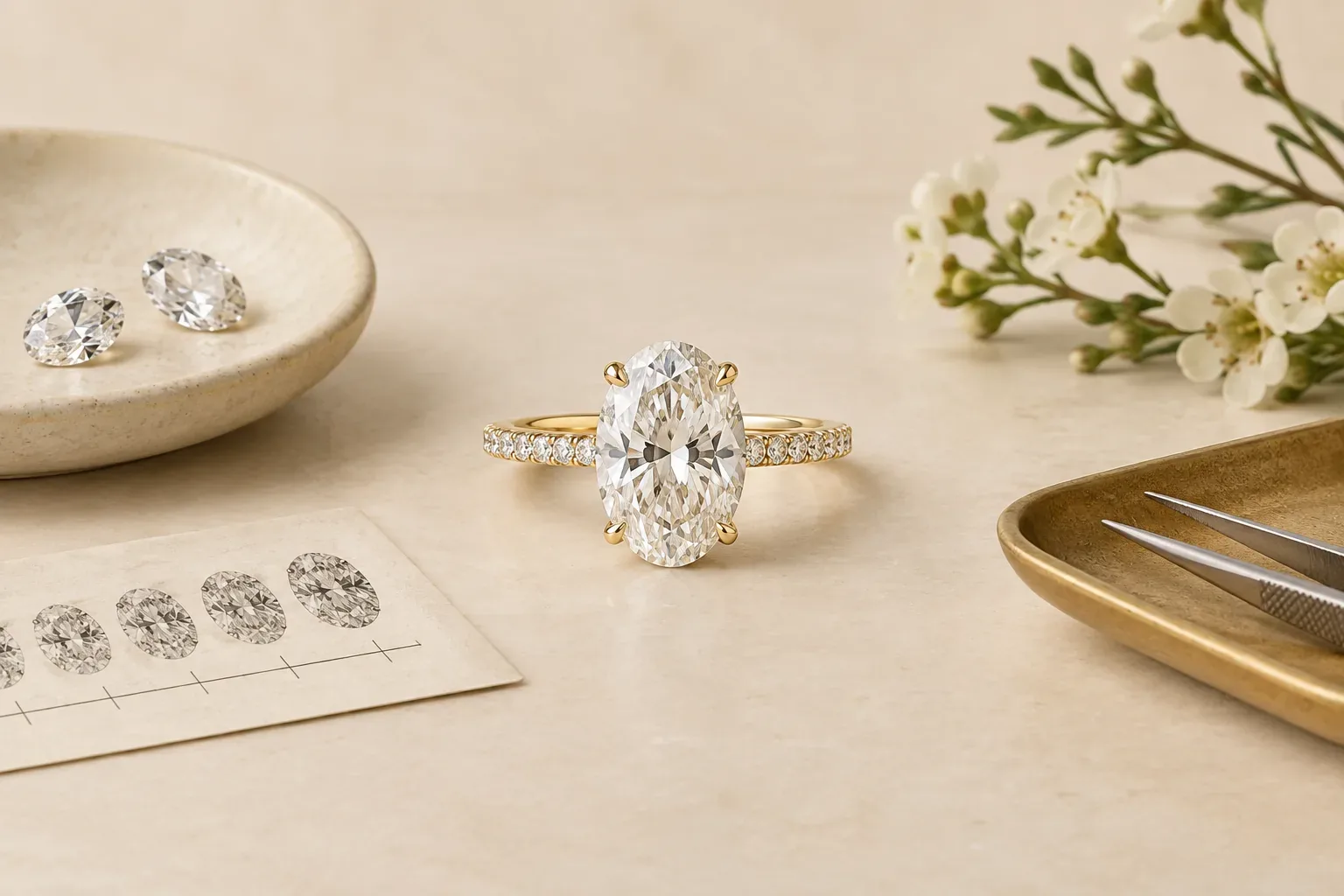
Meaning at a glance
Oval cut engagement ring styling balances the stone's length and width (how elongated or broad the oval is), the mounting and band proportions, and wearer factors such as finger length and lifestyle; choose by prioritizing visual coverage, comfort and durability, request written disclosures and certification, and rely on a qualified jeweler or gemological laboratory to verify treatments, origin and exact gem properties.
What shoppers mean by ‘styling’ and key decision criteria
When people search for oval cut engagement ring styling they usually want practical guidance on three linked points: how the oval’s shape affects finger coverage and perceived proportions, which settings and band profiles complement specific finger types, and what trade-offs to expect between visual size, durability and everyday wear. Decision criteria should therefore include the stone’s visible length and width, the ring’s mounting height and bezel or prong style, the band’s thickness and taper, and the wearer’s daily activities.
Styling is not only aesthetic. It includes how a ring sits and feels, how much the stone visually covers the finger relative to the wearer's size, and how easily the ring can be maintained. Being explicit about which of these matters most will simplify choices and make trade-offs clear when comparing stones and settings.
Historical evidence and documented meanings
Among the approved sources for this guide there is limited documentation tying the oval cut to a single, persistent cultural meaning. Contemporary industry and consumer-trend materials describe shifting consumer preferences and stylistic tendencies rather than ancient symbolic narratives. For example, 2026 market and search estimates identify strong consumer demand for engagement rings and specifically interest in oval engagement rings in the UK market (Imaginaire Digital).
Professional and trade sources emphasize modern styling trends and consumer priorities rather than historical symbolism. Jewelers Mutual’s 2026 observations note interest in fluid forms, modern stacking and gender-neutral styling, which helps explain why the oval’s elongated shape appears popular today. Where older cultural meanings exist for oval or egg-shaped motifs, those claims are not documented in the approved sources used here, so this guide separates those historical uncertainties from contemporary styling advice.
Documented history versus modern personal interpretation
The approved sources used for this guide document contemporary demand and industry trends, and regulatory advice about disclosures and treatments, rather than providing an unbroken historical record of symbolic meanings for the oval cut. Contemporary interpretations—such as seeing an oval as elegant, elongating or vintage—are modern personal meanings and stylistic shorthand adopted by designers and buyers. These modern interpretations sit alongside consumer priorities like versatility and craftsmanship that trade sources report, but they are not the same as historical or cultural symbolism documented by historical scholarship.
Treat historical meaning claims cautiously unless you can cite primary historical research or museum documentation. For the practical purpose of styling an engagement ring, the most useful information concerns how the stone shape visually behaves and what technical and provenance information you can verify.
How the oval motif appears in jewelry and how it changes finger coverage
In ring design the word 'oval' describes an elongated round shape with soft ends. Jewelers use that shape in many settings: a solitaire presentation that emphasizes length, a halo that increases perceived width, three-stone or side-stone arrangements that alter visual balance, and low-profile bezels or higher-prong mountings that affect how much of the stone and finger are visible. The same carat weight can look larger or smaller depending on these choices because visual coverage on the finger depends on the stone’s length across the finger and on how much band metal frames or overlaps the stone.
A narrower oval visually elongates the finger more than a broad oval, so buyers seeking an elongating effect typically choose proportionally longer shapes and minimal side metal. Conversely, buyers who want a fuller, more classical look often prefer a broader oval and settings such as a halo or tapered shoulders to add apparent mass. Band width and shoulder details also change perceived proportion: a slim band makes the stone appear larger and more delicate, while a wider band can balance a larger-looking stone and add durability for active wearers.
Practical selection and gifting guidance
Start with the priority you and the recipient value most: maximum finger coverage for a given budget, an elongating silhouette, vintage or contemporary look, or a design optimized for daily wear. Communicate that priority to the jeweler and ask for stone dimensions (length and width) in addition to carat weight. Dimensions tell you how much of the finger the stone will cover; carat weight alone does not. Request images or a model finger shot whenever possible to visualize scale.
Ask sellers for written disclosures about whether a gemstone is natural, lab-created, treated or imitated, and for any laboratory grading report if available. Federal Trade Commission guidance requires clear distinctions among natural, lab-created and treated materials; insist on written statements and readable documentation (FTC). For questions about treatments, durability and necessary care, consult Gemological Institute of America resources which explain how treatments affect durability and consumer questions about disclosure (GIA).
If provenance or non-treatment is important to you, plan to buy only from vendors who provide independent laboratory reports or who permit independent testing. A qualified gemological laboratory or an experienced independent jeweler is required to verify treatments, origin claims and grading if you need that level of assurance. For a gift, either include a clear return policy and receipts that document certification, or present the purchase with a promise that verification and sizing will be completed after gifting.
Trade-offs, durability and routine care
Choosing a longer, narrower oval maximizes visual length and apparent coverage but can concentrate depth into a slimmer table that may be more vulnerable to impacts depending on mounting. Choosing a broader oval reduces elongation yet can create a fuller look that some people prefer. Settings such as bezels add protection but change how much of the stone’s edge is visible and can reduce sparkle. Jewelers Mutual’s trend guidance underlines that modern buyers often balance craftsmanship and versatility, so think about how the ring will be worn with other jewelry and daily activities (Jewelers Mutual).
Treatments can affect how a gemstone should be cared for; consult the Gemological Institute of America for guidance about detectability, disclosure and special care concerns for treated gems (GIA). Avoid harsh chemicals and extreme temperature changes, remove rings for heavy manual work, and have prongs and shanks professionally inspected at least annually. Consider insurance or inspection options recommended by professional bodies to protect against loss, damage or unexpected repair needs (Jewelers Mutual).
What you cannot verify without a qualified jeweler or laboratory
You cannot reliably determine certain technical or provenance attributes by sight alone. Verifying whether a gemstone is natural or laboratory-grown, whether it has been heat-treated, fracture-filled or otherwise enhanced, and confirming origin claims or an accurate grading of color and clarity requires testing by a qualified gemological laboratory or an experienced, reputable jeweler with access to professional instruments. The FTC stresses that consumers need clear, written seller disclosures and that sellers must not blur the lines between natural, lab-created and imitation materials (FTC).
If certification is important to your purchase decision, insist on a named laboratory report and understand what that report includes. For any treatment-related concerns, consult GIA guidance on gem treatments and lab reports to know what tests and disclosures you should expect (GIA).
Putting it together: a brief shopping checklist
Decide whether elongation or fullness is your first priority, and ask a seller for stone length and width measurements as well as photos on a model finger. Request written disclosures about the gem’s type and any treatments, and ask for a laboratory report if provenance or grading matters. Choose a setting that balances protection and visual coverage according to lifestyle: bezels and lower profiles for protection, prongs and halos for maximum visibility and sparkle. Finally, plan routine inspections and consider insurer or jeweler-recommended maintenance to keep the ring looking and performing its best.
Related resources
For more on choosing a meaningful piece and researching jewelry symbolism, see our parent category for Jewelry Guides and the related articles How to Choose Meaningful Jewelry: A Practical Gift Guide, Jewelry Symbols for New Beginnings: A Thoughtful Guide, and How to Research the Meaning of a Jewelry Symbol.
Frequently asked questions
How does an oval cut affect how much of my finger the ring will cover?
Finger coverage depends on the stone’s length and width rather than carat weight alone; a longer, narrower oval will appear more elongated and cover more finger length visually, while a broader oval looks fuller. The mounting and band width also change perceived coverage, so ask for stone dimensions and model photos to compare.
Can I tell if an oval gemstone is treated or lab-created by looking at it?
No. Treatments and whether a gem is natural or lab-created generally cannot be determined reliably by eye. The Federal Trade Commission requires written seller disclosures and the Gemological Institute of America recommends laboratory testing for detectability and disclosure concerns; request documentation or lab reports if provenance matters.
What settings best protect an oval stone for everyday wear?
Protective settings include bezel or partial-bezel mountings that shield the edges and lower-profile mountings that reduce snagging. Prong settings maximize light return but leave edges more exposed. Balance protection against desired sparkle and visual coverage based on wearer lifestyle.
Should I prioritize carat weight or stone dimensions when choosing an oval cut?
Prioritize dimensions if finger coverage and proportion are your main concerns, because carat weight does not tell you the stone’s visible length and width. Ask the seller for length and width measurements and photos on a model finger to evaluate scale.
How often should I have an engagement ring inspected?
Have prongs, settings and shanks inspected at least once a year by a qualified jeweler to check for wear, loose stones or damage. Active wearers or those exposed to heavy manual tasks should inspect more frequently and consider protective settings or ring rotation.
What documentation should I get when buying an oval cut engagement ring?
Request written disclosures about whether the gem is natural, lab-created or treated, any available laboratory grading report, the stone’s exact length and width, carat weight, and the seller’s return policy. The FTC emphasizes that consumers should receive clear, written distinctions among materials.
Sources and further reading
- Imaginaire Digital — Imaginaire Digital
- Jewelers Mutual — Jewelers Mutual
- Gemological Institute of America — Gemological Institute of America
- Federal Trade Commission — Federal Trade Commission