Meaning at a glance
Choose pieces that use clear proportional rules, comfortable findings, and respectful, researched motifs; know the documented histories behind motifs and gemstones and follow consumer safeguards for treatments and authenticity.
Historical evidence and precise cultural contexts
Jewelry’s role as social display, identity marker, and personal ornament has shifted across times and places. The Victoria and Albert Museum’s exhibition material and research describe how jewelry styles and uses reflect changing social contexts rather than a single, continuous meaning. The V&A publications summarize examples from many periods where scale, technique, and ornament signalled status, sentiment, or affiliation rather than universal symbolic values.
Different cultures used specific motifs and gemstones in distinct ways. For example, in several pre-modern European contexts jewellery served clear social functions such as signifying marital status or memorializing the dead. In other regions and periods, gemstones and forms were chosen for aesthetic, technical, or trade reasons as well as for meaning attached within a cultural frame. The V&A’s A–Z of Gemstones places individual stones within those shifting histories and highlights that stone use and attributed meanings changed across cultures and eras.
Documented historical meanings versus modern personal interpretations
Documented historical meanings are those that appear in primary objects, trade records, or curatorial research. Museum work recorded by institutions such as the Victoria and Albert Museum shows how particular pieces functioned in their original contexts, whether as renown display pieces, tokens of grief, or everyday adornment. Those documented roles are specific to time, place, and social group.
Modern personal interpretations are contemporary meanings that wearers or designers attach to older motifs. These are valid for individual expression but are distinct from historical functions. For example, a motif that historically marked mourning or a legal status may be repurposed today as a purely decorative or identity-based element. Treat modern reinterpretations as contemporary cultural language rather than as continuations of historical practice unless a direct, documented lineage is established.
How motifs, gemstones, and traditions appear in maximalist jewelry
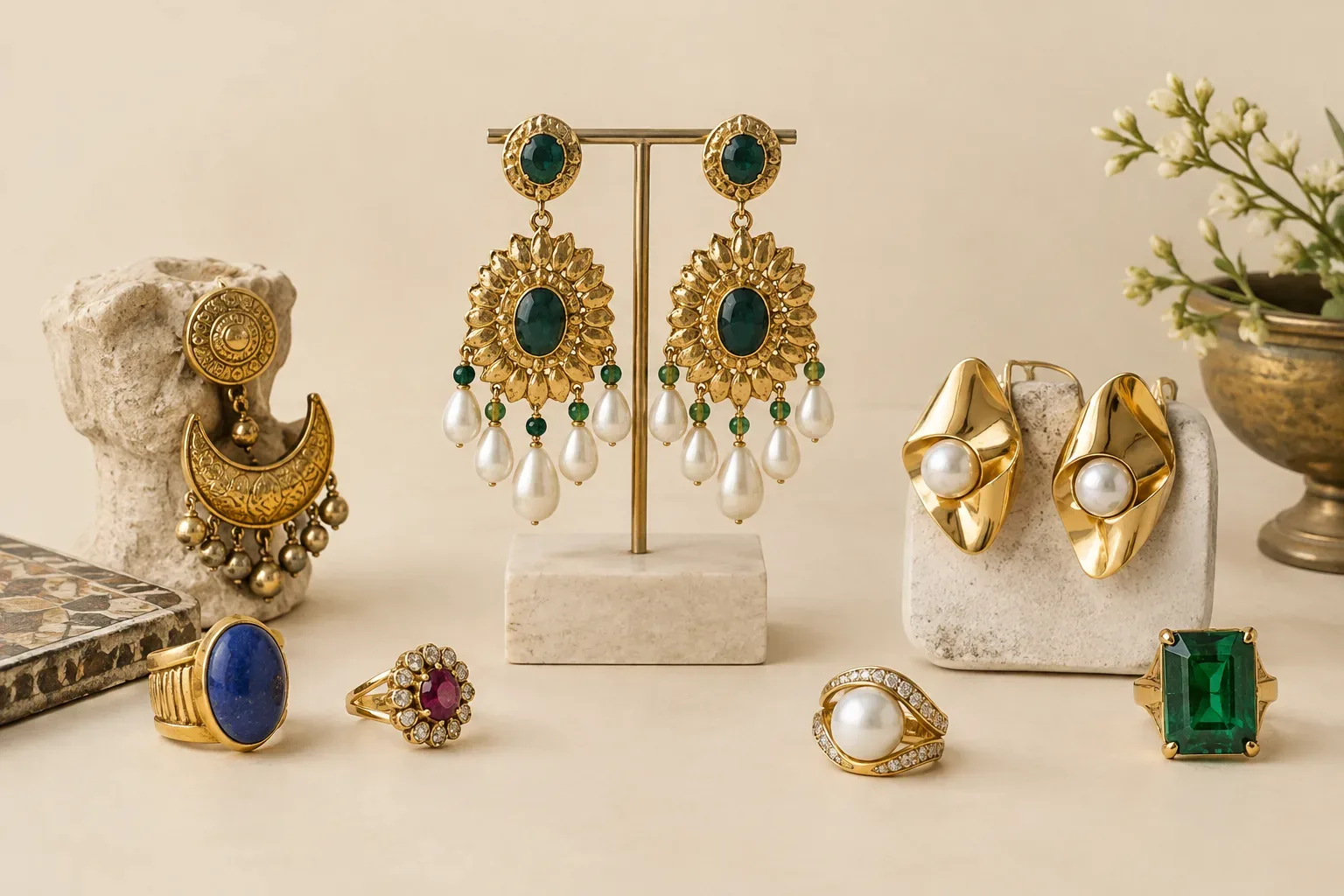
In maximalist wardrobes the same motifs and gemstones used historically are often scaled, repeated, or layered. Flowers, geometric forms, and symbolic devices are enlarged or reproduced across multiple pieces to create a cohesive maximal look. This is a change in presentation and frequency of use rather than in the motif’s basic graphic language.
Gemstones appear as large cabochons or clusters, in brightly contrasting color combinations, and frequently in mixed-metal settings. The Victoria and Albert Museum’s A–Z of Gemstones explains that stones have been polished, cut, and mounted differently depending on fashion and technique; in contemporary maximalism, historical cuts and settings are often exaggerated for visual effect while employing modern treatments and imitations as part of the aesthetic.
Scale and shape for statement earrings
Scale in earrings is about proportion to the wearer’s face, neck, and outfit. For maximalist styling choose a dominant scale and a supporting scale: a large chandelier or sculptural earring paired with smaller stud or hoop accents keeps the look intentional. Repeat a shape for cohesion, for example echoing a curved pendant motif in a ring or cuff.
Shape choices should consider silhouette and movement. Angular, architectural pieces read differently from soft, organic forms; combine shapes deliberately rather than randomly. For wearability, heavier larger shapes can be balanced with broader attachment points like leverbacks or ear hooks that distribute weight and reduce strain on the lobe.
Scale and shape for statement rings
Rings in maximalist wardrobes often mean stacking, cocktail rings, and sculptural signet-style pieces. Plan a hierarchy: a dominant ring on the index or middle finger complemented by thinner bands on adjacent fingers keeps the hand visually balanced. Consider how ring height sits against clothing—very tall settings can catch on fabrics or feel top-heavy for the wearer.
Shape matters for comfort and for how pieces read when the hand is in motion. Wide bands reduce perceived finger length and can require a slightly larger size; domed comfort-fit interiors, low-profile bezels, and tapered shanks improve everyday comfort while preserving bold visual impact.
Comfort: construction, weight, and ear and hand ergonomics
Comfort is essential if statement pieces are worn frequently. For earrings, prioritize secure closures that still allow the piece to move without pulling, such as hinged leverbacks, thicker posts with large backs, or well-fitting hoops. If a wearer is unpierced, quality clip-ons with broader pressure surfaces provide size and shape without piercing the lobe.
For rings, size and profile are critical. Remember that wider rings feel tighter; a comfort-fit inner surface and correct sizing avoid circulation and joint issues. Consider the weight of a ring’s top versus the shank: too much top weight can cause rotation and discomfort. In both earrings and rings, choose lighter materials or hollow construction for extreme scale, and prefer smooth edges where pieces may contact skin or fabric.
Material choices, gemstone treatments, and consumer protections
Materials alter the way scale reads and how comfortable a piece is. Solid gold is heavier than gold-filled or plated alternatives, and certain alloys are harder-wearing for everyday maximalist wear. If a piece uses imitation stones or heat-treated gems, these choices affect price, durability, and ethical considerations.
The Federal Trade Commission provides consumer guidance on buying gemstones, diamonds, and pearls and stresses disclosure about treatments and imitations. When selecting bold gemstone pieces for a maximalist wardrobe, ask vendors for clear information on treatments, origin where available, and whether a stone is natural, synthetic, or imitation. Insist on written disclosures or certification for high-value purchases and be aware that contemporary maximalist pieces sometimes use treated or assembled stones for color or stability.
Respectful selection and gifting guidance
When a motif has a clear cultural or religious history documented in museum records, treat it with care. Research the motif’s documented context via reputable sources before choosing it for personal wear or as a gift, and if the meaning connects to living cultural practices, consult members of that community or choose a design inspired by rather than appropriatively replicating sacred symbols.
Gifting practicalities are critical in maximalist jewelry: confirm ring size or provide an adjustable or easily resizable option, check piercing status and preferred earring style, and disclose materials and treatments. For heirloom-style or historically inspired pieces, include provenance or an explanatory note about the motif’s documented history versus your personal reason for gifting it. If you are unsure whether a design is appropriate, choose neutral, aesthetic-focused pieces that reflect the recipient’s style without invoking contested cultural meanings.
Putting it together: styling approaches
One cohesive approach is motif repetition: select an earring and a ring that share a primary shape or gemstone color. This unifies a maximal look without overcrowding. Keep one piece physically dominant, usually either the earrings or the rings, to anchor the outfit.
Another approach is contrast by scale: pair a single oversized earring or ear-cuff with several slimmer, textured rings. For everyday maximalism, favor lighter constructions and lower-profile ring settings; reserve heavier, more ornate pieces for shorter wear periods. Always consider the wearer’s daily activities when selecting maximal pieces—balancing bold aesthetics with functional comfort yields the most wearable maximalist wardrobe.
Frequently asked questions
Will large earrings damage my earlobes over time?
Large or heavy earrings can stretch or strain earlobes if worn frequently without appropriate support. Choose findings that distribute weight, such as leverbacks or wider posts with larger backs, and alternate heavy pieces with lighter options. If you plan to wear very heavy earrings regularly, consult a jeweller about reinforcement options and consider occasional use rather than daily wear.
How should I size rings for stacking and comfort?
Stacking rings and wide bands require careful sizing. Wider rings feel tighter, so you may need a slightly larger size than for a narrow band. Use a trusted jeweller for accurate sizing, especially if you wear multiple rings on the same finger, and consider comfort-fit interiors to reduce friction and rotation.
How can I tell if a gemstone has been treated or is an imitation?
Ask the seller for written disclosures, certifications, or lab reports. The Federal Trade Commission advises that treatments and imitations should be disclosed to consumers. Reliable vendors will explain whether a stone is natural, synthetic, treated, or assembled, and provide documentation for high-value purchases.
Is it appropriate to wear motifs from other cultures in maximalist styling?
If a motif has clear cultural or religious meaning, research its documented context and consider whether wearing it could be disrespectful. When in doubt, choose designs inspired by rather than directly copying sacred symbols, and where possible consult members of the community connected to the motif before wearing or gifting.
How can I make extreme scale comfortable for daily wear?
Select hollow or lightweight constructions, distribute weight with supportive findings, and favor lower-profile ring settings. Consider the wearer’s typical activities and reserve the heaviest pieces for shorter occasions unless they are engineered specifically for all-day comfort.
Sources and further reading
- Bedazzled: A History of Jewellery — Victoria and Albert Museum
- An A-Z of Gemstones — Victoria and Albert Museum
- Buying Gemstones, Diamonds, and Pearls — Federal Trade Commission