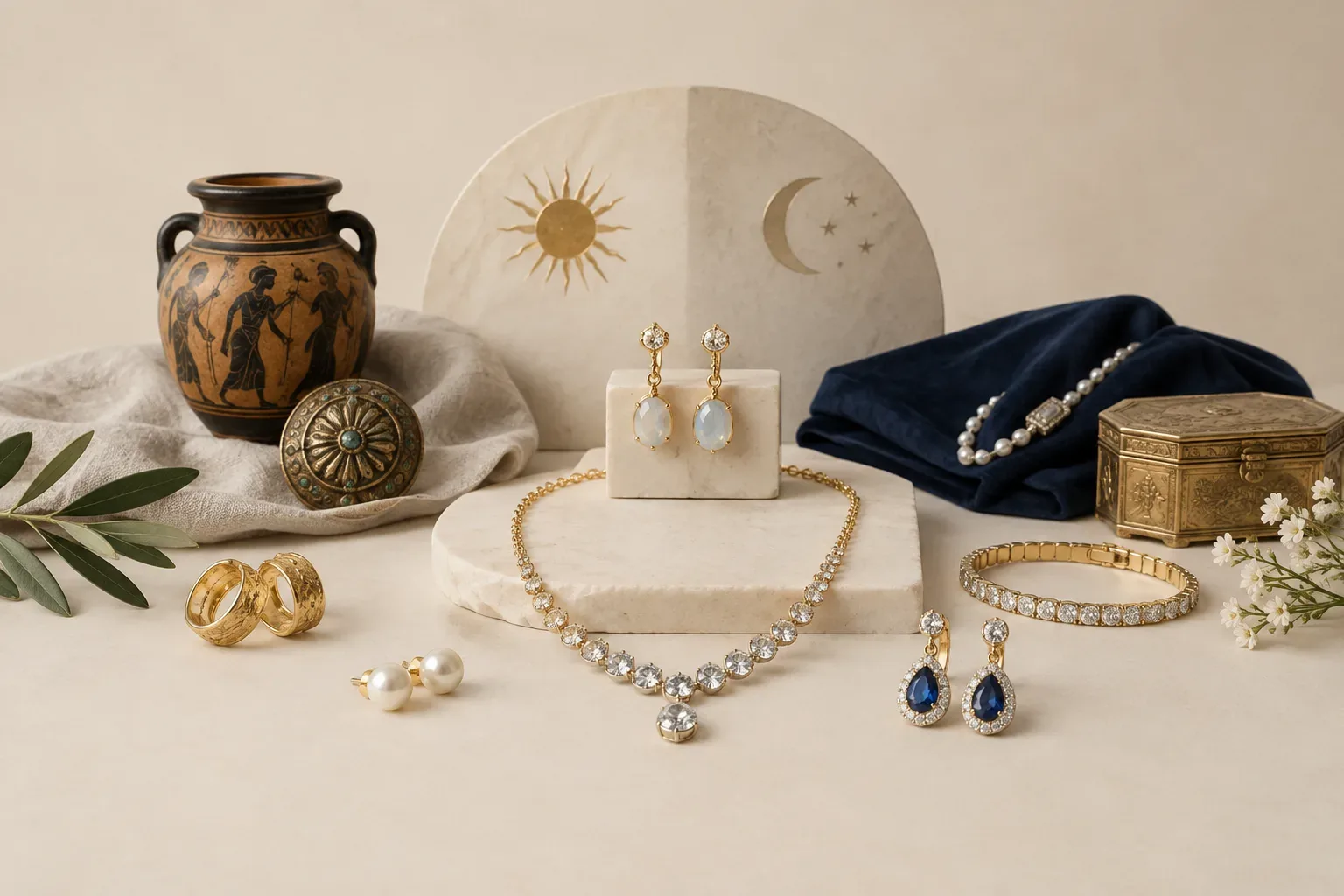
Meaning at a glance
Start with versatile pieces and change one or two focal elements—swap a simple stud for a drop earring, add a statement necklace or brooch, or layer a bold cuff—while considering the documented history of motifs and the materials involved, and following disclosure and care guidance for gemstones.
Short answer
Use a small number of simple swaps to move from a daytime to an evening look: introduce one statement piece (necklace, earring, cuff, or brooch), elevate metal or stone finishes, and simplify layering for a cleaner silhouette. At the same time, be aware that many jewelry motifs and gems carry distinct historical meanings and cultural associations; this article explains documented histories, separates them from modern personal interpretations, and gives practical guidance for choosing, wearing, and giving jewelry for evening outfits.
What the historical record shows (and how the V&A frames it)
The Victoria and Albert Museum (V&A) presents the history of jewelry as a record of changing social roles, materials and technologies rather than a single, fixed language of symbols. The V&A’s overview of jewellery history emphasizes how pieces that were once everyday or ritual objects have shifted through fashions, technologies and social uses. Use this museum-backed perspective to understand that what a piece signified in one period or culture may not hold the same meaning today.
For example, pieces classed as sentimental or mourning jewellery are well documented in European collections and by the V&A as forms connected to specific historical practices and social customs. Similarly, the museum’s treatments of gemstones show how particular stones have moved in and out of fashion because of changing sources, cuts and technologies rather than because a single symbolic meaning persisted unchanged across time or place.
Separating documented historical meanings from modern interpretation
Documented historical meaning is what contemporary records, museum catalogues, or surviving objects indicate about how a piece was used or understood in its original context. The V&A’s studies and exhibitions provide that documented evidence: for example, lockets and portrait jewellery in certain European contexts functioned as methods of keeping a likeness or memory close, and can be read in that historical frame. Those documented meanings are tied to times, places and social practices.
Modern personal interpretation is how wearers, designers and cultures today understand or repurpose a motif or gem. A motif once associated with mourning can be worn in the present as a fashion statement, a personal reminder, or as part of a trend; none of those modern uses erase the documented past, but they are distinct from it. When choosing jewelry for evening wear, treat historical meanings as informative context rather than as universal rules: some recipients may appreciate the historical reference, while others will appreciate only the visual or personal significance.
How motifs, gemstones and traditions appear in evening jewelry
Classic evening motifs appear repeatedly across periods because they read well at a distance and photograph easily: high-contrast gemstones, symmetrical drop shapes, and larger metal surfaces that catch light. The V&A’s guidance on gemstones explains how different stones and cuts behave with light and why certain cuts and settings became popular for formal wear as cutting and polishing techniques advanced.
Pearls and diamonds are two staples of evening dressing. Historically, pearls were prized in many societies for their natural luster, and diamonds for their hardness and brilliance; the V&A’s materials on gemstones outlines how both stones became associated with formality through changing tastes and availability. Colored gemstones—sapphires, emeralds, rubies and others discussed in the V&A’s A–Z of Gemstones—offer saturated color that reads well against evening fabrics, while mirror-polished metals and pavé settings increase sparkle under artificial light.
Motifs such as garlands, scrolls, floral sprays and geometric Art Deco forms recur in evening pieces because they scale well to necklaces, brooches and chandelier earrings. The way a motif appears—engraved on a cuff, as a pendant, or as a stone arrangement—affects how it performs with an evening outfit: a large brooch can anchor a satin wrap, while long drop earrings emphasize an exposed neck or updo.
Day-to-night styling techniques that work
Keep the base simple. Start the day with a restrained combination—small studs or a fine pendant—and carry one compact enhancement in your bag, such as statement earrings, a heavier chain, or a decorative brooch. Evening lighting favors fewer, larger focal points, so pick one area to emphasize: the neck, the wrist or the ears.
Swap, don’t layer. Replacing a small element with a bolder one gives an instant upgrade without adding visual clutter. Remove a fine necklace and replace it with a choker or short collar for a higher-impact neckline, or change a single stud for long drops. Alternatively, add a single substantial ring or cuff to shift attention to the hands.
Think about line and silhouette. Evening clothes often reveal more neckline, shoulder or wrist; choose jewelry that complements the garment’s cut. V-shaped or strapless necklines suit pendants or statement collars, while long-sleeved gowns benefit from bold bracelets or rings. Chandelier earrings pair particularly well with updos because they remain visible.
Practical selection and gifting guidance (materials, care, culture and disclosure)
Match materials to expected use. The V&A’s gemstone guidance shows how different gems and cuts interact with light and wear. For jewelry you expect to wear frequently for evenings—such as that special dinner dress—choose stones and settings known for durability: harder stones and secure prongs are less likely to chip or loosen. If the piece will be occasional, you can favor more delicate or historically accurate settings.
Ask about treatments and disclosure. The Federal Trade Commission’s guidance on buying gemstones, diamonds and pearls stresses the importance of disclosure for treatments, enhancements and imitations. When buying as a gift, request written information about whether a stone has been heat-treated, dyed, irradiated, filled, or is laboratory-grown, and confirm return and repair policies.
Consider personal and cultural meaning respectfully. If a motif has a clear cultural or religious function today, treat it with respect and, when in doubt, ask the recipient or avoid gifting items with strong ceremonial associations. If you want to acknowledge a historical motif (for example, a locket or mourning symbol) include a note explaining the piece’s background and your intent, since documented historical meanings differ from how contemporary wearers might understand them.
Practical care and longevity. Evening jewelry often encounters perfume, sweat and environmental wear. Ask about recommended cleaning and storage; many gemstones and organic materials require gentle care. For gift-giving, include a small care note and the purchase paperwork so the recipient can keep provenance and treatment disclosures together.
Putting it into action: example looks
Minimal day, signature night: daytime outfit with simple studs and a thin chain, then swap the studs for artful drop earrings and replace the chain with a short statement collar. This keeps the overall approach restrained while introducing a single dramatic element for evening lighting.
Layer-friendly to single-sculpture styling: daytime layered necklaces can be removed and replaced by a single pendant or a detachable decorative clasp that turns three thin chains into one bold piece. A brooch pinned to a lapel or scarf gives immediate visual weight for evening without requiring additional ear or neck pieces.
Hand and wrist focus: trade daytime watches or slim bracelets for a single, wide cuff or a cocktail ring. This is especially effective when your outfit has long sleeves or a simple neckline, directing attention to movement and gesture under evening lights.
Final note on meaning and modern taste
Historical documentation, such as the materials and analyses provided by the Victoria and Albert Museum, shows that jewelry meanings shift with technologies, social practices and fashions. Use that history to inform choices, not to dictate them. Whether you are selecting jewelry to honor a documented tradition, to convey a personal message, or simply to look appropriate for an evening event, combine respect for context with practical considerations about stones, settings and maintenance. When gifting, transparent information and sensitivity to cultural or ceremonial significance make a piece more likely to be welcomed and worn.
Frequently asked questions
What is the quickest way to make daytime jewelry suitable for evening?
Swap a single focal piece: replace small studs with statement earrings, exchange a thin chain for a collar or pendant, or add a bold ring or cuff. Simplifying other elements keeps the look elegant under evening lighting.
Are pearls appropriate for evening wear?
Yes. Historically pearls have been used in formal dress; they offer soft luster under artificial light. Consider size, setting and fragility—pearls are softer than many gemstones and need gentle care.
How should I handle gemstone treatments when buying for evening pieces?
Ask for written disclosure about any treatments, enhancements or whether a stone is laboratory-grown. The Federal Trade Commission recommends sellers provide this information so buyers can make informed choices about care and value.
Can a brooch modernize an evening outfit?
Yes. A well-placed brooch can anchor a look, pin a wrap or draw the eye to a neckline. Choose scale and style to match the garment and avoid competing focal points.
Should I avoid culturally specific symbols as gifts?
If a symbol is clearly tied to a religious or ceremonial practice, approach gifting with sensitivity. Either choose a neutral piece or confirm the recipient’s comfort and preference to avoid unintended offense.
How do I care for evening jewelry after a night out?
Wipe metals and stones gently with a soft cloth, avoid harsh cleaners unless recommended, and store pieces separately to prevent scratches. Keep any certificates or treatment disclosures with the jewelry for future reference.
Sources and further reading
- Bedazzled: A History of Jewellery — Victoria and Albert Museum
- An A-Z of Gemstones — Victoria and Albert Museum
- Buying Gemstones, Diamonds, and Pearls — Federal Trade Commission