Meaning at a glance
Explain the documented history and changing contexts of jewelry, separate cultural and religious evidence from later popular interpretations, and give practical guidance for choosing and wearing pieces that suit a minimalist wardrobe by considering scale, color palette, and a clear focal point.
What historical evidence shows (and how museums present that evidence)
Museum collections and exhibitions demonstrate that jewelry’s role, form, and social meaning have changed repeatedly. The Victoria and Albert Museum’s survey of jewellery emphasizes how different societies and periods used ornaments for status, identity, commemoration, and decoration rather than for a single universal purpose. The V&A’s holdings include objects from ancient Egypt and the classical world, medieval and Renaissance Europe, South Asia and East Asia, through to 19th- and 20th-century European styles, and those collections illustrate shifting materials, techniques, and wearing practices.
Across these cultures and periods, scale and visibility varied with fashion, function, and social norms. For example, some courtly and ceremonial contexts favored large, layered sets, while everyday personal adornment tended to be smaller and subtler; those distinctions are visible across the V&A’s historical holdings. The museum’s chronological and regional displays show that what counts as ‘minimal’ or ‘ornate’ is historically contingent: a discreet gold hoop in one society can be a high-status signal in another.
Documented meanings versus modern interpretations
When assessing meaning, separate documentary evidence from later or contemporary readings. Documented meanings are those that come from archival records, inscriptions, inventories, wills, or contemporary texts and are preserved in museum catalogues and scholarship. The V&A’s materials and captions generally make this distinction explicit, indicating when a function or meaning is recorded by historical sources and when a meaning is inferred from context or style.
Modern personal interpretations — including current minimalist readings — are contemporary uses of older motifs or stones. People today often repurpose historical forms (for example, a signet-style disc or a Victorian lock of hair motif) and attach new meanings such as privacy, continuity, or pared-back status signalling. Those are valid personal meanings, but they are not identical to documented historical beliefs unless specific sources tie the meaning to the original context.
How motifs, gemstones, and traditions appear in jewelry and what to look for
Motifs appear as small engraved surfaces, geometric forms, single charms, or simplified cultural symbols in minimalist jewelry. Historically elaborate motifs—foliate scrolls, pictorial scenes, or portrait miniatures—may be distilled into a tiny pendant or stud that references the original without reproducing its scale. The V&A’s exhibitions and description practices show how artisans reduced complex compositions into wearable elements across time.
Gemstones in minimalist jewellery are often used singly as a color accent rather than as part of a dense pavé or cluster. For background on gemstones, the Victoria and Albert Museum’s 'An A–Z of Gemstones' explains how different stones have been cut and set through history and how their color and durability influence their use. A single sapphire cabochon or an emerald bead will read very differently from a dense multi-stone collar—the first suits minimalist proportion and color restraint.
Traditional forms—lockets, signet-style disks, thin bangles, and chain necklaces—resurface in minimalist wardrobes as reduced or flattened versions. The V&A collection illustrates continuity in technique (engraving, bezel setting, chain links) while demonstrating stylistic shifts in size and emphasis. Recognizing how a motif or tradition appears helps you choose whether you want an historically resonant piece or a contemporary design that simply references history.
Choosing proportion for a minimalist wardrobe
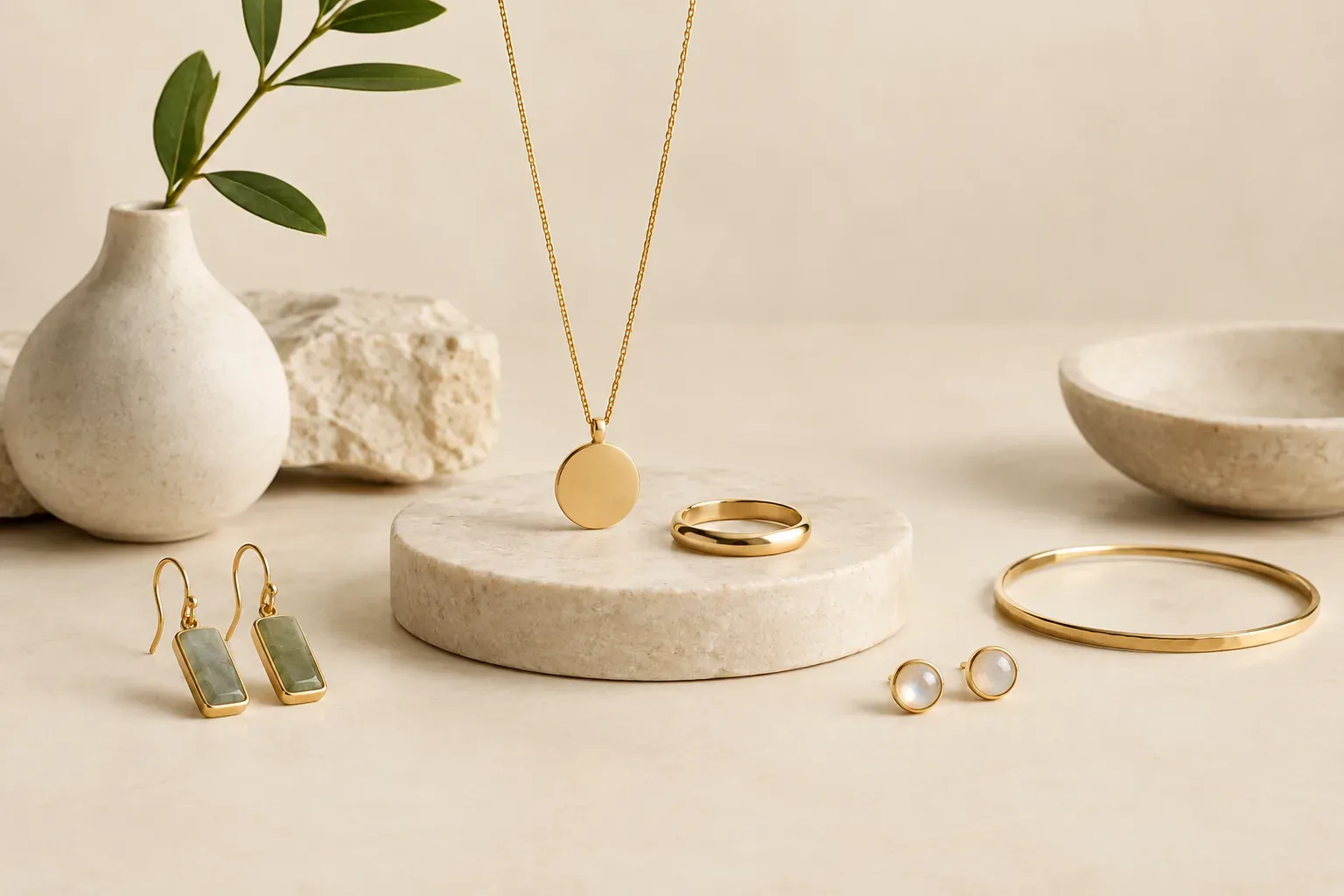
Proportion is the first practical decision. Minimalist wardrobes often rely on clean lines and reduced visual noise; jewelry should complement rather than compete. Choose pieces scaled to the wearer and to the clothing’s neckline and sleeve lines. For example, short delicate chains and small pendants suit higher necklines and collars, while a fine longer chain can add vertical emphasis to a crew or turtleneck without disrupting the silhouette.
Consider thickness and mass: thin bands and light chains sit unobtrusively and layer easily when desired, but an intentional single cuff or signet ring can function as the wardrobe’s focal point if proportionally larger. Measure the visual weight of a piece relative to the body and garment: the goal in a minimalist approach is balance, not invisibility.
Choosing color: metals, gemstones, and palette restraint
Minimalist jewelry favors a limited palette. Select one or two metal tones—warm gold, cool white gold/silver/stainless steel, or a matte black finish—and coordinate jewelry with the dominant tones in your wardrobe. Small colored stones can act as controlled accents; choose hues that appear in your clothing or neutral gemstones like diamonds, pearls, or moonstone to maintain restraint.
When deciding on gemstones, consult historical and material notes to understand durability and colorfastness. The V&A’s gemstones guide is useful for understanding how different stones behave and how their cuts affect color and sparkle. For everyday minimalist pieces, choose hard, durable stones and secure settings to keep a simple look consistent over time.
Defining focus: single statement versus restrained stacking
Decide whether your minimalist outfit will carry one clear focal piece or a deliberately restrained stack. A single focal item—such as a modest signet, one pendant, or a cuff—anchors an outfit and clarifies intent. Alternatively, tight, disciplined stacking of very thin rings or bracelets can create rhythm without clutter when the pieces share scale, finish, and theme.
Be intentional about placement. A single statement ring draws attention to the hands; a short pendant centers the face; a cuff frames the wrist. Choose the focal location that best complements your clothing lines and daily activities.
Gifting and selection guidance (practical and respectful)
When gifting minimalist jewelry, respect personal style and cultural context. Ask about metal sensitivity, preferred metal tone, and whether the recipient favors a clear focal piece or subtle multiples. If you are uncertain, choose neutral materials (matte gold-plated sterling, plain silver, or stainless steel) and classic, well-sized proportions rather than a highly specific motif tied to a culture or religion unless you are certain of the recipient’s preference.
For motifs with cultural or religious associations, avoid assuming shared meaning. Research before gifting and, when in doubt, choose simple geometry or an ungendered single-stone piece that will be read as aesthetic rather than symbolic. The V&A’s contextual presentations demonstrate how motifs acquire specific meanings in particular contexts; a respectful gift practice is to reflect that documented context or to select pieces with neutral, personal meanings.
Practical buying notes and material disclosure
Pay attention to material treatments, imitations, and disclosure requirements when buying gemstones or pearls. The U.S. Federal Trade Commission provides clear consumer guidance on buying gemstones, diamonds, and pearls and on disclosures sellers should make about treatments and imitations. Ask for information about metal content, gemstone treatments, and return or repair policies before purchase.
Look for secure settings and quality finishes that suit everyday wear. Minimalist pieces must sometimes endure frequent wear—thin chains and small settings should be well made. If buying secondhand or vintage, confirm provenance and condition; museums like the V&A show how wear and repair accumulate on historical objects, and a well-made modern minimalist piece should have longevity in mind.
Care and long-term considerations
Minimalist jewelry becomes most successful when it integrates into daily life. Store pieces separately to avoid scratches, especially for polished metals and faceted stones. Have delicate chains soldered and reinforced when needed, and ask a jeweller about re-plating options if the piece is plated. Because minimalist pieces rely on subtlety, small signs of damage or wear will change their visual balance, so periodic inspection and simple maintenance preserve the intended aesthetic.
Finally, remember that historical precedents can inform but not dictate modern choices. The museum record demonstrates continuity of technique and variation of purpose; use that record to make informed and respectful design and gifting choices rather than assuming a universal symbolic language.
Frequently asked questions
What scale of jewelry works best with a minimalist wardrobe?
Smaller, well-proportioned pieces usually work best: thin chains, small pendant sizes, narrow bands, and delicate stud earrings that balance the body and clothing lines. If you choose a statement piece, make it the sole focal item and keep other jewelry minimal.
How many metal tones should I mix for a minimalist look?
Stick to one or two complementary metal tones. One consistent metal creates cohesion; two can work when they are intentionally coordinated—for example, warm gold accents with a neutral watch case. Excessive mixing can undermine a minimalist aesthetic.
Are specific motifs off-limits because of cultural meaning?
Some motifs or symbols have strong cultural or religious associations. Unless you have clear, documented permission or understanding of the symbol’s context, choose neutral geometric motifs or ask about the recipient’s preferences to avoid inappropriate use.
How should I care for delicate minimalist pieces?
Store items separately to avoid abrasion, inspect and reinforce thin chains and settings regularly, and follow any metal- or stone-specific care guidelines. Because small blemishes affect minimalist pieces visibly, routine maintenance helps preserve their look.
What should I ask sellers about gemstones and treatments?
Ask whether a gemstone has been treated or enhanced and whether any plating is used on the metal. The Federal Trade Commission advises consumers to request clear disclosure about treatments, imitations, and return policies before purchase.
Sources and further reading
- Bedazzled: A History of Jewellery — Victoria and Albert Museum
- An A-Z of Gemstones — Victoria and Albert Museum
- Buying Gemstones, Diamonds, and Pearls — Federal Trade Commission