Meaning at a glance
This article explains documented historical contexts for evening jewelry, distinguishes those records from later personal meanings, and gives practical guidance on choosing earrings and rings for evening outfits with attention to scale, shape, and comfort.
What the historical record actually shows
Museum research indicates that jewelry’s role in evening dress has changed with social norms, technology, and fashion rather than following a single uninterrupted rule. The Victoria and Albert Museum’s materials on jewellery history highlight how practices around wearing and displaying jewels reflect changing social contexts and occasions, such as public evening entertainments, court ceremonies, and private dinners. Use of showy gemstones, long drops, and glittering metalwork often tied to the desire to read social status under dimmer lighting conditions, but the exact styles and rules varied by period and place.
When discussing gemstones and materials, authoritative catalogues such as the V&A’s A–Z of Gemstones trace a long history of certain stones being prized for luster, color, or symbolic associations. Those historical preferences help explain why pearls and diamonds became staples of nightwear in many Western courts and societies: their reflective properties read well in candlelight and early electric lighting. These museum sources document observable patterns and surviving objects; they do not claim a single universal meaning for any motif or stone across cultures.
Separating documented cultural evidence from modern personal interpretations
Documented evidence in museum collections and curatorial writing tells us what people actually wore, how pieces were manufactured, and how items were displayed or exchanged. For example, the V&A shows how jewelry design, from small portrait lockets to large, gem-set parures, responded to changing occasions and technologies. Those records are descriptive and often tied to specific regions or courts.
Modern interpretations—such as reading a particular gemstone as carrying a single, fixed emotional message for everyone—are usually later developments or marketing narratives. Contemporary wearers and designers frequently repurpose historical motifs for personal meanings, but that reinterpretation should be distinguished from what the historical objects themselves document. The V&A’s contextual work helps identify where an object’s original social function ends and later fashion or sentimental readings begin.
How motifs, gemstones, and traditions appear in evening earrings and rings
Motifs: In historical pieces curated by museums, motifs such as stars, flowers, and geometrics appear as decorative motifs rather than universally fixed symbols. Stars and celestial motifs are common in a number of periods because they translate well into sparkling stones and metalwork; floral motifs appear because they can be arranged to fall neatly from an earlobe or around a ring bezel.
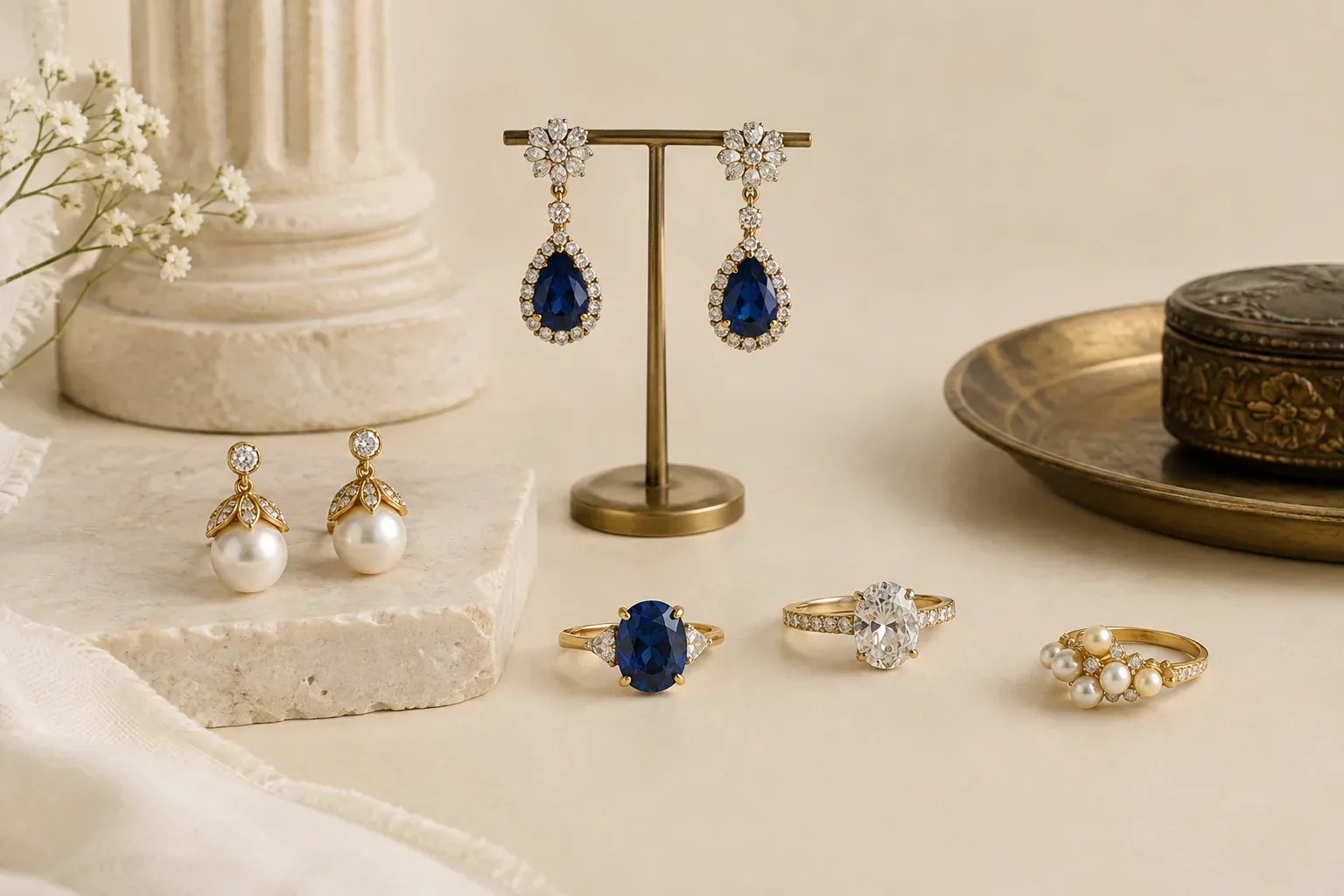
Gemstones: The A–Z of Gemstones explains that certain stones were historically favored for their optical and practical qualities. Pearls were prized for soft, lustrous reflection that complemented evening light. Diamonds and white sapphires read as sparkle under candlelight, making them popular for formal occasions. Colored gemstones—sapphires, rubies, emeralds—were used for contrast and to signal taste or, in some contexts, rank. The appearance of these stones in earrings and rings must be read alongside period fashion and lighting technologies, as documented by museum research.
Traditions: Traditions such as wearing a single statement earring, matching earring-and-necklace parures, or a dedicated ‘cocktail ring’ for evenings are visible in surviving collections and exhibition notes. Museums record these conventions as part of changing dress practices rather than immutable rules, and they vary widely between cultures and periods.
Styling principles for evening earrings: scale, shape, and context
Scale: Match the size of an earring to the neckline and the wearer’s features. Larger drops and chandeliers suit open necklines and formal events where pieces should be visible across a room. Smaller studs or short drops work for higher necklines, busy necklines, or when the outfit itself is the focal point. Historical examples in museum collections show larger pieces being favored for court or stage settings, where visual impact mattered.
Shape: Choose shapes that complement the face and the outfit. Elongating drops and linear shapes can balance round faces; wider, more horizontal designs suit longer faces. Consider how motif lines read at a distance—delicate filigree may disappear under dim lighting whereas defined geometric shapes or larger stones retain presence.
Comfort and security: For evening events that involve movement—dancing, dinner service, or photographing—prefer secure fastenings and manageable weight. Clip-backs, screw-backs, and locking lever-backs reduce the risk of loss; lighter materials or hollowed metal settings cut weight without sacrificing scale. Museum objects show many historic evening pieces designed for durability and repeat wear, not just display.
Styling principles for evening rings: scale, wearability, and activities
Scale and placement: Cocktail rings or single statement rings are a long-documented approach to evening wear. A single large ring on the dominant hand reads as a focal point, while multiple smaller rings create a layered effect. Consider the wearer’s typical activities: large stones can snag on clothing or hair, and high settings may be uncomfortable for sitting at a table.
Shape and profile: Low-profile settings reduce the chance of catching and are more comfortable for dining and dancing. Smooth, rounded bands are less likely to irritate or interfere with gloves. Museum examples show how rings intended for regular evening wear were often constructed with practicality in mind, balancing ornament with comfort.
Practical comfort tips: Check ring shank width for fit under movement and for how it feels with other rings. Ensure gemstones are securely set, and choose mounting styles that protect the stone’s girdle and pavilion. Historically, well-made settings were valued for both security and longevity, according to museum documentation.
Material, treatment, and disclosure: what to ask when buying
Ask about gemstone treatments and imitations. The Federal Trade Commission provides guidance on buying gemstones, diamonds, and pearls and stresses disclosure of treatments and imitations. Always ask the seller whether stones have been heat-treated, irradiated, fracture-filled, dyed, or are simulants. For evening wear, treated stones can offer attractive color and durability, but full disclosure matters for valuation and care.
Inquire about metal weight and construction. For evening earrings and rings, solid but hollowed constructions can offer scale without excessive weight. Ask about fastenings and whether earrings include safety features suitable for active wear.
Selection and gifting guidance with cultural respect
When choosing or gifting evening jewelry, consider documented cultural associations and avoid assuming a motif carries one universal meaning. Check museum and scholarly sources if you need to understand a motif’s original cultural context. If choosing a piece with a motif strongly associated with a particular religion or identity, ask the recipient or a knowledgeable intermediary whether that motif is appropriate as a fashion or gift item.
For gifting, prioritize comfort and proportion: choose earrings that the recipient can wear for several hours without pain, and rings sized correctly or easy to resize. Present information about materials and care, including any known treatments, because transparency helps recipients value and maintain the piece. If you are unsure about size or motif meaning, gift a flexible option such as a classic stud, a simple band, or a certificate with the option to exchange.
Care, practical wear, and common evening scenarios
Consider event activities when planning jewelry: seated dinners, cocktails, ballroom dancing, and outdoor evening events each create different needs. For dancing, prioritize secure backs and low-profile rings. For outdoor or candlelit settings, choose stones with good reflective qualities so the jewelry reads well in softer light. Keep a small repair kit or know a local jeweler in case a back loosens or a prong needs attention after an event.
Store evening pieces separately to avoid abrasion, and follow care guidance appropriate to the materials. Pearls, for instance, should be kept away from chlorine and strong chemicals, and soft stones need protective settings. The V&A’s gemstone resources and the FTC’s buying guidance are practical starting points for learning how to care for specific materials.
Closing practical checklist
For a balanced evening look: match earring scale to the neckline and event formality; prioritize secure fastenings and manageable weight; choose ring profiles that suit dining and dancing; verify gemstone treatments and ask for disclosure; and respect cultural meanings by checking sources or consulting the recipient when a motif has a specific cultural or religious history.
Frequently asked questions
Should I match my earrings to my ring for an evening outfit?
Matching is optional. Historically, coordinated parures were used for formal occasions, but modern styling allows contrast for interest. Prioritize balance: if earrings are large or highly detailed, choose a simpler ring profile to avoid visual overcrowding and ensure comfort while eating or dancing.
Are heavy statement earrings appropriate for dancing?
Heavy earrings can be uncomfortable and risk loosening backs during movement. For dancing choose lighter constructions, secure backs (lever-backs or locking mechanisms), or designs that distribute weight closer to the earlobe.
How can I tell if a gemstone has been treated or is a simulant?
Ask the seller for written disclosure about treatments and whether the stone is natural, treated, or a simulant. The Federal Trade Commission recommends buyers request details on treatments such as heat, dye, irradiation, fracture filling, or whether the stone is an imitation.
What ring profile is best for an evening when I’ll be dining?
Choose a lower-profile setting and a smooth band to avoid catching on napkins or cutlery. Protecting prongs and choosing a secure bezel or low-prong setting reduces the chance of snagging.
Is it respectful to gift jewelry with a cultural motif?
Research the motif’s documented cultural meaning before gifting. If a motif is strongly tied to a specific religious or ethnic identity, consult reliable sources or the recipient to ensure the gift is appropriate and respectful.
Sources and further reading
- Bedazzled: A History of Jewellery — Victoria and Albert Museum
- An A-Z of Gemstones — Victoria and Albert Museum
- Buying Gemstones, Diamonds, and Pearls — Federal Trade Commission