Meaning at a glance
Layering necklaces for casual everyday wear is both a contemporary style technique and a practice with historical precedents; the Victoria and Albert Museum documents changing social contexts for multiple necklaces across periods, while modern wearers combine varying chain lengths, pendants, and gemstones for visual balance and personal meaning—choose clear length steps, mix textures to reduce tangling, research cultural or religious motifs before wearing or gifting, and check material disclosures for treated or imitation stones as advised by the FTC.
What the historical evidence shows
Museum collections and exhibitions provide the clearest documented record that wearing multiple necklaces is not purely a modern fashion invention. The Victoria and Albert Museum (V&A) interprets jewellery in its social and historical contexts and documents examples of layered or multiple necklaces across a variety of periods and cultures, showing that the practice has been used for ornament, display of wealth, and personal memory rather than a single universal meaning.
Because the V&A treats jewellery as social history, its materials demonstrate that the form and function of wearing several necklaces changed from one period to another and varied by culture. For example, layered chains appear among items collected and explained by the museum in ways that link materials and design to status, trade, and sentiment rather than to a single symbolic message. The V&A’s approach is to place pieces in specific historical and cultural contexts rather than to generalize a universal meaning.
Documented meanings versus modern personal interpretation
When the museum record attributes a meaning to a piece, that interpretation is based on provenance, maker’s notes, written sources, or consistent cultural practice surrounding the object. Those documented meanings include uses such as signifiers of wealth, markers of social rank, protective amulets when clearly associated with a religious or folk tradition, or sentimental lockets used to carry portraits or hair.
Modern personal interpretations—how an individual wearer reads a charm, motif, or gemstone today—are often different from historical meanings. Contemporary layering frequently blends aesthetic considerations with personalized symbolism: a wearer might pair a simple chain, a gemstone pendant for birth month, and a charm with perceived protective value. That modern, individual meaning is valid for the wearer but should not be presented as the historically documented purpose unless supported by primary evidence. Keep these two levels separate when choosing or describing a piece.
How motifs, gemstones, and traditions appear in layered necklaces
Motifs and gemstones show up in layered necklaces in several ways: as small pendants repeated for rhythm, as a single dominant pendant surrounded by simpler links, or as multiple distinctive charms each carrying a different association. The V&A’s reference material on gemstones explains how different stones have been used and understood in jewellery collections, and how gem materials themselves—cut, setting style, or treatment—contribute to a piece’s appearance and historical reading.
The physical form of motifs matters in layering. Flat, low-profile pendants lie closer to the collarbone and can serve as a base layer; longer, heavier pendants become focal points. Gemstones used in historical pieces may be set in closed-back settings, cabochons, or faceted mounts, and the appearance of those settings will affect how a pendant sits within a layered composition. When motifs are culturally or religiously specific, their traditional meanings will be documented separately from how they are repurposed in modern fashion.
Practical guide: choosing lengths, achieving balance, and preventing tangles
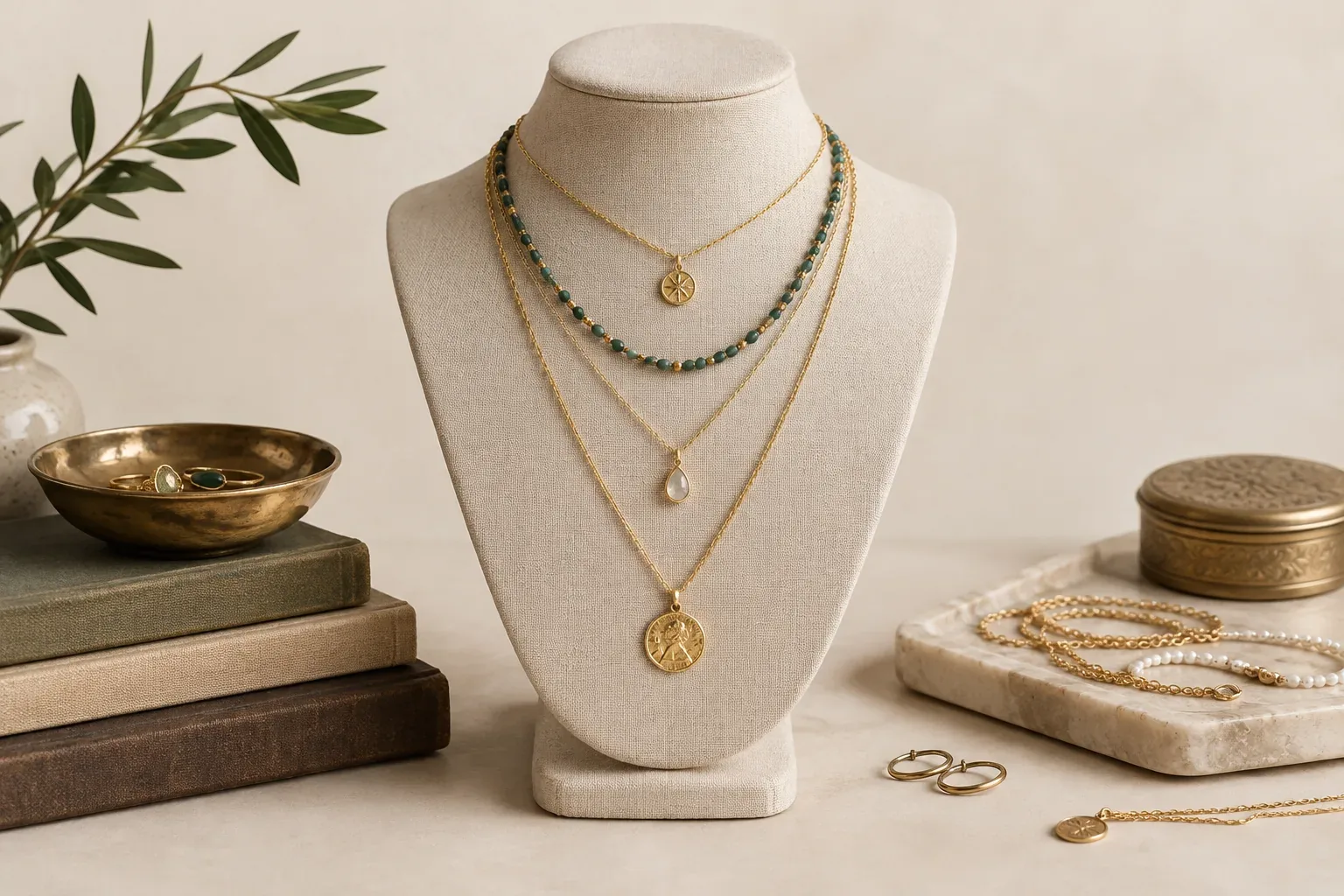
Start with clear length steps so each necklace is visible. Common length groups for everyday layering use a short chain (14–16 inches) at the collarbone, a medium chain (18 inches) that sits just below it, and a longer chain (20–24 inches) that falls on the upper chest. The visual principle is to leave at least an inch or two between pendants so each has breathing room and the layers read as distinct elements rather than a single cluttered mass.
Balance weight and focal points. Place the largest or heaviest pendant on the longest chain so the drop feels intentional rather than pulling against shorter chains. If you want an even visual rhythm, repeat a small motif in two different sizes or materials on separate lengths. If you prefer contrast, mix a fine chain with a chunkier link to create texture. Keep in mind that very heavy pieces may require specific clasps or reinforcement and may be less suitable for everyday casual wear.
Choose chains and clasps that reduce tangling. Chains with a more open or textured profile, such as box, curb, or paperclip links, slide past one another more readily than many fine cable chains. Using necklaces with different chain thicknesses and textures helps prevent the chains from wrapping together. Consider necklaces with fixed focal points or integrated short lengths that limit how much they can slide, or invest in a simple multi-chain clasp or connector that keeps multiple strands aligned on a single neckband.
Layering from a practical clothing perspective: match neckline to the stack. For a crewneck T-shirt, shorter layers sit best; for a V-neck, allow a longer pendant to follow the line of the neckline. Leave space for movement so pendants do not constantly bump into clothing seams or pockets, which causes wear and tangling.
Selection and gifting guidance: respectful, practical, and evidence-aware
Research motifs before wearing or gifting. If a pendant carries a specific cultural, national, or religious meaning, check reliable sources or museum descriptions to understand documented associations. The V&A’s collections can be a starting point for learning how particular motifs or settings were used in their historical contexts. If in doubt, ask the recipient or choose a neutral motif for a casual everyday stack.
Be transparent about materials. The Federal Trade Commission (FTC) advises sellers and buyers to disclose treatments, imitations, and the nature of gemstones and metals. If you are buying or gifting a gemstone pendant as part of a layered set, confirm whether the stone is natural, treated, lab-grown, or a simulant and make that clear to the recipient. This is especially important when the buyer or wearer values authenticity or wants to know about care and durability.
Match care needs to lifestyle. For a casual everyday wearer who wants low maintenance, choose durable metals such as solid gold or sterling silver with protective finishes and avoid softer stones that scratch easily. If gifting, include care notes about cleaning and storage to help the recipient preserve the layered look, and consider an organizer that keeps chains separated when not worn.
Respect personal and cultural boundaries when gifting symbolic jewelry. A gift that references personal beliefs or identity should reflect the recipient’s own practices or preferences. If the motif is uncertain in meaning or potentially sacred, prefer a more neutral decorative piece or obtain guidance from someone knowledgeable in that tradition.
Care, repairs, and material notes
Simple maintenance prevents tangles and extends wear. Remove layered necklaces before sleeping and store them flat or hung so chains do not cross. Regularly inspect jump rings and clasps for wear—small failures are the most common cause of lost pendants in layered sets. The FTC’s consumer guidance about buying gemstones, diamonds, and pearls includes advice that applies equally to care: know what you own so you can care for it appropriately and recognize when professional cleaning or repair is needed.
If a piece has historical or sentimental value, handle repairs conservatively. For vintage or heirloom pendants, consult a jeweller experienced in conservation rather than applying modern fixes that change the piece’s character. When buying new pieces intended to fit with older heirlooms, pay attention to scale and attachment types so that the modern item complements the older piece without forcing structural changes.
Final tips
Treat layered necklaces as a composition: think in lengths, textures, and a single focal point rather than a collection of unrelated elements. Keep historical and cultural meanings distinct from personal symbolism: use museum references like those from the V&A to understand documented context, and rely on personal interpretation for individual expression. Check material disclosures following FTC guidance when buying gemstones or unfamiliar metals, and prefer clarity and respect when choosing or gifting pieces with cultural or religious associations.
Frequently asked questions
What chain lengths should I use when layering necklaces for casual outfits?
A practical everyday layering approach is to use distinct length steps so each necklace is visible: a short chain around 14–16 inches at the collarbone, a medium chain around 18 inches, and a longer chain between 20–24 inches. Leave at least an inch or two between pendants so they do not overlap visually.
How can I avoid necklaces tangling when layered?
Choose chains with different textures and thicknesses, use fixed focal points, or employ a multi-chain clasp or connector to keep strands aligned. Store layered necklaces flat or hung separately, and avoid sleeping in them to reduce tangling.
Are there cultural or religious risks to wearing certain motifs?
Yes. Some motifs and symbols have specific cultural or religious meanings. Consult reliable references or museum descriptions to learn documented associations, and when gifting, ensure the recipient is comfortable with the symbol. If unsure, choose a neutral decorative motif.
How should I approach gemstones in layered necklaces?
Decide whether you prefer durable stones for everyday wear and confirm whether stones are natural, treated, lab-grown, or simulants. The FTC recommends clear disclosure about treatments and imitations, and knowing the material helps with care and expectations.
Can I mix heirloom pieces with modern necklaces?
Yes, but be mindful of scale, attachment styles, and fragility. Place heavier or focal heirloom pendants on the longest chain, and consult a jeweller for conservation-minded repairs rather than altering vintage pieces to fit modern hardware.
How many necklaces is too many for a casual look?
There is no fixed number, but for casual everyday wear three layers is a common and manageable maximum for clear visual separation. The goal is visible steps, balanced weight, and comfortable movement rather than sheer quantity.
Sources and further reading
- Bedazzled: A History of Jewellery — Victoria and Albert Museum
- An A-Z of Gemstones — Victoria and Albert Museum
- Buying Gemstones, Diamonds, and Pearls — Federal Trade Commission