Meaning at a glance
Choose earrings and rings for button-down shirts by balancing visual scale with collar proportions, selecting shapes that clear fabric and fasten securely for comfort, and considering gemstone treatments and cultural meanings separately from personal style — informed by museum history and consumer-protection guidance.
Historical evidence and changing contexts
Jewellery has not always been treated as purely decorative; the Victoria and Albert Museum (V&A) presents jewellery as a changing social language that signals status, identity, or sentiment across periods and places. The V&A's resources on the history of jewellery outline how forms, materials, and functions have shifted from ancient religious and funerary objects to Renaissance court display and later personal or fashion uses. The museum's coverage does not tie any single earring or ring shape to a universal meaning across all cultures, but it documents that scale and material choices often reflected social context and wearability.
The V&A's A–Z of gemstones explains how particular stones moved through historical fashions and uses. Gemstones that were once prized for rarity or believed properties later became fashion statements or symbols in specific cultural moments. That movement from material-signifier to fashion motif is exactly why present-day styling choices for button-down shirts should be informed by both historical context and contemporary practicality rather than assumed 'timeless' symbolism.
Documented historical meanings versus modern personal interpretation
Museum documentation demonstrates that historical meanings were often local, time-bound, and linked to social systems. For example, jewellery could indicate rank in a royal court, serve as a trade good, or be part of funerary practice, as outlined in the V&A's historical surveys. Those documented functions and meanings are specific to particular cultures and historical periods and should not be treated as universal.
Modern wearers commonly attribute personal meanings to motifs, gemstones, or inherited pieces, and those modern interpretations are valid personal or cultural practices. However, it is important to keep a clear distinction: if a motif historically belonged to a particular religious or social practice, that provenance is a documented fact in the historical record; choosing to wear a motif today may carry new personal significance that is separate from its original context. The V&A materials help identify the documented past; contemporary meaning-making is largely individual or communal and changes with fashion cycles.
How motifs, gemstones, and traditions appear in contemporary jewellery
Motifs that appear on modern pendants, studs, or signet rings often derive from historically recorded patterns, but they have been adapted in scale and material for everyday wear. The V&A shows many examples where motifs once used on large ceremonial objects are miniaturized into personal pieces. In contemporary earring and ring design for button-down shirts this means a motif can be rendered as a small stud, as a short drop pendant, or as an engraved signet that sits flush against a cuff or collar.
Gemstones behave similarly. The V&A’s A–Z of gemstones explains both aesthetic and historical uses of stones, while consumer guidance from the U.S. Federal Trade Commission (FTC) stresses that modern gems can be treated or imitated and that sellers must disclose treatments and imitations. In practice, that affects styling choices because some treatments influence durability and hardness — factors that determine whether a stone will withstand incidental contact with shirt fabric or buttons. Buyers should use the FTC guidance when evaluating gemstone resilience and truth-in-advertising rather than assuming a name alone guarantees particular properties.
Practical selection and gifting guidance
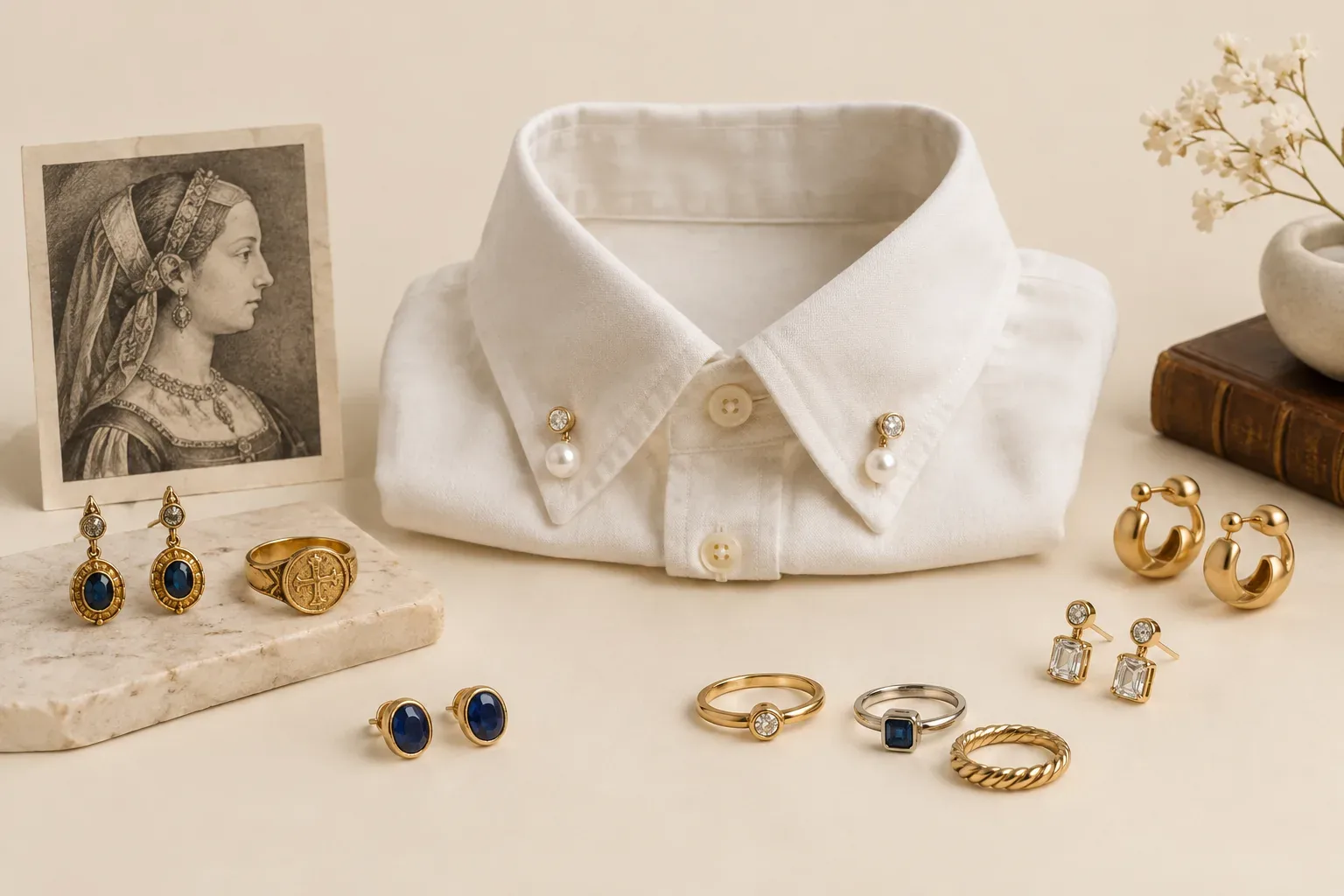
When selecting earrings or rings for someone who often wears button-down shirts, start by observing how they wear their collars. If they frequently button to the neck or wear narrow collars, choose small studs, very thin hoops, or short drop earrings that sit close to the lobe. When collars are left open or are wide, slightly larger hoops or longer, tapered pendants will balance the neckline without snagging the fabric. For rings, examine sleeve length and cuff tightness. A wide, high-profile ring can press against fabric or obstruct buttoning; a lower-profile bezel or flush-set stone is less likely to catch.
For gifting, be respectful of any cultural or familial symbolism. If a motif might have specific cultural or religious meaning, ask discreetly about its significance or choose neutral designs if unsure. When the gift involves gemstones, consult sellers about treatments and origin as recommended by the FTC, and request documented disclosures. Consider comfort-fit bands, plain signets, or thin stacked rings that are easier to layer with shirt cuffs. If your recipient values historical provenance, include a note explaining the documented history of a motif sourced from museum references rather than asserting universal meaning.
Styling rules: scale, shape, and comfort
Scale is the simplest practical concern. A collar that is tightly buttoned creates a small visual space; heavy or long earrings will compete with that area and are more likely to catch. Aim for earring length that sits within the vertical measurement of the open collar or falls no further than the top of the shirt placket when worn with a typical buttoning style. When collars are open, you can increase the visual scale of earrings, but still avoid elements that protrude sharply or have exposed hooks.
Shape determines how easily a piece will interact with fabric. Smooth, rounded shapes and hinged closures are less likely to snag than multi-pronged settings or sharp filigree. For rings, choose settings without high claws or protruding elements if you expect the wearer to handle buttons or cuffs regularly. Comfort is a function of weight and balance as well as closure: secure backs for earrings and interior-rounded bands for rings reduce the risk of irritation or movement while dressing.
Care, materials, and disclosure
Materials matter for both longevity and comfort. The V&A's A–Z of gemstones and the museum's historical summaries highlight how certain materials were historically prized, but modern buyers should also consider durability and wearer sensitivity. The FTC guidance on buying gemstones, diamonds, and pearls makes clear that treatments and imitations must be disclosed, and that those treatments can affect durability. For example, softer or filled stones may be more vulnerable to abrasion from fabric or fasteners. Ask sellers about hardness, treatments, and recommended care.
Consider hypoallergenic metals for people with sensitive skin, and favor closed-back or bezel settings when durability is important. When cleaning jewellery worn frequently with shirts, avoid harsh chemicals that can dull polish or damage stones and finishes, and check that clasps or settings are secure after repeated contact with fabric. These are practical steps that protect both the jewellery and the garment.
Final thoughts
Styling jewellery for button-down shirts is primarily a design and comfort question informed by historical context. Museum documentation, like that from the Victoria and Albert Museum, helps trace how jewellery’s form and function have changed, and government consumer guidance, like the FTC’s advice, helps you evaluate materials honestly. Neither source prescribes how an individual should wear jewellery today; they provide evidence about historical usage and consumer protections so you can make informed, respectful choices.
When in doubt, prioritize safe closures, lower-profile ring settings, and materials appropriate to the wearer’s lifestyle. If you are gifting, combine an awareness of provenance with clear information from the seller about materials and treatments. That approach keeps the focus on wearability and respect for both the object’s history and the person who will wear it.
Frequently asked questions
What earring lengths work best with a high-buttoned collar?
With a high-buttoned collar, choose earrings that sit close to the earlobe, such as studs, small hoops, or short drops. These maintain a tidy silhouette and reduce the chance of catching fabric when buttoning or moving.
Which ring settings are least likely to snag shirt cuffs?
Low-profile bezel settings, flush-set stones, and plain bands without raised claws are least likely to catch on cuffs. Comfort-fit bands also reduce rubbing and pressure when sleeves move.
How should I check for gemstone treatments or imitations before buying?
Ask the seller for written disclosure about treatments, enhancements, and whether stones are laboratory-grown or imitations. The U.S. Federal Trade Commission recommends that sellers clearly state such information, and consumers should use those disclosures when assessing durability and value.
Are there motifs I should avoid gifting because of cultural sensitivities?
If a motif is closely associated with a particular religion or cultural practice and you are unsure of the recipient’s relationship to that culture, it is respectful to either ask discreetly or select a neutral design. Museum resources can help identify a motif’s documented provenance, but contemporary sensitivities vary by community.
How can I make jewellery more comfortable for everyday wear with shirts?
Choose lighter pieces with smooth shapes and secure closures, ensure ring sizes allow natural finger movement without tightness, and opt for hypoallergenic metals if the wearer has sensitive skin. Regularly check clasps and settings to prevent accidental catching.
Sources and further reading
- Bedazzled: A History of Jewellery — Victoria and Albert Museum
- An A-Z of Gemstones — Victoria and Albert Museum
- Buying Gemstones, Diamonds, and Pearls — Federal Trade Commission