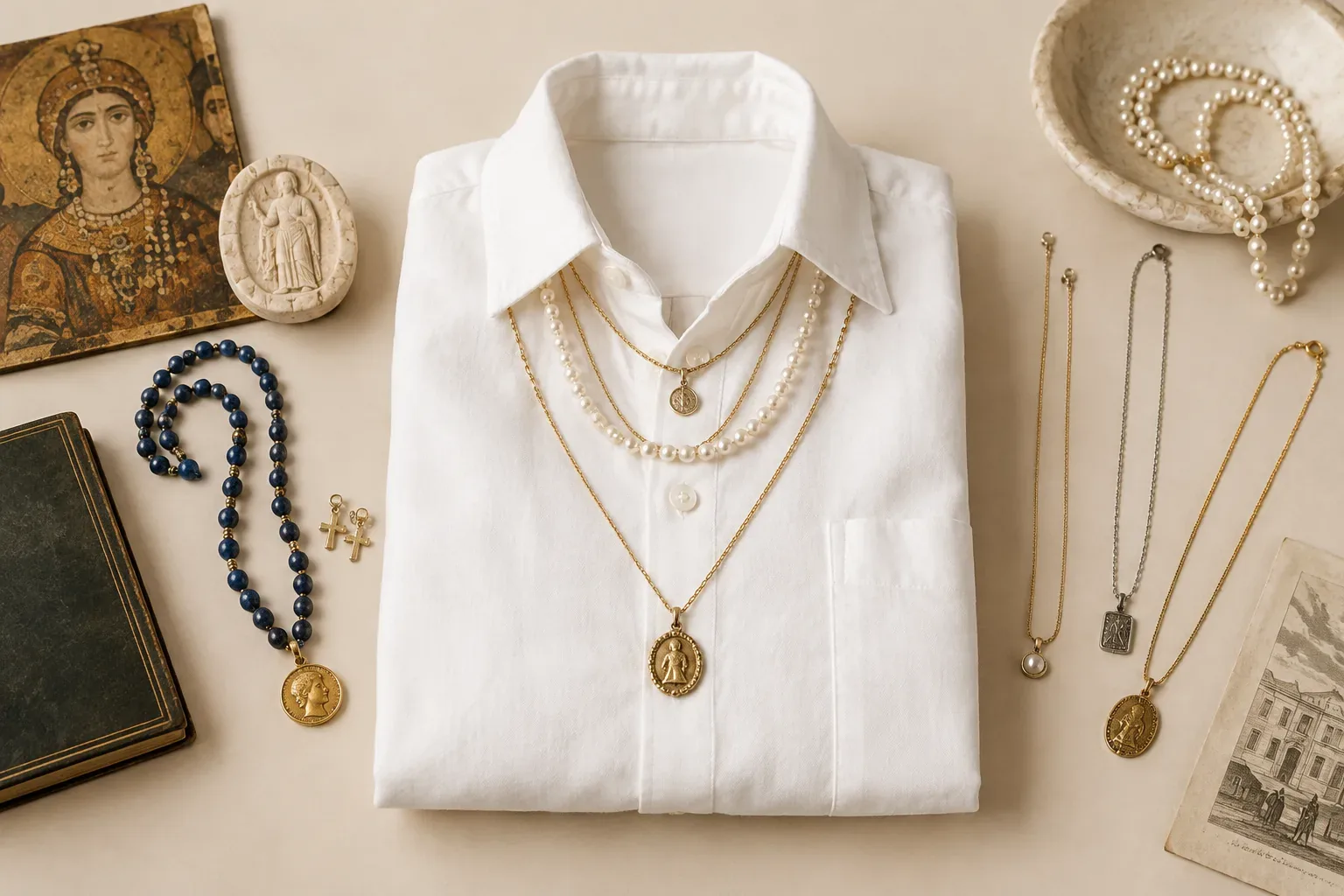
Meaning at a glance
Explain the documented history and changing contexts of the jewelry for button-down shirts necklace layering motif, separate cultural or religious evidence from later popular interpretations, and give practical guidance for choosing and wearing the motif in modern jewelry.
Quick answer
Layered necklaces work well with button-down shirts if you choose complementary lengths, keep a clear focal point, and manage chain thickness to avoid tangles. Historically, people have layered pendants and chains as part of changing fashion and social practices; modern wearers add personal meanings that are not universally documented. Use shorter chains closer to the collar and longer chains that fall over the shirt opening, balance scale and weight visually, and favor secure clasps or link-spacers to reduce tangling.
What history actually shows
Museum research indicates that jewelry styles and the social meanings attached to them have shifted repeatedly across time and place. The Victoria and Albert Museum summarizes jewellery’s long history, demonstrating that what was fashionable, what signified status, and how pieces were worn all changed with dress, technology and social norms. The V&A’s overview shows that layering, pendants, and ornamental chains appear in many periods as decorative and social signifiers rather than as a single, stable symbol.
That broad museum perspective is useful when thinking about modern layering over a button-down shirt: the practice of wearing multiple necklaces together is part of a longer pattern where layered pieces reflect taste, class, sentiment, or ritual in different contexts. Specific meanings must be traced to their own cultures and historical moments; the V&A’s material makes clear that a single look can carry many different, time- and culture-specific meanings rather than a single universal message.
Separate documented cultural meanings from modern interpretations
Where a symbol, motif, or gemstone has an established cultural or religious meaning, that meaning is documented within that culture’s history and objects; where it does not, contemporary wearers may assign personal significance. For example, a religious pendant worn close to the throat may be identifiable as a faith symbol in a particular faith tradition and has meanings anchored in that tradition’s texts and practices. That documented usage is different from modern fashion choices in which the same pendant might be worn as a purely aesthetic focal point.
When you see layered necklaces on a button-down shirt today, part of the message is stylistic and part may be personal. The documented historical record, as surveyed by the Victoria and Albert Museum, supports reading layers as social and stylistic practice rather than assuming a single symbolic meaning for everyone who wears them. Always avoid assuming that a motif seen in modern fashion retains all its historical or religious connotations in every use.
How motifs, gemstones, and traditions appear in layered necklaces
Motifs such as lockets, small medallions, geometric pendants, and charm clusters commonly serve as focal points in layered necklaces. In layered styling these elements are typically placed on chains of different lengths so one motif sits nearer the collar and another becomes a visual anchor lower on the torso. Historically, small portrait lockets and sentimental pendants were common personal markers; the V&A documents lockets and portrait miniatures as persistent forms of sentimental jewelry, illustrating how a small suspended object becomes a focal point.
Gemstones appear in layered necklaces both as center stones in pendants and as beaded chains that add color and texture. The Victoria and Albert Museum’s A–Z of Gemstones describes individual gems’ physical qualities and how they were used in jewellery across different periods. That resource helps identify which stones are commonly faceted or cabochon-set, and how their color and hardness affect everyday wear—useful when choosing stones for a necklace you plan to layer with other pieces.
Materials and construction affect how a motif behaves when layered. Flat, lightweight pendants and small bezel-set stones sit neatly against a shirt placket; heavy, protruding mounts can pull chains or flip inward and increase tangling. Chain type—snake, box, cable, curb—also changes how a layered combination drapes and whether pieces lie flat against fabric or twist around one another.
Practical guidance for choosing and wearing layered necklaces with button-down shirts
Start with length planning: commonly used necklace-length ranges are choker (around 14–16 inches), princess (approximately 17–19 inches), matinee (20–24 inches) and opera (28–36 inches). For a standard button-down shirt leave space for the collar and buttons; a three-layer arrangement that works with many shirts places a short chain that sits above or at the top button, a mid-length that lands somewhere near the mid-placket, and a longer chain that falls near the lower placket or just above the chest. Keep at least 2–4 inches of difference between adjacent lengths to reduce overlap and tangling.
Balance chain thickness and focal weight. Put the heaviest pendant on the sturdiest chain and nearer the middle or lower position so it reads as the anchor. Lightweight chains with small motifs can fill in above without pulling on shirt fabric or creating uneven tension across collars. Consider visual contrast: mixing metals can work if the motifs are intentionally coordinated, but abrupt changes in scale (a very thick chain next to a fine chain) can look top-heavy and increase twisting.
Control tangling with small technical choices. Use chains of different textures so they resist knotting, or add a simple spacer bar or multi-strand connector behind the neck to hold chains apart. When you layer necklaces at home, clasp them in the order you plan to wear them from shortest to longest so they separate naturally when you put them on. For travel, hang layered sets individually rather than stuffing them into a pouch to avoid knots.
Consider shirt details. A spread or button-down collar gives a frame for shorter pieces; a narrow placket benefits from a single, clear focal point. When shirts are buttoned to the throat, choose a short, close-set piece or omit the longest layer so nothing crowds the neckline. When the shirt is worn open, longer chains and pendants can take advantage of the visible negative space created by the opening.
Clasp, material, and care choices matter for durability and disclosure. If a piece contains gemstones or has undergone treatments, check seller information and disclosure. The Federal Trade Commission advises buyers to expect transparency about treatments, imitations, and the nature of gemstones and pearls. When gifting, ask whether a jeweler provides written information on the materials and care so the recipient knows how to preserve the piece.
Respectful selection and gifting guidance
Be mindful of cultural and religious symbols. If a pendant explicitly references a living religion or a cultural practice, research its meaning and current usage before gifting or wearing it casually. The V&A’s historical materials demonstrate how objects that functioned as personal or communal markers in one time or place can be repurposed in another; that historical fluidity does not remove the contemporary significance that a community may attach to a symbol today.
Choose motifs and materials with the wearer in mind. For someone who moves between professional and casual settings, select chains with secure clasps and low-profile mounts that won’t catch on collars. If you want a sentimental piece, lockets or small engraved pendants remain historically recognized forms for personal messages; see the V&A for background on sentimental jewellery traditions. For gemstone choices, prioritize hardness and setting security for stones meant for everyday wear, and consult seller disclosures about treatments and imitations as recommended by the Federal Trade Commission.
When in doubt, ask. A respectful question—about preferences, about any religious symbolism, or about allergic sensitivities to certain metals—often matters more than an assumption. Gifting a layered set can be both practical and intimate; include care instructions and, where appropriate, provenance or treatment information so the recipient can make informed decisions.
Care, repair, and longevity
To reduce wear on chains passing over shirt buttons, choose hard-wearing metals and protective settings for gemstones. Store necklaces separately to minimize abrasion and tangling, and check clasps and jump rings regularly. For stones and pearls that are softer or porous, follow the specific cleaning guidance given by reputable museum resources and retailers, and heed any treatment disclosures that accompany the piece.
If a layered set is intended as an everyday combination, have a jeweller review the construction: soldered jump rings and soldered clasps reduce the chance of breakage, and welded or thicker connectors can support heavier pendants. For heirloom or antique pieces, consult a conservator or trained jeweller before adapting them for new wear habits; museum documentation shows that older constructions often require different handling than modern machine-made chains.
Closing guidance
Layering necklaces with button-down shirts is a practical way to combine personal expression with dress. Ground your choices in the wearer’s lifestyle and the construction of the pieces, and treat motifs with respect by separating documented cultural meanings from modern personal uses. Use the practical steps above—length spacing, balanced weight, secure clasps, and simple anti-tangle techniques—to make layered necklaces sit comfortably and elegantly over a button-down shirt.
Frequently asked questions
What necklace lengths work best with a standard button-down shirt?
A three-layer scheme often used with button-down shirts places a short chain near the collar (about 14–16 inches), a mid-length chain around 17–20 inches, and a longer chain falling at 24 inches or more; keep 2–4 inches between adjacent layers to reduce overlap and tangling. Adjust to the wearer’s torso length and the shirt’s collar style.
How can I stop layered necklaces from tangling when I put them on?
Clasp necklaces in order from shortest to longest, use slightly different chain textures to reduce knotting, and consider a small multi-strand connector or spacer behind the neck to hold chains apart. For storage, hang each layered set separately to avoid travel tangles.
Are there materials or gemstones I should avoid for everyday layered wear?
Choose hard stones and secure settings for everyday pieces; softer or porous gems and some organic materials require gentler handling. Also check seller disclosures about treatments and imitations—regulators such as the Federal Trade Commission advise buyers to expect transparent information about gemstone treatment and authenticity.
Is it appropriate to wear cultural or religious symbols as part of a layered look?
If a piece has an identifiable cultural or religious meaning, research its contemporary significance before wearing or gifting it casually. Museum histories show that objects can shift meaning over time, but that does not remove current community meanings. When unsure, ask or choose neutral motifs.
What should I look for when gifting a layered necklace set?
Select coordinated lengths that suit the recipient’s shirt styles, prioritize secure clasps and appropriate materials, and include information on gemstone treatments or care as provided by the seller. A brief note asking about any cultural or religious preferences can make a gift more thoughtful and respectful.
Sources and further reading
- Bedazzled: A History of Jewellery — Victoria and Albert Museum
- An A-Z of Gemstones — Victoria and Albert Museum
- Buying Gemstones, Diamonds, and Pearls — Federal Trade Commission