Meaning at a glance
Explain the documented history and changing contexts of the jewelry for strapless dresses necklace layering motif, separate cultural or religious evidence from later popular interpretations, and give practical guidance for choosing and wearing the motif in modern jewelry.
Why a history-first approach matters
Decisions about what to wear with a strapless dress are both aesthetic and cultural. Understanding how necklaces and layering have been used in different periods helps you make choices that are stylish and respectful rather than assuming meanings are universal. The Victoria and Albert Museum’s overview of jewellery history emphasizes that jewelry has long signaled rank, personal identity, and taste as its social contexts change, so contemporary styling sits on a deep, variable past rather than a single tradition.
Documented historical evidence and where it comes from
Museum research collected by the Victoria and Albert Museum demonstrates that necklaces, pendants, and layered ornament have been made and worn from ancient times through the modern era, and that their forms changed with technology, materials, and social norms. The V&A’s exhibition and research materials show examples across cultures and periods where neck ornamentation functioned as personal display, a marker of social status, and sometimes as a carrier of symbolic objects or portraits.
The V&A’s A–Z of gemstones provides context for how particular stones entered jewelry collections and how their cutting, setting, and perceived value evolved. Historical associations of particular gems reflect those changing fashions and technologies rather than a single, fixed meaning. For consumer-facing concerns about modern materials and treatments, the U.S. Federal Trade Commission explains rules and guidance vendors should follow about disclosure of treatments, imitations, and the origins of gemstones, which matters when you are choosing a piece to wear against bare skin or giving one as a gift.
Separating documented historical meanings from modern personal interpretations
Documented historical meanings are the functions and social uses scholars and museums have recorded: for example, the use of neck ornaments to indicate rank, affiliation, or commemoration as described in museum catalogues and exhibitions. These are contextual observations about how objects were used within particular societies and times, and they belong to the documentary record rather than to everyone who wears the object today.
Modern personal interpretations are individual or community meanings that develop in contemporary contexts, such as wearing layered necklaces with a strapless dress to emphasize the neckline, to signal a fashion sensibility, or to express personal sentiment through pendants and charms. These interpretations are valid as personal expression but should not be presented as the historical or universal meaning of any particular motif or stone.
How necklace layering and motifs appear in jewelry
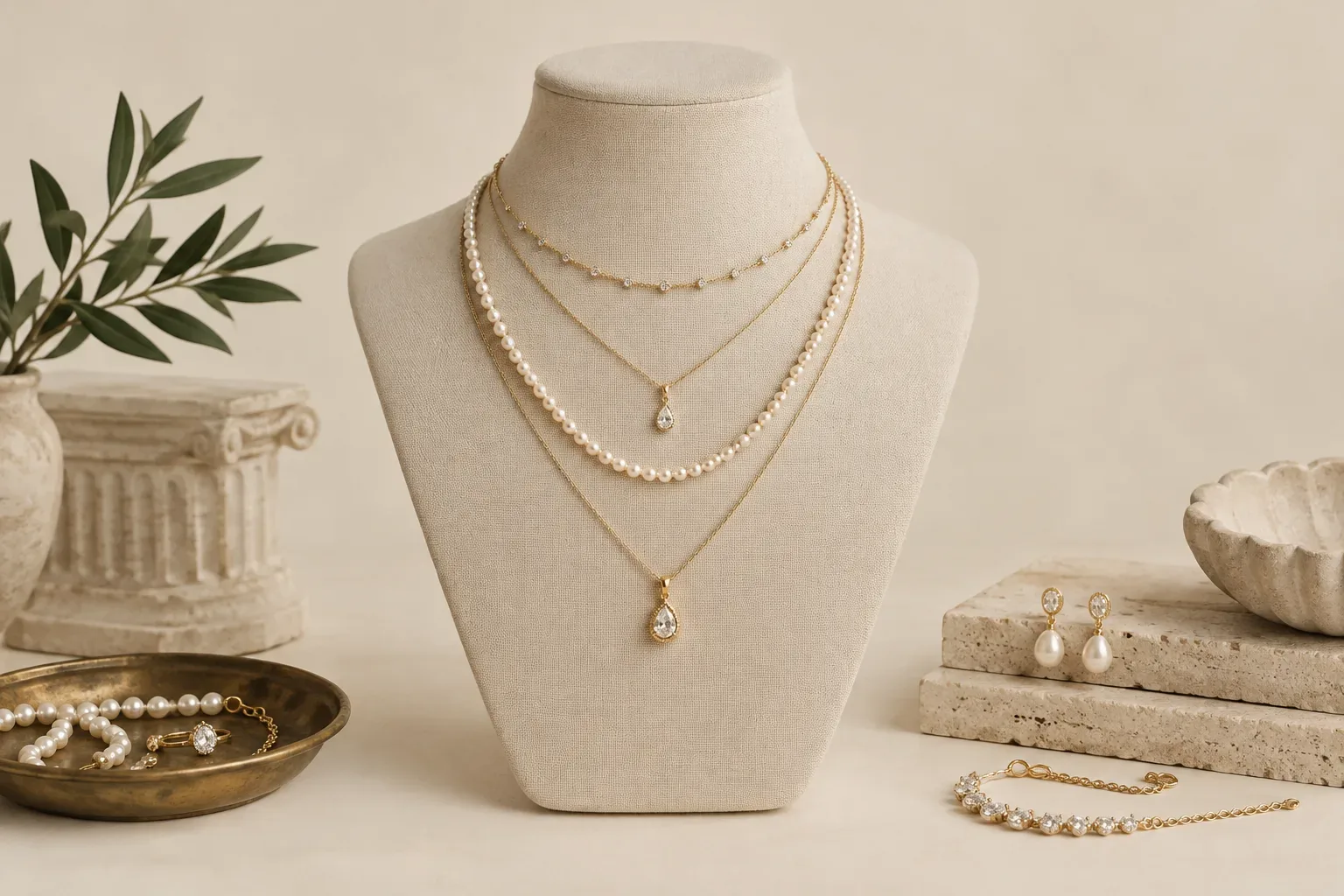
Layering is a compositional approach rather than a single motif: it combines different necklace lengths, finishes, and focal points. Historically documented jewelry shows many instances of suspended pendants, chains, and strung gemstones, and contemporary layered sets mirror that long practice by combining chokers, short chains, pendant necklaces, and longer strands to create depth across the throat and chest.
Motifs that appear in layered designs include simple geometric discs, solitary gemstones set as pendants, engraved lockets, and small charms. Gemstones themselves are incorporated as centerpieces or as bead strings; the V&A’s A–Z of Gemstones explains how cutting styles and settings influence how a stone reads visually and how it will sit in a layered composition. When a historic motif resurfaces in modern jewelry, careful makers will adapt proportions and suspensions so that pieces sit well together and do not compete visually or mechanically.
Length: choosing proportions for strapless necklines
With a strapless dress you have a wide open neckline, so layering is primarily about graduated vertical space. Start with the shortest piece close to the collarbone, add a mid-length focal piece, and finish with a longer line for balance. Aim for clear vertical separation so each necklace has its own visual territory and does not sit on exactly the same plane as another.
Practically, select pieces so that each falls a few centimeters below the one above it, creating a stepped effect. This graduated approach respects the strapless silhouette by echoing its horizontal boundary with a complementary vertical rhythm, helping the eye move naturally from the neck to the décolletage without one piece overwhelming the others.
Balance: mixing weights, focal points, and metals
Balance comes from contrasting scale and focal weight. Pair a delicate choker or short chain with a bolder pendant on a mid-length chain, and consider a longer, simpler strand to finish the composition. If every necklace has an equally strong focal ornament, the result can feel crowded; instead, choose a single dominant center of attention and support it with subtler companions.
Metal tones can be mixed for a contemporary look, but do so with intention. Combining similar undertones or repeating a small motif across different lengths will create cohesion. If you are gifting, consider the recipient’s existing wardrobe and metal preferences to avoid forcing a combination that will rarely be worn.
Tangling: construction choices and practical wear tips
Tangling is a mechanical problem solved by construction and wear technique. Choose necklaces with different clasp placements, chain thicknesses, or chain textures; a variety of chain styles is less likely to fuse into a single knot than several identical thin chains. Fasten longer pieces first and shorter pieces last so the shortest sits nearest your neck without threading through the longer ones.
Use small, discrete anti-tangle solutions if you need them: a single connector that clasps multiple short chains at different points behind the neck or a weight on the longest strand can keep pieces distributed and prevent looping. When storing layered sets, lay them flat, or hang each piece separately to avoid introducing kinks and loops that become tangles when you put them on.
Materials, gemstone choices, and disclosure
If you plan to layer with gemstones against bare skin, consider hardness, setting security, and weight. The V&A’s A–Z of Gemstones emphasizes that different stones have different historical and material qualities, and those qualities affect how a stone is cut and set. Softer stones can scratch or chip when worn close to the body, so protective settings or bezel mounts are practical choices.
When buying or gifting, ask about treatments, imitations, and disclosure. The Federal Trade Commission offers guidance that sellers should disclose artificial enhancements, glass-filled stones, and imitations, because these factors influence care needs, value, and wearer expectations. Respectful gifting includes communicating what the piece is, any special care it needs, and whether the stones are natural, treated, or lab-created.
Cultural respect and thoughtful gifting
Some motifs and techniques carry cultural or religious significance in particular communities. Because museum work shows that meanings are specific to time and place, avoid assuming that a motif you like from one context can be borrowed without consequence in another. If a design element is clearly identified as belonging to a living cultural tradition, consider the maker’s provenance, the community’s views on cultural use, and whether the piece was produced with consent and fair compensation.
When you choose a layered set as a gift for someone who will wear it with a strapless dress, consider their everyday jewelry habits, skin sensitivity, and symbolic preferences. A practical note included with the gift about materials, cleaning, and how to avoid tangles will help the recipient wear the piece more often and with confidence.
Putting it together: a simple styling workflow
Start by identifying the point you want to emphasize: the collarbone region, a pendant at mid-chest, or a sweeping long line. Select one piece to act as the focal point and choose two or three supporting pieces with graduated lengths and contrasting weights. Try the set on with the actual dress and adjust lengths so that the top piece sits near the collarbone and the longest piece finishes a few inches above the bust line to keep the overall effect elegant rather than heavy.
Finish by checking comfort and movement. Walk, sit, and raise your arms to make sure nothing catches on the dress and that the necklaces move independently. If a piece shifts or threads through another, change clasp order or introduce a connector to secure the arrangement without altering the visual composition.
Frequently asked questions
What necklace lengths work best for a strapless dress when layering?
Aim for graduated lengths so each necklace has its own space. Start with a short piece near the collarbone, add a mid-length focal necklace a few centimeters lower, and finish with a longer, simpler strand that falls several centimeters below the mid-piece. This stepped arrangement creates vertical rhythm and avoids visual crowding.
How can I stop layered necklaces from tangling when putting them on for a strapless dress?
Fasten longer chains first and shorter ones last so the shortest sits nearest the neck without threading through the longer pieces. Choose a mix of chain thicknesses or textures, consider a small connector to anchor multiple short chains behind the neck, and store pieces flat or hung separately to reduce pre-existing loops.
Are certain gemstones unsuitable for wearing close to bare skin in a layered look?
Some softer gems can scratch or chip more easily and may need protective settings such as bezels. The Victoria and Albert Museum’s gemstone guidance highlights material differences, and the Federal Trade Commission recommends asking sellers about treatments and durability so you can choose stones suited to frequent wear.
How do I respect cultural meanings when choosing motifs for layered necklaces?
Because meanings are context-specific, avoid assuming that a motif is decorative only. If a design clearly belongs to a living cultural or religious tradition, research its provenance, consider whether the item was produced with community consent, and prefer makers who acknowledge and compensate cultural origins. Treat such symbols with the same care you would a personal emblem.
What should I ask a seller before buying a gemstone necklace as a gift?
Ask whether the stones are natural, lab-created, or imitations, and whether any treatments have been applied. The Federal Trade Commission advises that sellers disclose enhancements and imitations. Also ask about setting security, metal content, and cleaning recommendations so the recipient can wear and care for the piece safely.
Sources and further reading
- Bedazzled: A History of Jewellery — Victoria and Albert Museum
- An A-Z of Gemstones — Victoria and Albert Museum
- Buying Gemstones, Diamonds, and Pearls — Federal Trade Commission