Meaning at a glance
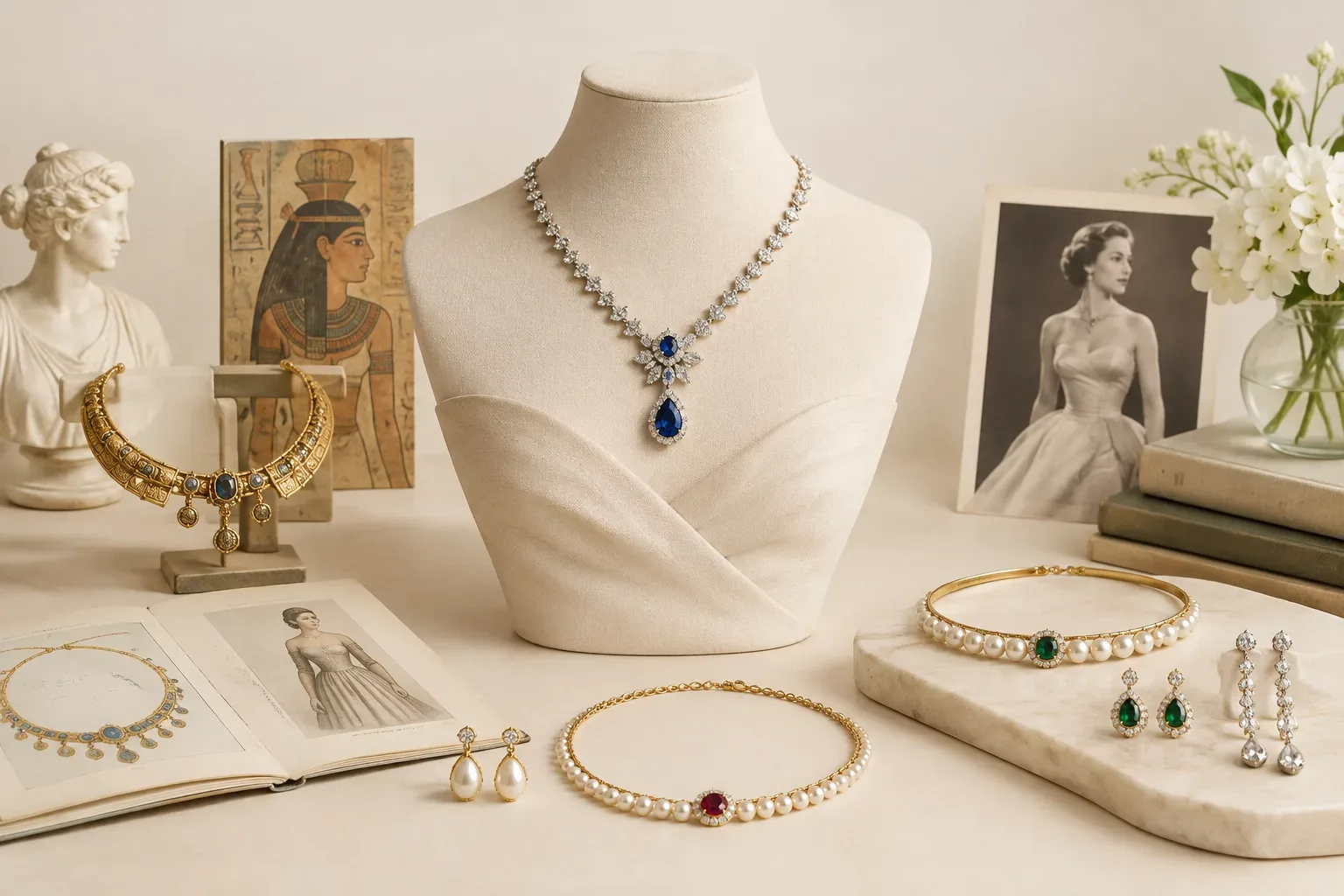
Choose jewelry for a strapless dress by making the piece's scale and focal point complement the dress's neckline and the wearer’s proportions, select gemstone colors that harmonize with fabric and skin tone, and use historical context only as background rather than prescriptive symbolism.
Why proportion, color, and focus matter
A strapless dress removes shoulder and strap visual anchors, which makes the neck, collarbones, and upper chest the primary canvas for jewelry. This altered visual field changes how scale and focal points read: a very long necklace can look lost against bare skin, while an oversized collar can compete with rather than complement the gown. Proportion addresses scale between body, garment, and jewelry. Color determines how jewelry reads against fabric and skin. Focus is the intended visual destination—the throat, the face, the décolletage, or the shoulders.
Documented historical evidence and changing contexts
Jewellery’s role in marking status, identity, and fashion has shifted across eras and cultures. The Victoria and Albert Museum’s materials on the history of jewellery emphasize that what a necklace, brooch, or earring 'meant' changed with social context, fashion, and technology rather than staying fixed. The V&A exhibition text and articles document how jewellery functioned differently in court dress, mourning fashions, and mass-produced modern styles, showing social rather than universal symbolic systems.
Gemstones and materials likewise carry varied histories. The V&A’s A–Z of Gemstones outlines how particular stones acquired prestige or popularity at particular times because of trade, lapidary technology, or changing tastes rather than because of immutable meanings. For example, the prominence of pearls or diamonds in a given period often related to supply, cutting techniques, or the conventions of court and bridal dress rather than a single universally agreed symbolic message.
Separating documented historical meanings from modern interpretations
Documented historical meanings are those that museums, records, and contemporary writers linked to objects at the time, such as jewellery used in court ceremonies, mourning jewellery worn in the Victorian period, or specific gemstones valued because of trade routes and fashion. The Victoria and Albert Museum’s resources make this distinction clear: jewellery is best understood as embedded in shifting social practices.
Modern personal interpretations are how wearers and gift-givers read meaning today. Wearing a choker with a strapless dress might now be read as edgy, vintage-inspired, or romantic depending on taste. These contemporary readings are legitimate personal meanings but are not the same as established historical function. Treat historical documentation as context: it enriches understanding but does not dictate what a piece must mean to the current wearer.
How motifs, gemstones, and traditions appear on strapless-appropriate jewellery
Motifs and forms commonly used with strapless necklines include collar necklaces, chokers, princess-length necklaces, pendants, and statement bib pieces. Collars and chokers sit near the throat to frame the neckline; princess-length necklaces (typically around 45 cm or 18 inches) fall near the collarbone and are a classic pairing with low or strapless bodices. Pendants create a vertical line that draws the eye down the centre of the chest, which can lengthen the torso visually.
Gemstones appear in these settings both as isolated focal stones and as repeated motifs. The V&A’s A–Z of Gemstones explains how different stones have been cut, mounted, and combined in different historical periods; the same techniques are used in modern designs to create contrast or harmony with fabrics. Pearls, for instance, have long been used in collar and princess lengths; diamonds are often set to add sparkle to a neckline. Modern settings use these materials in contemporary silhouettes but the physical placement—collar, pendant, drop—remains the primary factor in how they affect proportion and focus.
Practical guidance for choosing jewellery for a strapless dress
Start with the dress’s neckline shape and the look you want. A straight-across strapless bodice benefits from a curved collar or choker that echoes the line. A sweetheart neckline pairs well with a pendant that nestles in the curve. For a plunging strapless dress, choose a longer pendant to echo the vertical dip and avoid collars that stop above the plunge and look disconnected.
Consider the wearer’s proportions. Short necks are often best complemented by longer lines or modest pendants that visually lengthen the throat; long necks can carry chokers and collars without appearing overwhelmed. Broader shoulders can balance a wider collar necklace, but if the goal is to soften the shoulder line, choose a focal pendant or statement earrings instead.
Match color thoughtfully. Use gemstone color to harmonize with fabric or to create a deliberate contrast. Cool-toned stones and metals read differently on warm-toned fabrics and skin than on cool tones. The V&A’s A–Z of Gemstones provides historical context for stones but use contemporary color theory and personal preference as your primary guide for pairing.
Decide where you want the visual focus to be. If the jewelry is the focal point, simplify other accessories: opt for a single statement necklace and small studs. If the face is the focus, emphasize earrings and keep the neckline minimal. Remember that the dress and jewelry should work together; avoid competing centers of attention.
Respectful selection and gifting guidance
When selecting jewellery as a gift for someone who will wear a strapless dress, learn their preferred scale and metal tones discreetly. Some people prefer delicate pieces; others favor bold statements. Consider whether the recipient typically wears fine or fashion jewellery and whether they have metal allergies. Matching the metal to their usual jewellery—yellow gold, white gold, rose gold, or silver—will make the gift more wearable.
Be aware of cultural and personal significance. While museums like the V&A document historical uses, a motif that was ceremonial in one culture might be purely decorative or even inappropriate in another context today. If a motif is known to have sacred or community-specific meaning, confirm that the recipient will be comfortable wearing it in a contemporary setting.
For special occasions, choose pieces that allow flexibility. A convertible necklace that can be worn as a choker or with a drop pendant offers options to suit different strapless silhouettes. If you are uncertain about size, choose designs that can be adjusted or returnable receipts. Presentation and a thoughtful note about why you chose the piece will make it more meaningful than relying on a presumed symbolic meaning.
Buying, authenticity, and care
When buying gemstones or pearls for a strapless-appropriate piece, be alert to treatments and imitations. The Federal Trade Commission’s guidance on buying gemstones, diamonds, and pearls explains that many gems undergo treatments to improve appearance and that sellers should disclose treatments and whether a stone is natural or synthetic. Ask for documentation and, where appropriate, certificates for valuable stones.
Consider construction and wearability. A strapless dress often accompanies formal occasions, so choose secure settings and sturdy clasps. Think about comfort: heavy necklaces can shift on bare skin, and certain settings can chafe at the collarbone. Care instructions will vary by material; follow professional cleaning and storage guidance for pearls and soft gemstones.
Putting the pieces together
Balance is the guiding principle. Let the dress’s silhouette and the wearer’s proportions guide whether size, color, or focal point should dominate. Use historical resources such as those from the Victoria and Albert Museum to appreciate how similar combinations have been used in different periods and to avoid assuming fixed symbolic meanings. Use FTC guidance when assessing value and disclosure, and choose pieces that the recipient can comfortably wear and care for.
Frequently asked questions
Is a choker or a pendant better for a strapless dress?
It depends on the neckline and the look you want. A choker or collar frames a straight or high-across strapless bodice, while a pendant adds a vertical focal point to sweetheart or plunging necklines. Consider the wearer’s neck length and overall proportions before deciding.
Which gemstones suit formal strapless gowns?
Choose stones that either harmonize with the gown’s color or provide a deliberate contrast. Traditional choices include pearls and diamonds for formal wear, but colored gemstones can be equally appropriate; the Victoria and Albert Museum’s A–Z of Gemstones provides historical context for many popular stones.
How can I make a necklace versatile for different strapless styles?
Select convertible pieces or those with adjustable lengths so the necklace can be worn as a choker or a longer pendant. Convertible designs let the wearer adapt the piece to different necklines without buying multiple necklaces.
Should I worry about gemstone treatments when buying jewelry for a special occasion?
Yes. The Federal Trade Commission advises buyers that many gemstones are treated or enhanced and that sellers should disclose such treatments. Ask for documentation or certificates for higher-value stones to understand whether you are buying natural, treated, or synthetic material.
Are there cultural meanings I should avoid when gifting jewelry?
Some motifs have specific cultural or religious significance. If you suspect a motif might be sacred or community-specific, check its meaning respectfully before gifting. Use historical resources for context, but prioritize the recipient’s comfort and cultural background.
How do I choose between statement earrings and a necklace with a strapless dress?
Decide which area you want to emphasize. If the goal is to draw attention to the face, choose statement earrings and pair them with a simple necklace or none at all. If you want to emphasize the décolletage, select a necklace as the main focal point and keep earrings understated.
Sources and further reading
- Bedazzled: A History of Jewellery — Victoria and Albert Museum
- An A-Z of Gemstones — Victoria and Albert Museum
- Buying Gemstones, Diamonds, and Pearls — Federal Trade Commission