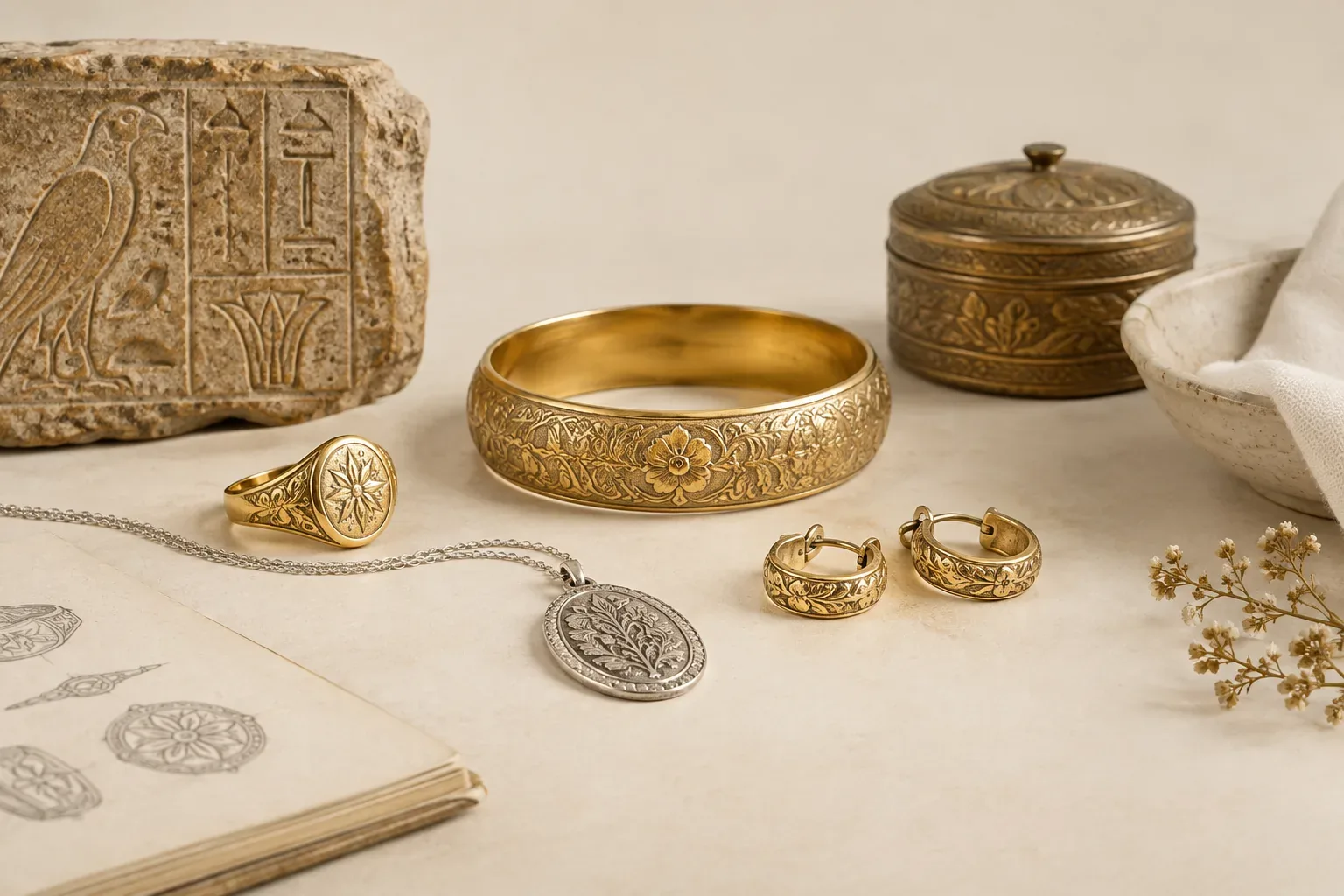
Meaning at a glance
This guide explains the documented history and changing contexts of engraved jewelry, separates cultural and historical evidence from later interpretations, and gives safe, practical cleaning and storage methods plus advice for selecting or gifting engraved pieces.
Direct answer — what this guide explains
Concise answer: Engraved jewelry cleaning and storage requires gentle, non-abrasive cleaning of engraved recesses, careful avoidance of treatments or machines that can damage soft gemstones or shallow engraving, and individual, low-humidity storage to prevent tarnish and scratches. This article explains the documented history and changing contexts of engraved jewelry, separates cultural or religious evidence from later popular interpretations, and gives practical guidance for choosing and wearing engraved pieces today.
What the historical record shows
Museum collections and scholarship demonstrate that engraving has been used in jewelry for many purposes and across many societies. The Victoria and Albert Museum (V&A) frames engraving as part of jewellery’s long history of serving personal, social and commemorative functions, documenting engraved rings, lockets and other objects used to mark identity, memory and social ties. These uses shift in meaning with time and place, so a single engraved motif may have carried different associations in different eras.
Because museums such as the V&A collect examples from many regions, the documented evidence emphasizes changing social contexts rather than a single cultural meaning. For example, the V&A’s exhibitions and articles show how portrait lockets and inscribed memorials became prominent in certain European social contexts as ways to keep a likeness or a date close to the body, while other cultures have used inscriptions and engraving for seals, talismans, or ornament in distinct ways. The V&A’s material provides context for how engraved forms and motifs have been employed rather than asserting a universal symbolism.
Distinguishing documented meanings from modern interpretations
Documented historical meanings are those recorded in museum catalogues, contemporary accounts, or surviving labels and provenance. The V&A’s work, for instance, traces engraved lockets and rings to practices of remembrance, status display, or personal identification in particular social settings. These documented meanings are tied to specific times and communities and should be attributed as such.
Modern personal interpretations—how wearers or gift-recipients understand an engraved motif today—are valid as individual meanings but are not the same as historical evidence. A floral engraving once commonly associated with Victorian sentimentality may now be chosen simply because the pattern is attractive, or a symbol once used in a religious context may be repurposed as fashion. When selecting or explaining an engraved piece, note whether you are referencing an historical practice (as recorded by museums like the V&A) or expressing a contemporary personal meaning.
How engraving, motifs and gemstones appear in jewelry
Engraving appears in many forms: initials and monograms carved into rings and lockets, dedications and dates on the inside or back of bands, decorative motifs cut into metal surfaces, and shallow line engraving around gemstones or on signet faces. Gemstones often accompany engraved work: they may be set next to inscriptions in memorial pieces or used as focal points around which engraving decorates a mount. The V&A’s resources describe both the technical variety (tools and techniques) and the functional variety (identity, memory, decoration) of engraved jewellery.
Gemstone choice affects care. The V&A’s A–Z of Gemstones explains the different physical properties of stones—hardness, porosity and cleavage—and these characteristics determine whether certain cleaning or storage methods are safe. For example, porous gems, delicate cabochons, or composite materials need gentler handling than hard, non-porous stones.
Safe cleaning methods for engraved jewelry
Begin with assessment: identify the metal, note any gemstones, and check how deep and crisp the engraving is. If the piece has soft stones, bright-cut engraving, filled or plated surfaces, or if it is antique with signs of previous repair, consider professional cleaning or conservation first.
For most modern engraved pieces in gold, platinum or sterling silver without fragile stones, a safe at-home method is warm water with a mild, phosphate-free dish soap and a soft-bristled toothbrush or a soft synthetic brush. Dip the brush, work gently into engraved recesses to dislodge grime, rinse thoroughly in warm water, and dry carefully with a soft lint-free cloth to avoid trapping moisture in the engraving.
Avoid household chemicals, harsh abrasives, and rough brushes that can flatten engraving or remove surface finishes. Ultrasonic cleaners and steam cleaners can be useful for some sturdy settings and hard stones but can damage pearls, opals, emeralds, resin inlays, or old repairs. When in doubt, do not use ultrasonic or steam cleaners on pieces with soft or porous gemstones or on items identified as antique or repaired.
If a piece is plated or filled (gold plating, vermeil, or filled metals), gentle cleaning only is appropriate because vigorous abrasion or repeated cleaning will wear through the plating. The Federal Trade Commission advises consumers to be aware of material treatments and to expect accurate disclosure when buying gemstones, diamonds and pearls; ask about treatments and finishes before choosing cleaning methods that might affect them.
Common cleaning mistakes to avoid
Scrubbing engraved areas with abrasive pastes or hard metal brushes can widen grooves and damage delicate details. Using silver dips or abrasive polishes on pieces with oxidized engraving (where contrast is intentional) will remove patina that may be part of the design or historical finish.
Soaking engraved jewelry with glued-in stones or porous inlays can loosen adhesives or penetrate materials. Running engraved pieces through mechanical or ultrasonic cleaning without confirming stone suitability risks fracturing or altering gemstones. Finally, ignoring manufacturer or maker notes on antique items or bespoke pieces can cause irreversible damage.
Storage: safe practices and mistakes
Store engraved jewelry individually to prevent abrasion of raised metal and to keep engraving from catching on fabrics or other pieces. Use soft pouches or fabric-lined compartments and avoid stacking. Keep items away from high humidity and chemical atmospheres; a small packet of silica gel in a storage box controls humidity without aggressive chemicals.
For sterling silver, anti-tarnish strips or cloths can reduce surface oxidation, but avoid scents or oils that can penetrate engraved recesses and attract dirt. For pieces with soft stones or composite materials, lay them flat in separate cushioned compartments to avoid knocks and pressure. Regularly check stored pieces for signs of tarnish or moisture and air boxes occasionally to prevent stale conditions.
Common storage mistakes include leaving engraved pieces in direct sunlight (which can fade certain gemstones and damage organic materials), storing different metals together (which can cause contact wear), and keeping jewelry near household chemicals or cosmetics that will accelerate wear.
Choosing and gifting engraved jewelry respectfully
When selecting an engraved piece as a gift, consider three things: the material and its care requirements, the depth and placement of the engraving, and the cultural or personal meanings attached to the motif. If you are invoking a historical motif or religious symbol, do so with awareness that museum records show meanings can be specific to time and place. Cite that provenance if the historical connection matters to the recipient, or choose a neutral decorative motif if you want to avoid specific cultural associations.
Ask sellers about treatments, plating, and stone properties before buying and ask for care instructions. The Federal Trade Commission recommends that consumers seek disclosure about treatments and be informed when purchasing gemstones, diamonds and pearls. If gifting an antique or heirloom, disclose its age or provenance and recommend professional conservation for major cleaning or restoration rather than household methods.
Respect personal taste: some recipients prefer personalized initials or dates engraved deeply for longevity, while others may prefer a removable, reversible addition such as a small engraved tag that can be detached if meanings change over time.
Practical checklist for engraved jewelry care
Inspect: identify metals and stones, ask the seller about treatments. Clean: use mild soap, warm water, and a soft brush for most engraved metalwork; avoid ultrasonic or steam on soft stones. Dry: ensure engraved recesses are fully dry to prevent trapped moisture. Store: keep pieces individually in soft, low-humidity storage with silica gel if needed. Professional help: seek a jeweller or conservator for antique, repaired, plated, or complex items. Disclosure: when buying, ask for written details on treatments or fillings and retention of any original provenance if it matters to the piece’s meaning.
Frequently asked questions
Can I use an ultrasonic cleaner on engraved jewelry?
Ultrasonic cleaners can safely clean many solid-metal settings with hard, non-porous gemstones, but they can damage pearls, opals, emeralds, composite or glued-in stones and old repairs. If you are unsure of the stone type or the piece’s condition, avoid ultrasonic cleaning and choose gentler methods or seek professional advice.
How do I remove dirt from the recesses of an engraving without damaging it?
Use warm water with a mild, phosphate-free dish soap and a soft-bristled brush, working gently into the recesses. Rinse thoroughly and dry with a soft, lint-free cloth. Avoid abrasive pastes and hard brushes that can widen or soften engraved details.
How should I store engraved pieces to prevent tarnish and wear?
Store each item separately in a soft pouch or lined compartment, control humidity with a silica gel packet, and avoid direct sunlight and contact with other metals. For sterling silver, anti-tarnish cloths or strips can help, but do not use products that leave oils or residues in engraved recesses.
Are engraved inscriptions permanent?
Engravings cut into metal are durable but not absolutely permanent. Repeated polishing, aggressive abrasion, or plate wear can soften or remove shallow engraving over time. Deeper, well-cut engraving survives longer; if permanence is important, request deeper engraving and confirm the base metal and finish.
Should I reveal the historical meaning of a motif when gifting engraved jewelry?
If a motif carries a documented historical or cultural meaning and you know the recipient values provenance, it is respectful to share that context. If the motif has specific religious or cultural significance, consider whether the recipient would appreciate or be uncomfortable with that association and choose accordingly.
Sources and further reading
- Bedazzled: A History of Jewellery — Victoria and Albert Museum
- An A-Z of Gemstones — Victoria and Albert Museum
- Buying Gemstones, Diamonds, and Pearls — Federal Trade Commission