Meaning at a glance
Documented museum evidence shows engraved jewelry has served identification, commemoration, and decorative roles across distinct periods; modern meanings are often personal. Care for engraved pieces by inspecting regularly, using gentle cleaning and proper storage, and consulting a qualified jeweler or conservator for loose settings, structural damage, or antique conservation. Ask about gemstone treatments and request documentation before repair.
What the historical record shows (and where that record comes from)
The idea that engraved jewelry carries meaning is well documented in museum collections and scholarship. The Victoria and Albert Museum (V&A) presents engraved objects and signet rings in contexts ranging from ancient to modern, showing that engraving has been used for practical identification, sealing documents, and personal ornament across many cultures. The V&A's coverage points to engraved hardstone intaglios and signet rings in ancient Egypt and Rome where carved imagery could serve as a marker of identity or authority, to Renaissance and early modern Europe where engraved gems and metalwork conveyed status and fashion, and to the 18th and 19th centuries when engraved rings, lockets and mourning jewels played roles in commemorative practices and personal memory.
Separating documented historical meanings from modern interpretations
Documented meanings: Museum catalogues and historical records, as summarized by the V&A, show engraved jewelry often had functional uses—seals for authentication, inscriptions for commemoration, and carved imagery associated with status or trade networks. These are historical functions supported by object records and curatorial interpretation.
Modern interpretations: Contemporary wearers frequently attach personal meanings—family stories, romantic messages, spiritual significance, or fashion statements—that differ from original contexts. These personal meanings are valid for the wearer but are distinct from the documented historic functions. It is important not to claim a single, universal symbolic meaning for an engraved motif across time or cultures; the V&A emphasizes changing social contexts and fashions, which means a motif's significance can shift dramatically between periods and places.
How engraving, motifs and gemstones appear in jewelry
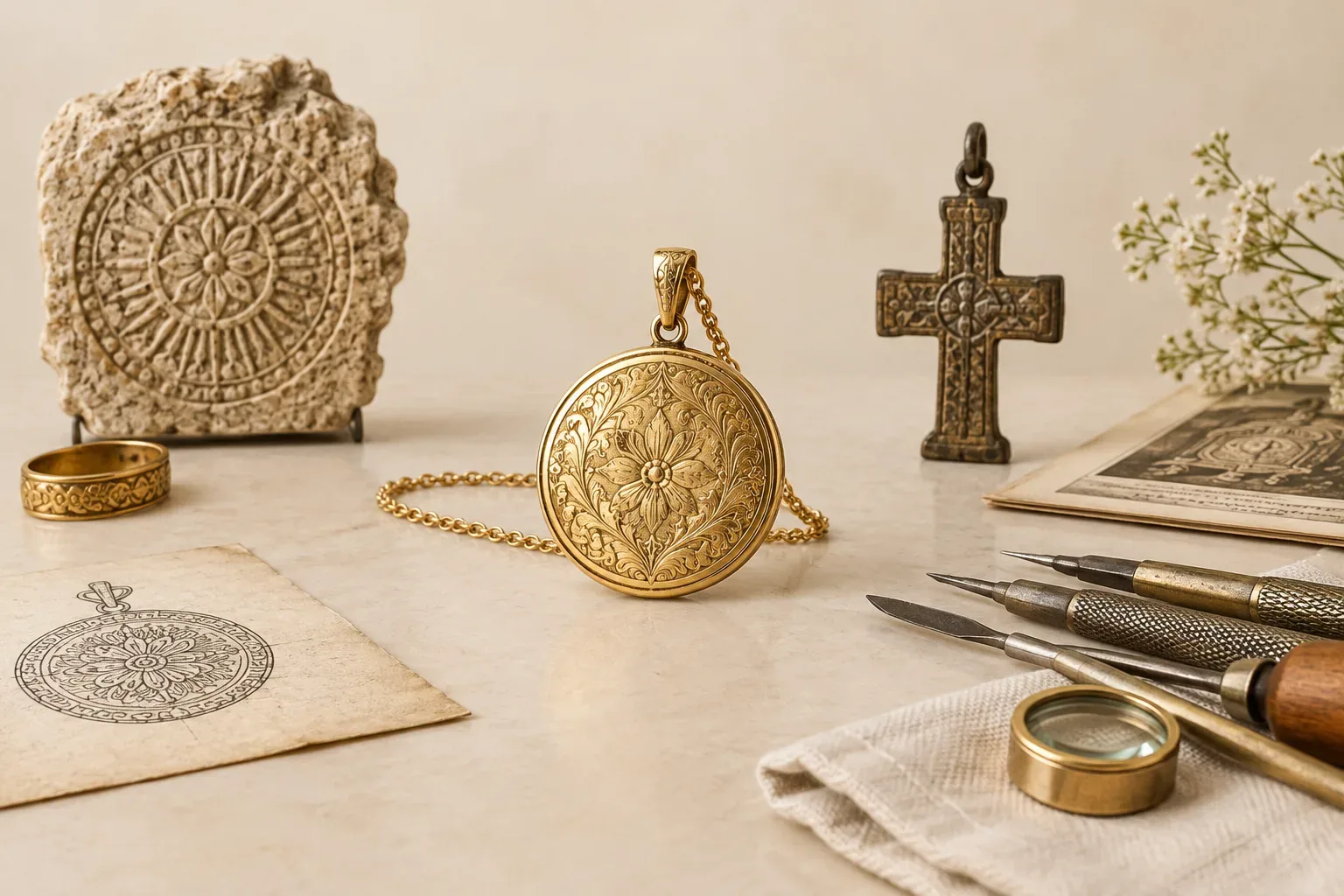
Engravings appear in many forms: incised lettering on bands, carved intaglios or cameos in hardstone gems, stamped or chased metal surfaces, and hand-engraved decorative panels on lockets and brooches. Signet rings and intaglio gems were cut so the engraved image could create a seal impression in wax; cameo carving presents a relief image cut in layered stones. These practices are attested in museum collections and historical surveys catalogued by the V&A.
Gemstones can be the engraved material themselves or an accompanying decorative element. Hardstones such as carnelian, jasper, agate and chalcedony were commonly used for carved gems because of their toughness and layered structure. The V&A's A–Z of Gemstones explains how different stones have distinct physical properties and historical uses, which affects how they were carved, set and worn. In modern engraved jewelry, common metals (gold, silver, platinum) and gemstones (diamonds, sapphires, emeralds, pearls) are set and sometimes engraved around, with engraving used for personalization on the reverse or interior faces of pieces.
Everyday maintenance: cleaning, storage, and inspection
Keep engraved jewelry dry, clean and protected from abrasive contact. Regularly inspect pieces for loose stones, worn prongs, deep scratches in engraved surfaces, thinning chains and weakened jump rings. Clean gently: use a soft brush, mild soap and water for most modern gold and platinum jewelry, rinse thoroughly and dry with a soft cloth before storage. Avoid aggressive polishing that can erase fine engraving or remove original surface patina on older pieces.
For carved gemstones and pieces with fragile inlay or enamel, avoid soaking for long periods, harsh chemicals, or ultrasonic cleaners unless a professional confirms the method is safe. The physical properties of gemstones vary (see the V&A's A–Z of Gemstones), and some stones and historic materials tolerate mechanical or chemical cleaning poorly.
Warning signs that indicate professional repair is needed
Seek professional attention if you notice any structural problems: a missing or loose stone, a cracked gem, split shanks or band fractures, broken or bent settings, open or broken solder joints, thinning or fraying chains, or deep gouges that threaten the integrity of a piece. Rapid discoloration, flaking of enamel, or sudden loosening of engraved plates also require a specialist.
For antique or historically important items, signs such as loss of original mounting, unstable inlays, or detached elements should prompt a conservator consultation rather than a quick repair. Untrained repairs can remove historic fabric, erase provenance evidence, or introduce non-reversible materials.
Choosing a repair specialist and what to expect
For modern pieces with simple structural faults, a qualified jeweler who provides documentation and insurance, and who has experience with the metal and gemstone involved, is usually appropriate. For historic or high-value engraved items, seek a conservator or a jeweler with conservation experience. Before work begins, ask for a written condition report, a clear estimate, and any proposed methods for repair. A responsible professional will explain how they will protect fine engraving, match alloys or solder color, and document interventions so your piece's history remains traceable.
Discuss cleaning methods and ask whether ultrasonic or steam cleaning will be used. If the piece contains treated gemstones, composites or assembled materials, request that the jeweler confirm any known treatments and proceed cautiously. The Federal Trade Commission advises consumers to ask sellers and professionals about treatments, imitations and material disclosure when purchasing or repairing gemstones and jewelry.
Repair techniques that preserve engraving and historic character
Conservative approaches prioritize stabilizing the piece and preserving original surfaces. Where necessary, re-soldering, re-tipping prongs, replacing worn jump rings, or resetting stones can be done with attention to visual matching. Re-cutting or re-engraving is sometimes offered to restore lettering or motifs, but this is invasive: re-cutting removes original material and can alter historical evidence. For heirlooms or museum-quality pieces, consider reversible or minimal interventions and retain before-and-after documentation.
When metal fills, plating or composite repairs are proposed, ask about long-term aging and how those repairs will affect future conservation. A qualified professional should be able to explain tradeoffs between aesthetic restoration and preserving original material.
Practical and respectful selection and gifting guidance
When choosing engraved jewelry as a gift, consider durability: a simple engraved band in a harder metal such as gold or platinum will withstand daily wear better than a thinly plated piece. For engraved gemstones or fragile inlay, select designs intended for occasional wear. Think about the wearer’s lifestyle and whether the engraving is placed where it will be exposed to abrasion.
Respect cultural and religious significance. Some engraved motifs and symbols have particular meanings in specific communities; if choosing a culturally sensitive motif, learn its contemporary significance and, when appropriate, consult knowledgeable sources or the recipient. Remember that modern personal interpretations are common, so a simple, clearly personal engraving (initials, an important date, a private message) is often the most respectful and meaningful choice.
Ask the seller about gemstone treatments and any special care requirements. The FTC encourages consumers to seek disclosure about treatments, imitations and origin when buying gemstones, because disclosure affects value and maintenance choices.
Cost considerations and documentation
Repair costs vary widely depending on the work required, materials and whether conservation-level care is needed. Request an itemized estimate and weigh the piece’s sentimental or monetary value against repair expense. For antiques or items with provenance, request a written record of the work performed and keep photographs and receipts; detailed documentation preserves future resale or conservation options.
If the piece is insured, check your policy before proceeding with significant repairs. Some insurers require estimates or specialist approval for conservation work.
Final thoughts
Engraved jewelry connects wearer and maker across time. The V&A's scholarship underscores that engraving’s functions have changed with culture and fashion, and modern personal meanings are layered on top of that history. Treat engraved pieces—especially historic or gemstone-engraved examples—with care: routine inspection, gentle cleaning, and prompt professional consultation for structural issues will prolong life and preserve both aesthetic and historic value.
Frequently asked questions
How often should I clean engraved jewelry?
Clean engraved jewelry gently when it looks dull or dirty—typically every few months for frequently worn pieces. Use a soft brush, mild soap and water, rinse and dry thoroughly. For fragile settings, carved gems, or antique pieces, consult a professional before attempting cleaning.
Is it safe to use an ultrasonic cleaner on engraved pieces?
Ultrasonic cleaning can dislodge stones, damage fragile inlays and harm certain gemstones and enamel. Do not use ultrasonic cleaners on antique or delicate engraved items without professional advice.
When should I seek professional repair for an engraved item?
Seek a jeweler or conservator if you notice loose or missing stones, bent or broken settings, cracks in gems, split bands, thinning chains, flaking enamel, or loss of original mounting on antique pieces.
Can engraving be restored if the design is worn?
Re-cutting or re-engraving is technically possible, but it removes original material and can alter historic value. For modern pieces, re-cutting may restore clarity; for antiques, consult a conservator and weigh the trade-offs between restoration and preservation.
How do I know if a gemstone has been treated or is an imitation?
Ask the seller or a qualified appraiser about treatments and disclosure. The Federal Trade Commission advises consumers to request information on heat treatments, dyeing, fillings, composites and whether a stone is an imitation or synthetic, because treatments affect value and care.
Should I insure my engraved heirloom jewelry before repair?
If the piece has significant monetary or sentimental value, contact your insurer before major repairs. Some policies require estimates or specialist approval for conservation work. Keep photographic records and receipts of any restoration.
Sources and further reading
- Bedazzled: A History of Jewellery — Victoria and Albert Museum
- An A-Z of Gemstones — Victoria and Albert Museum
- Buying Gemstones, Diamonds, and Pearls — Federal Trade Commission