Meaning at a glance
This guide distinguishes documented historical contexts for mixed‑metal jewelry from later personal meanings, lists warning signs of damage, and gives practical, nontechnical advice on cleaning, maintenance, and when to consult a professional jeweler.
Short answer
Mixed‑metal jewelry repair and maintenance require attention to how different metals and finishes age and interact; document the piece, watch for solder failures, loose stones, unusual discoloration or corrosion, and avoid risky DIY repairs. For anything beyond routine cleaning or polishing, consult a jeweler experienced with mixed‑metal work who will test metal content and explain options for conservation, rejoining, or re‑finishing while respecting any historical or sentimental value.
What the historical record says (and what it doesn’t)
Museum scholarship shows that the use of multiple metals in a single object is not new, but its meaning has shifted by time and place. The Victoria and Albert Museum describes how jewellery techniques, materials, and social contexts changed across periods, and how makers combined metals for technical, decorative, and social reasons rather than a single universal symbolism. Use of contrasting metals has functioned as a sign of craftsmanship, luxury, or fashion in different eras, but the precise cultural meanings depend on the specific period and culture documented by curators and historians at institutions such as the Victoria and Albert Museum.
The historical record preserved in museum collections and catalogues typically links metal choice and combination to factors such as availability, cost, technological advances, and changing tastes. Where museums and curators document a symbolic or ritual use for certain metals in a clearly identified culture or era, those attributions are tied to that culture’s historical sources and material evidence rather than to a timeless meaning that applies to all mixed‑metal objects.
Separating documented history from modern interpretations
When you read modern descriptions that ascribe a single symbolic meaning to mixed‑metal jewellery—balance, unity, or a specific spiritual property—treat them as contemporary personal interpretations unless a particular culture’s historical sources or museum scholarship explicitly record that meaning. The Victoria and Albert Museum’s work on jewellery history emphasizes changing social contexts; a description of meaning in a modern catalogue or social post often blends historical fact with current fashion narratives and personal sentiment.
Personal or contemporary symbolic uses are legitimate and important to wearers today, but they are distinct from documented historical meanings. If you care about historical authenticity, look for primary documentation or museum references linking a motif or treatment to a particular time and place rather than relying on broad modern claims.
How mixed‑metal appears in jewelry: forms and common pairings
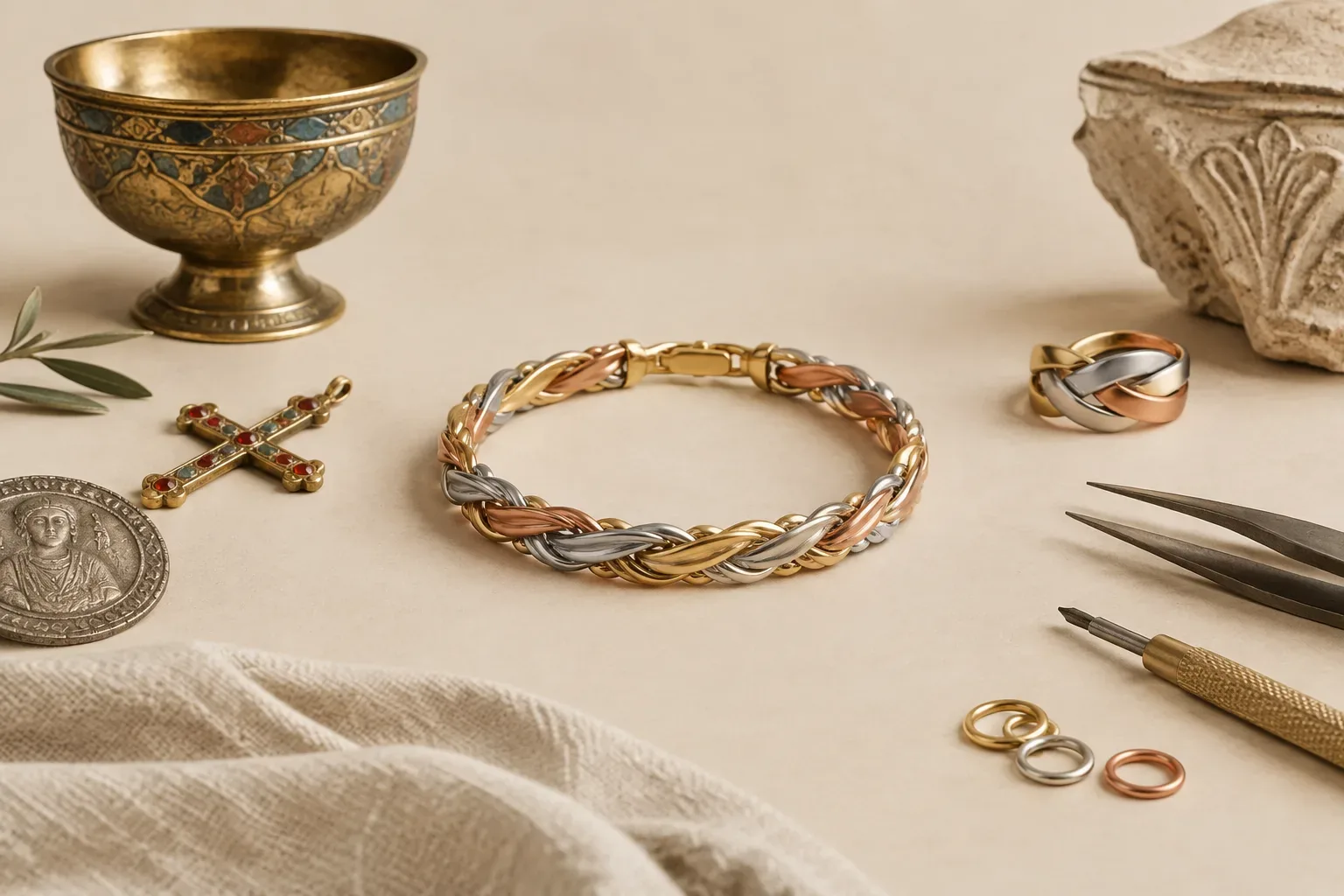
Mixed‑metal jewellery appears in many forms: two‑tone finger rings and wedding bands, bracelets with inlaid metal stripes, necklaces that combine yellow gold, white gold, and silver elements, and pieces that use a base metal under a plated surface. Craftspeople may contrast warm and cool tones for visual effect or combine a durable metal for structural elements with a softer metal for decorative components.
Gemstones and settings interact with mixed metals in visible ways. Curators and gemstone guides at the Victoria and Albert Museum note how gem mounting and setting traditions vary with the stone and period; historically, makers selected metal types for their strength, color contrast, or how they affected a stone’s appearance. In modern pieces, plating, solder joints between differing alloys, and metal inlays are common techniques used to achieve mixed‑metal looks.
Warning signs: when maintenance is needed
Look for changes that indicate the piece needs care or professional attention. Discoloration that seems to occur preferentially at joins or under settings, soft or broken solder joints, obvious pitting or greenish corrosion near areas where copper is present, stones that wobble in their settings, missing or deformed prongs, and seams that separate are all warning signs.
Also note surface changes such as flaking plating, a sudden loss of shine that does not respond to gentle cleaning, or persistent odors after cleaning. These signs can indicate chemical reactions between dissimilar metals, breakdown of plated layers, or degradation of solder or adhesives used in repair history. If the item has documented age or provenance, seek conservational advice before proceeding with aggressive cleaning or repairs that could remove historic finishes.
Basic care you can safely do at home
Routine, gentle cleaning is often enough to slow wear. Use a soft cloth to remove daily oils and dust, and a mild, pH‑neutral soap with lukewarm water for occasional cleaning. Rinse thoroughly and dry completely before storage. Avoid abrasive pads or harsh chemicals that remove intentional finishes or thin platings, and keep pieces separated to prevent scratching and metal transfer.
Store mixed‑metal pieces in ways that reduce contact with moisture and chemicals: a dry environment, individual pouches or compartments, and avoidance of direct sun for long periods. If a piece carries sentimental or recorded historical value, document its condition with photographs and notes before any cleaning or service so that changes can be tracked.
When to stop and call a professional
Do not attempt soldering, aggressive polishing, re‑plating, or adhesive repairs on valuable, sentimental, or historically significant mixed‑metal pieces yourself. Those interventions can irreversibly alter structure, surface patinas, and value. Call a reputable jeweler for these issues: loose or missing stones, snapped chains, broken settings, a failing solder join, or any situation where metal parts separate.
Ask potential repairers about their experience with mixed‑metal work and whether they will test metal content and surface treatments before proceeding. The Federal Trade Commission recommends asking sellers and service providers about material treatments and disclosure. A jeweler should explain what they will do, how it will affect the appearance, and whether they can preserve original surface finishes or patinas if that is important.
Choosing the right professional and evaluating repair options
Find a jeweler who will first examine and document the piece and who is willing to discuss noninvasive options and conservation‑minded approaches. Ask whether they will perform tests to identify metal alloys and surface plating and whether they will preserve a historic finish rather than polishing it away. A good repairer will explain risks and alternatives and provide a written estimate.
Be cautious about quick, low‑cost fixes that involve heavy polishing, aggressive re‑plating, or irreversible reshaping. For important pieces, consider seeking a conservator or a jeweler with conservation training. If the piece is modern and intended for regular wear, prioritize repair methods that restore structural integrity while acknowledging that finishes may be refreshed as part of maintenance.
Selecting or gifting mixed‑metal jewelry: practical and respectful guidance
When selecting mixed‑metal jewellery as a gift, consider the recipient’s everyday habits, metal preferences, and any known allergies. If the wearer prefers low‑maintenance pieces, choose durable alloys or items where the contrasting metals are mechanically joined rather than simply plated. If the piece is intended as a keepsake with historical or family value, ask about provenance and past repairs and document those details to preserve the gift’s story.
Respect cultural meanings by researching the origin of a design before presenting it as a symbol. If a mixed‑metal style or motif comes from a defined culture or period documented by museum scholarship, reference that context rather than imposing a new symbolic interpretation. For contemporary symbolic gifting—if you and the recipient agree on a modern meaning such as balance or connection—clarify that it is a personal sentiment rather than an historically verified attribute.
Cost and timeline expectations
Repair costs and timelines vary widely depending on the work needed, the rarity of the metals, and whether testing or conservation is required. Simple tightening of settings or replating small areas may be relatively inexpensive and quick, while structural repairs between dissimilar metals, conservation of historical finishes, or sourcing matching components can take longer and cost more. Request a written estimate and an explanation of methods and expected timing before authorizing work.
Documenting care and repairs
Keep a written record of any cleaning, service, tests performed, and material disclosures supplied by sellers or repairers. Photograph your piece before and after work, keep invoices, and note the name and credentials of the person who performed the work. These records are useful for future maintenance, resale, insurance, and for preserving the object’s provenance if it has historical interest.
Frequently asked questions
How often should I have mixed‑metal jewelry inspected?
For pieces worn regularly, have a jeweler inspect settings and joins at least once a year; inspect visually yourself more often and bring it in if you notice wobbling stones, gouges, or seams opening.
Can I clean mixed‑metal jewelry with household cleaners?
Avoid harsh chemicals and abrasives; stick to a soft cloth and mild, pH‑neutral soap with lukewarm water. If a piece has thin plating or historic finishes, consult a professional before stronger cleaning.
Is it safe to replate only part of a mixed‑metal piece?
Partial replating can change how contrasting metals look; discuss visual and conservation implications with a jeweler and ask for before‑and‑after expectations in writing.
What questions should I ask a jeweler before repair?
Ask which tests they will run to identify metals or treatments, whether they will preserve patina or original finishes, what methods they propose, a written estimate, and how they document the work.
How do I avoid allergies with mixed‑metal gifts?
Ask the seller for a clear materials disclosure. If the recipient has known metal allergies, choose pieces explicitly labeled hypoallergenic or made from known safe alloys, and avoid unknown plated items unless the base metal is disclosed.
Sources and further reading
- Bedazzled: A History of Jewellery — Victoria and Albert Museum
- An A-Z of Gemstones — Victoria and Albert Museum
- Buying Gemstones, Diamonds, and Pearls — Federal Trade Commission