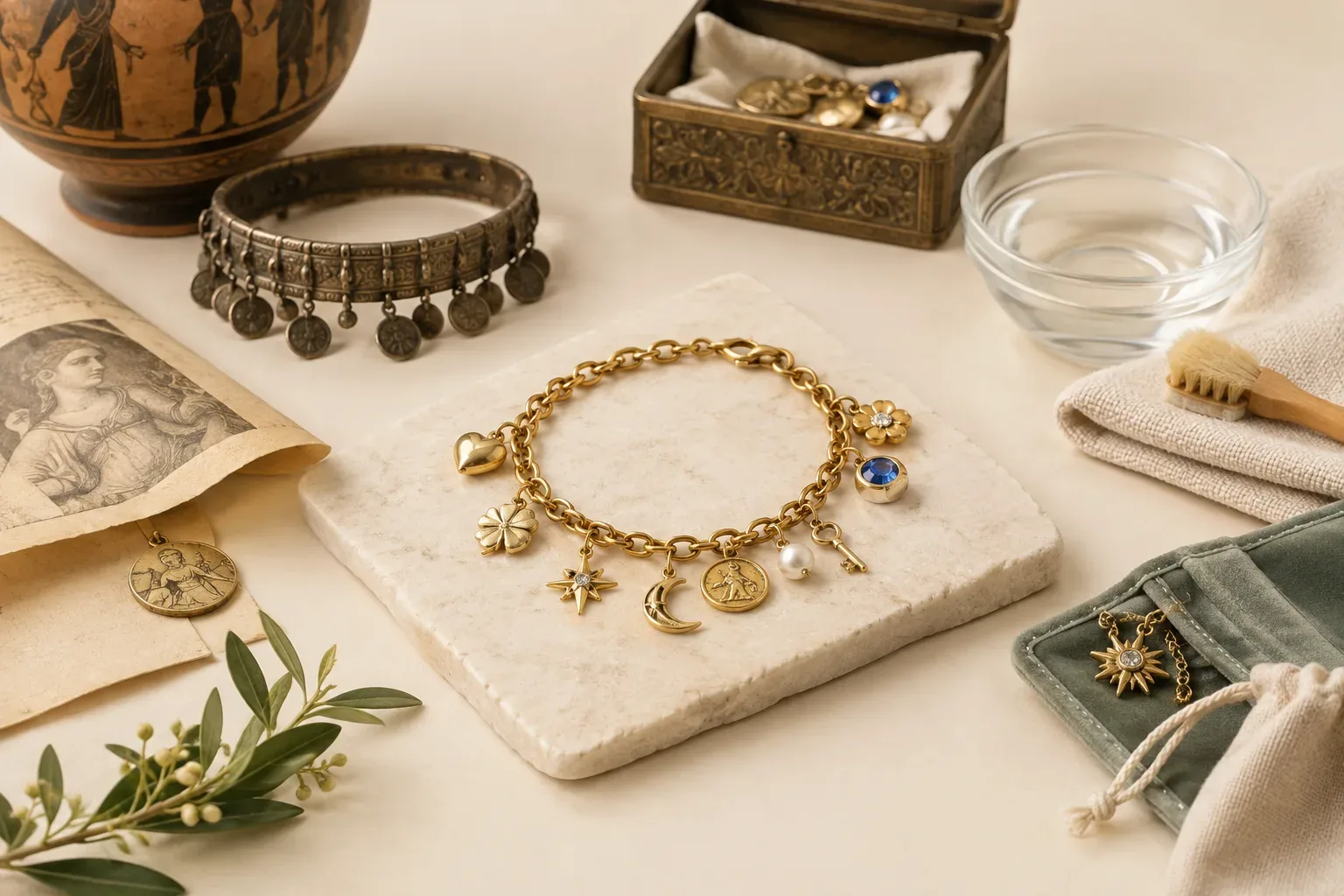
Meaning at a glance
Use gentle, material-specific cleaning and separate, padded storage to protect charms and chains; check for treated or fragile gemstones before any wet cleaning; understand historical uses of charms (as recorded by the Victoria and Albert Museum) but separate those documented meanings from modern personal symbolism when choosing or gifting.
What the historical evidence shows
Museums and curators trace the practice of wearing small personal tokens and motif-bearing jewelry through many eras, not as a single continuous tradition but as changing forms and uses. The Victoria and Albert Museum presents jewelry examples from ancient through modern times that show how wearable objects functioned as identity markers, amulets, souvenirs, and status signals across cultures and periods.
That museum record demonstrates that what we call 'charms' or 'charms on bracelets' has no single origin story. In different times charms were worn for remembrance, protection, social signaling, or ornament. The V&A exhibition materials and collections highlight these shifting social contexts rather than a single, fixed meaning for charms or charm bracelets.
Separating documented historical meanings from modern interpretations
Documented uses of charm-like objects in museum collections are contextual: for example, some small pendants or tokens from earlier periods are clearly associated with mourning, pilgrimage, or particular social rituals as recorded in museum catalogues and exhibition notes. The Victoria and Albert Museum places such objects within their social histories rather than treating all charms as interchangeable.
Modern wearers often adopt charms as personal narrative tools—collecting souvenirs, marking life events, or assembling an aesthetic mix. These contemporary personal meanings are valid, but they are different in kind from the documented social or ritual meanings recorded in historical collections. Avoid assuming a single meaning is historically universal; instead, treat historical interpretations as context-specific and treat modern symbolism as personal or cultural reworking.
How motifs, gemstones, and traditions appear on charm bracelets
Motifs on charms vary widely: animals, initials, religious symbols, coins, mechanical miniatures, and symbolic objects. Historically these motifs have signalled protection, rank, memory, or affiliation; today they are often used for personal narrative or fashion. Charms can be cast, stamped, engraved, enamelled, or set with stones depending on era and maker.
Gemstones and organic materials commonly appear in charms and their settings. The Victoria and Albert Museum's overview of gemstones explains the historical use and identification of many gem materials in jewellery. Some gemstones are hard and stable in water and gentle cleaners, while others are porous, fracture-filled, or treated and therefore vulnerable to common cleaning methods.
Material-specific cleaning recommendations
Start by identifying components. If you cannot identify a gemstone or a surface treatment, err on the side of caution and avoid immersion and strong chemical cleaners. The Federal Trade Commission advises buyers that gemstones and pearls may be natural, treated, or synthetic, and that treatment status can affect care and value; verify any treatments or repairs before cleaning.
For solid gold and platinum components, warm water with a drop of mild dish soap and a soft brush is usually safe. Rinse thoroughly and dry with a soft cloth to avoid water spots. For silver, gentle soap and water followed by drying and storing in an anti-tarnish pouch will slow tarnishing; avoid bleach or ammonia-based cleaners.
For pearls, coral, ivory, and other organic materials, wipe with a soft, slightly damp cloth and let air-dry flat. Do not soak organic materials, avoid ultrasonic cleaners, and keep them away from acidic or alcoholic substances. For soft or porous gemstones such as opal, turquoise, and some treated emeralds, avoid prolonged soaking, steam, and ultrasonic cleaning; wipe gently and consult a jeweller if in doubt.
Enamel and painted surfaces can be scratched by abrasives. Use only a soft cloth and avoid soaking if the enamel is old, crazed, or cracked. Mechanical charms or lockets with moving parts should be cleaned gently and checked for dirt trapped in hinges; if the mechanism is delicate, have a professional jeweller service it.
Safe general cleaning process for mixed-component charm bracelets
Lay the bracelet on a clean towel and work over it. If all components are identified as stable, prepare a bowl of warm water with a small amount of mild liquid soap. Use a soft-bristled brush to clean metal chain links and around settings, keeping the brush strokes gentle. Rinse quickly under a low stream of water and immediately pat dry with a soft cloth. If any part looks porous, cracked, or has an unusual coating, stop and isolate that charm for specialist care.
When in doubt, consult a qualified jeweller for evaluation, especially for heirloom pieces, jewellery with glued settings, or items containing multiple materials. Professional conservation is worth the expense for sentimental or high-value pieces.
Storage practices that protect charm bracelets
Store charm bracelets separately to avoid tangles and abrasion. Flat compartments in a lined jewellery box or fabric pouches for individual bracelets limit contact damage. For long-term storage, keep items in a stable, dry environment away from direct sunlight and extreme temperature changes; a small silica gel packet can help control humidity in a closed box.
Avoid storing charms with different metals in direct contact because dissimilar metals can rub and wear each other. Hanging storage can work for single, lightweight bracelets to avoid knots, but heavier charm bracelets are safer stored flat so the weight is supported and clasps are not strained.
Common mistakes to avoid
Do not use household silver polishes indiscriminately; abrasive polishes can remove plated finishes or delicate surface details. Do not soak bracelets that include glued settings, organic materials, or unknown treatments. Do not store multiple bracelets loosely together, which causes scratching and tangling. Do not assume all gemstones are durable; many popular stones have treatments or structural vulnerabilities that make them sensitive to heat, ultrasonic cleaning, or solvents.
Selection and gifting guidance (practical and respectful)
When choosing a charm bracelet as a gift, consider the recipient’s daily life and the durability they need. Opt for secure, well-made clasps and solid links if the recipient is active. Choose wear-resistant materials for everyday pieces, and reserve delicate stones and enamels for occasional-wear jewellery.
Be culturally and personally sensitive about motifs. Some symbols carry specific religious or cultural meanings in particular communities; the Victoria and Albert Museum highlights that many motifs in historical collections are context-dependent. If you are unsure about a symbol’s contemporary significance, research before gifting or choose a more neutral motif. If a charm has a documented historical or ritual use, consider whether a recipient will appreciate that history or prefer a modern, personal symbolism.
Include care instructions with a gift. A note that identifies the metal, any known treatments, and recommended cleaning and storage steps helps the recipient preserve the piece. If you cannot provide that information, suggest that they have the bracelet evaluated by a reputable jeweller.
When to seek professional help
If a charm bracelet is an antique, combines multiple sensitive materials, or has complex mechanical parts or repair needs, entrust cleaning and conservation to a professional jeweller or conservator. Professional inspection is also wise if you find loose stones, worn jump rings, or damaged clasps. Conservators and specialist jewellers can advise proper cleaning methods and safe storage to prevent further damage.
Frequently asked questions
How often should I clean a charm bracelet?
Clean a frequently worn bracelet every few months with a gentle method if all components are stable. For everyday wear, wipe metal parts with a soft cloth weekly and perform a more thorough gentle clean every two to three months. For delicate or unknown components, clean less often and consult a professional for inspection.
Can I put my charm bracelet in an ultrasonic cleaner?
Do not use ultrasonic cleaners on bracelets that include pearls, opals, turquoise, fracture-filled or treated stones, glued settings, or delicate enamels. Ultrasonic cleaning can dislodge stones, worsen fractures, or strip surface treatments. Use ultrasonic machines only when you are certain all components are safe for that process.
What is the safest cleaner for silver and gold charms?
A mild solution of warm water and a drop of dish soap applied with a soft brush is usually safe for solid gold and many silver pieces. Rinse and dry thoroughly. Avoid abrasive pastes and strong chemical polishes on plated or antique finishes without professional advice.
How should I store charm bracelets to prevent tarnish and tangling?
Store bracelets flat or in individual soft pouches or lined compartments to prevent tangles and abrasion. Keep pieces dry, out of direct sunlight, and in a stable temperature environment. Anti-tarnish strips in a closed box can slow tarnishing of silver, and silica gel packets help control humidity.
Are there symbols I should avoid gifting because they’re culturally sensitive?
Yes. Some religious or cultural symbols have specific, context-dependent meanings. The Victoria and Albert Museum’s work shows that motif meanings vary by period and culture. If you are unsure about a symbol’s contemporary significance, research before gifting or choose a neutral charm.
Sources and further reading
- Bedazzled: A History of Jewellery — Victoria and Albert Museum
- An A-Z of Gemstones — Victoria and Albert Museum
- Buying Gemstones, Diamonds, and Pearls — Federal Trade Commission