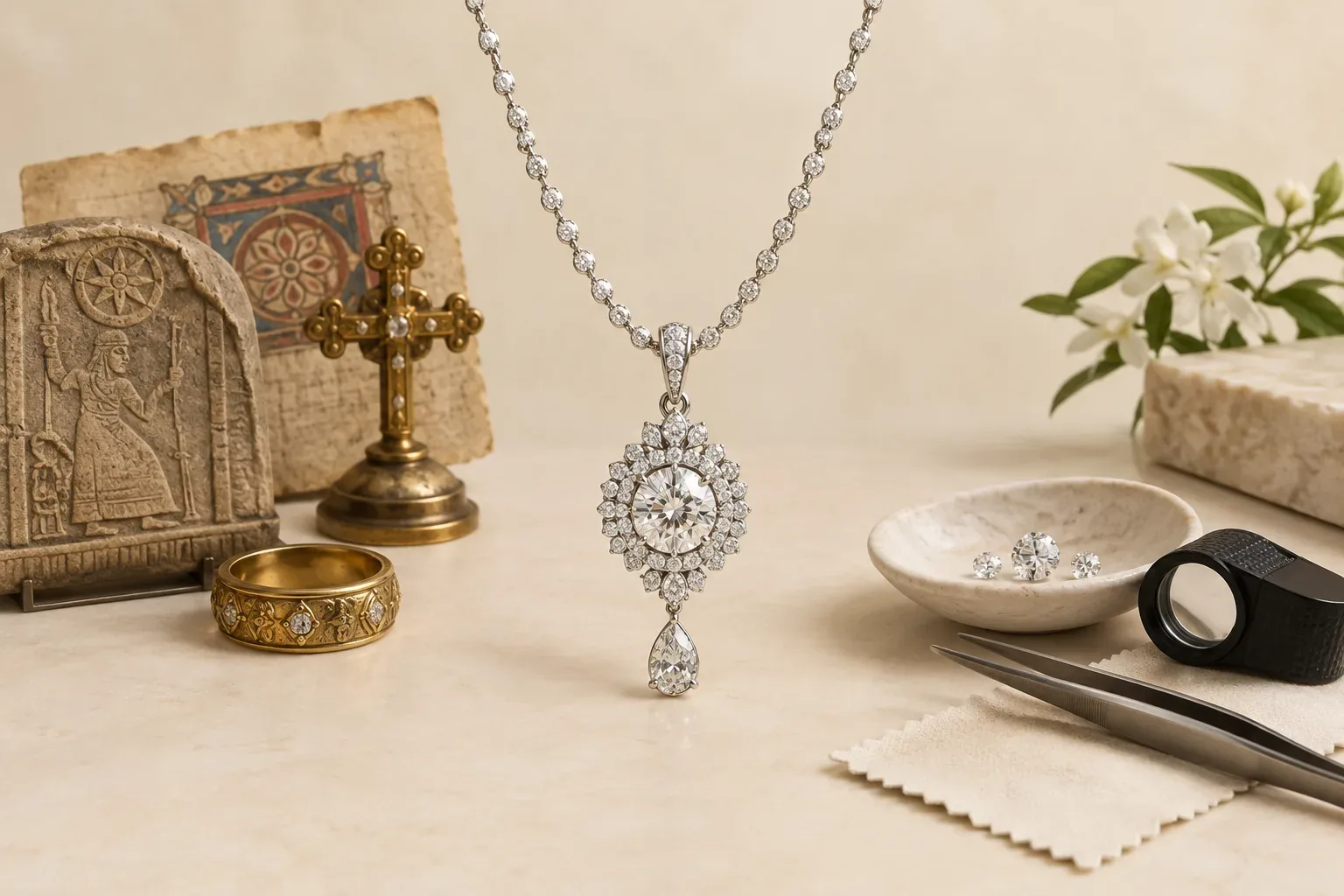
Meaning at a glance
Explain the documented history and changing contexts of the diamond jewelry repair and maintenance motif, separate cultural or religious evidence from later popular interpretations, and give practical guidance for choosing and wearing the motif in modern jewelry.
What the historical record shows (and what it does not)
Museum research and collections make it possible to trace how diamonds and other gemstones appeared in jewellery and how repair and maintenance practices changed with styles and technology. The Victoria and Albert Museum presents the changing social contexts of jewellery across periods and regions, showing that how people used and valued gemstones has shifted repeatedly rather than remaining fixed. Use the V&A’s material as a documented record of objects, techniques and social context rather than as a single, universal meaning.
Identifying cultures and periods precisely
When citing historical evidence, the responsible approach is to reference specific objects and collections. The V&A’s exhibitions and articles identify pieces by culture and period—for example, which court or workshop produced an object, or which century a technique was typical. That level of provenance is what counts as documented history; later broad claims about ‘‘what diamonds mean’’ in all of human history go beyond the museum record and should be treated as modern interpretation.
Documented historical meanings versus modern personal interpretations
Documented meanings arise from sources that record use, function, or explicit symbolic intent—catalog entries, maker marks, inventories, and contemporary texts. Museums such as the Victoria and Albert Museum preserve many of those documentary links, and you can use them to understand why an object originally had a particular role or value. Modern personal interpretations—sentimental, romantic, or fashion-related meanings—are valid for the wearer but are not the same as documented historical uses. Treat museum-based claims as evidence about how objects were made and used, and treat present-day symbolic meanings as personal or cultural additions that evolved later.
How the diamond and related motifs appear in jewellery
Diamonds appear in jewelry through a combination of cuts, settings, and decorative motifs. Historically and today, jewellery settings such as prong (claw) mountings, bezel settings, pavé and channel settings, and flush mounts are common ways to hold diamonds in place. Each setting has different implications for wear: prongs make a stone more visible but require periodic inspection because prongs can bend or thin; bezels protect the stone rim but can hide edges and require precise repair if damaged. These patterns are visible in museum collections and contemporary designs alike; the V&A’s A–Z of Gemstones discusses how gem handling and mounting have evolved alongside cutting and setting technology.
Typical signs that a diamond piece needs attention
Some problems are obvious; others are subtle. Noticeable warning signs include stones that appear loose, missing stones, bent or worn prongs, cracked or warped bands, unusual gaps where parts of the setting no longer sit flush, and clasps that no longer lock securely. Audible or tactile clues can also help: a stone that rattles when the setting is tapped lightly, or a ring that suddenly turns on the finger because the shank has thinned. Surface damage such as deep scratches or chips should prompt inspection; although diamonds are very hard, they can chip at the girdle or pavilion if struck sharply.
Everyday maintenance owners can do safely
Regular home care extends the life of diamond jewellery. Clean pieces gently with a soft brush and a mild, non-abrasive soap solution and dry with a lint-free cloth. Remove jewellery when doing heavy manual work, when using chemicals, and when bathing in chlorinated pools or hot tubs. Store pieces separately to avoid contact that can scratch metal or other stones. Avoid repeated twisting or prying on settings. These habits reduce wear and the number of times a piece needs professional repair.
When to seek professional repair and what to expect
If you observe loose stones, broken prongs, missing stones, damaged shanks, or malfunctioning clasps, consult a professional jeweller rather than attempting permanent repairs yourself. Qualified jewellers can re-tension prongs, re-set or replace stones, re-solder broken joints, re-size rings using appropriate techniques, and restore complex settings while preserving a piece’s integrity. For valuable or antique items, choose a jeweller with experience in conservation or antique repair so that original materials and historic techniques are respected.
Choosing a professional and what to ask
Select a repairer who will document work in writing, give a clear estimate, and explain the techniques and materials used. Ask whether the jeweller will test and disclose any treatments or non-natural materials found in the piece; the Federal Trade Commission requires sellers to disclose material treatments, imitations, and enhancements, so a reputable shop will provide transparent information consistent with those guidelines. For valuable diamonds, request a written appraisal or condition report before and after repair and consider insured shipping for work done off-site.
Practical guidance for selection and gifting
When choosing diamond jewellery as a gift, match the piece to the recipient’s lifestyle and preferences and consider settings that suit daily wear if the recipient plans to wear the piece often. For active wearers, choose secure settings such as bezels or low-profile channels. For recipients who prize traditional or collectible pieces, prefer reputable dealers and request documentation about treatments and provenance. Always recommend regular inspections, and if gifting an heirloom piece, provide the recipient with a written condition note and advice on care.
Insurance, documentation, and long-term care
Maintain up-to-date documentation—a photographic record, invoices, and any gem reports or appraisals. Insure pieces appropriately and declare any modifications made during repair. Routine professional inspection every six to twelve months is a practical cadence for frequently worn items; less-used pieces can be inspected annually. When considering significant work on antique jewellery, balance restorative aims with historical preservation—ask whether work can be reversible and whether original elements can be conserved rather than replaced.
Final practical checklist
Watch for loose or missing stones, bent prongs, thinning shanks, and faulty clasps. Clean gently at home and remove jewellery for strenuous or chemical exposure. Choose experienced repair professionals who provide documentation and disclose treatments. Keep thorough records and insure valuable pieces. Treat museum literature, such as that produced by the Victoria and Albert Museum, as the source for documented historical context and the Federal Trade Commission guidance as the basis for transparency about treatments and imitations.
Frequently asked questions
How often should I have my diamond jewellery professionally inspected?
For frequently worn pieces, a professional inspection every six to twelve months is a sensible interval. Less-used items can generally be inspected annually. Inspections should check prongs, settings, clasps and the overall integrity of the mount.
Can I fix a loose prong or missing stone myself?
Minor cleaning can be done at home, but re-tipping prongs, re-setting stones or re-soldering requires professional tools and experience. Attempting permanent repairs at home risks further damage and loss of stones.
What should I ask a jeweller before repair work begins?
Ask for a written estimate and a description of the work, whether original materials will be conserved or replaced, whether the work is reversible, and whether the jeweller will document the piece’s condition before and after repair.
Are there treatments or imitations I should know about?
Yes. Some diamonds and other gems undergo treatments or there are simulants and synthetics. The Federal Trade Commission requires disclosure of material treatments and imitations, so ask for full disclosure and supporting documentation when buying or repairing valuable pieces.
How should I store diamond jewellery to reduce wear?
Store pieces separately in soft pouches or compartments to prevent metal and stone contact. Keep items in a dry, stable environment and avoid storing jewellery where it will be exposed to chemicals or extreme humidity.
Should I insure heirloom diamond jewellery before sending it for repair?
Yes. For valuable or sentimental pieces, ensure the item is insured and obtain a condition report before shipping or handing it over for repair. Ask the repairer about their insurance and handling procedures.
Sources and further reading
- Bedazzled: A History of Jewellery — Victoria and Albert Museum
- An A-Z of Gemstones — Victoria and Albert Museum
- Buying Gemstones, Diamonds, and Pearls — Federal Trade Commission