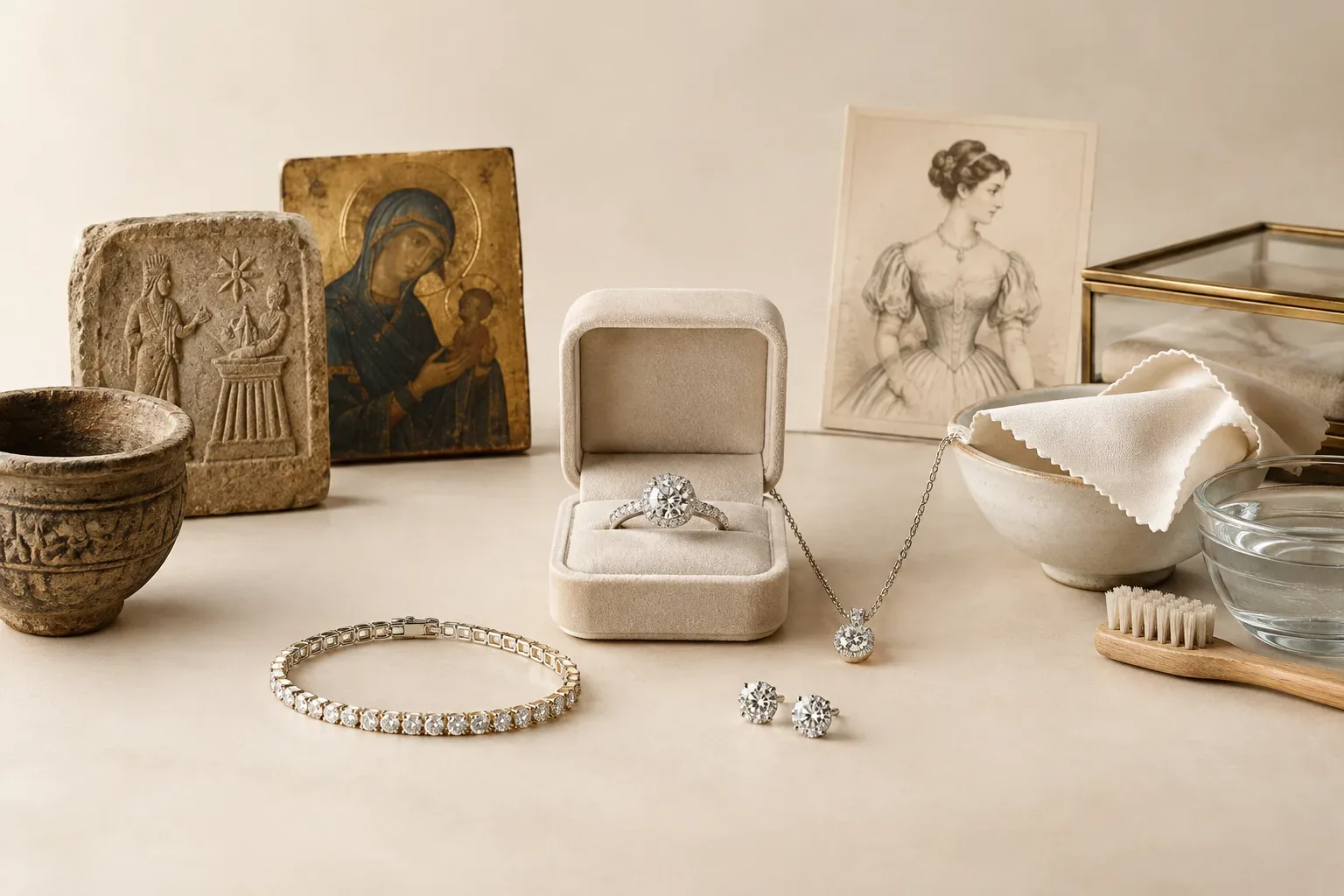
Meaning at a glance
This article explains how documented history frames care and display of diamond jewelry, distinguishes historical evidence from modern interpretations, and provides practical, cautious guidance on safe cleaning, storage, selection, and gifting.
What the historical record shows
The Victoria and Albert Museum describes jewelry as an object class whose meanings and uses have shifted across cultures and historical periods, and whose treatment and display reflected those changing social contexts. The Museum’s research and exhibitions show that jewelry was at times primarily wearable status display, at other times a repository of sentimental keepsakes, and that display and storage adapted accordingly rather than remaining static.
The Museum’s compiled guides to gemstones also place diamonds and other gems into long historical contexts, explaining how different societies identified and valued stones and how technological changes altered what was possible for setting and finishing gemstones. Those changes in technique and taste affected how owners cleaned, maintained, and stored pieces, because new cuts, settings, and metalwork required different handling and made different trade-offs between wearability and ease of care.
Separating documented historical practices from later interpretation
Museum documentation provides evidence about what people actually did with jewelry: how pieces were made, how they were worn, and how they were kept in boxes, cabinets, or on display. That documentary evidence is distinct from later, popular or personal meanings attached to the act of cleaning or storing jewelry. For example, the fact that owners historically took care of valuable pieces does not by itself demonstrate a universal ritual meaning for cleaning; historians at the Victoria and Albert Museum focus on social and material contexts rather than universal symbolic claims.
Modern interpretations—such as the idea that a particular way of cleaning or a specific storage item carries a universal protective meaning—are contemporary layers of personal or commercial significance that are not documented as universal practices in the historical record. Treat those modern interpretations as optional personal meaning rather than a historical fact, and check cultural or family histories if a particular ritual or symbol matters to you or the recipient.
How the care-and-storage motif appears in jewelry and accessories
The theme of care and safekeeping appears in jewelry itself in two main ways: through functional features and through symbolic motifs. Functional features include secure settings, sturdy clasps, and lockable cases or traveling boxes that were developed so pieces could be worn and stored safely. Victoria and Albert Museum studies of jewelry history show that as settings and gemstones evolved, makers adapted forms and fittings to protect stones and to suit changing lifestyles.
Symbolic motifs that evoke safekeeping, such as padlocks, lockets, or protective containers, are common across many periods and were often used for sentimental reasons. The Museum’s work on jewelry’s changing social roles describes lockets and related objects as devices for memory and private display. These motifs are often chosen today for their sentimental associations rather than because they were originally intended as cleaning or storage instructions.
Practical, cautious cleaning guidance
If you plan to clean diamond jewelry at home, the safest general approach is gentle and conservative: use warm water, a mild, non-abrasive soap, and a soft brush to remove dirt, then rinse thoroughly and dry with a soft lint-free cloth. Work over a bowl or a cloth to prevent accidental loss and avoid working over an open drain. Always handle settings and fine filigree gently, because mechanical pressure and abrasion are common causes of damage.
Avoid household chemicals that are strongly acidic, alkaline, or contain chlorine, and avoid abrasive cleaning powders and rough cloths that can scratch metal. Ultrasonic cleaners and steam cleaners can be effective for many modern pieces but are not universally safe. They can dislodge stones, stress fragile settings, or damage certain treatments and filled or composite materials. If a piece is antique, has a fragile setting, or contains mixed materials, seek a professional jeweler’s advice before using aggressive mechanical cleaners.
When in doubt, stop and consult a qualified jeweler or conservator. A professional can check prongs and settings, advise whether a piece is treated, and recommend suitable cleaning or repair approaches. The Federal Trade Commission recommends understanding whether a stone has been treated or is an imitation, because treatments and materials affect how an item should be cleaned and cared for.
Practical, respectful storage guidance
Store diamond jewelry individually to avoid metal-to-metal and stone-to-stone contact that can produce scratches. Use soft pouches or separate compartments in a jewelry box; keep pieces with fragile enamels, pearls, or coated stones separate from hard gemstones. A dry, stable environment away from direct sunlight and extreme temperature swings is preferable for most pieces, and avoid storing jewelry in bathrooms where humidity and chemicals can accelerate tarnish or degrade some components.
For travel and long-term storage, use secure, padded cases and consider the level of insurance or registration appropriate for the piece. For antiques and historically important pieces, archival-style boxes and periodic professional condition checks are appropriate. Label storage locations for quick reference and make sure any documentation, receipts, or certification is stored separately and securely.
Common mistakes to avoid
Do not assume every diamond or setting tolerates the same care. Treating all hard stones as identical can lead to damage when a piece includes softer stones, coated surfaces, or glued settings. Do not rely only on informal internet instructions for complex or valuable pieces; take a conservative approach and consult a professional when you encounter unfamiliar materials or settings.
Avoid storing mixed jewelry loosely, using abrasive cloths, and exposing valuable pieces to household chemicals, intensive heat, or prolonged sunlight. Also avoid assuming a jewel’s materials are undisclosed; the Federal Trade Commission advises buyers to seek disclosure about treatments, fillings, or synthetics because these factors influence cleaning and storage choices.
Selection and gifting guidance with respect
When selecting or gifting diamond jewelry, consider the recipient’s lifestyle and the practical upkeep the piece will require. A wearer who leads an active life may prefer a low-profile setting with sturdy prongs that needs less frequent adjustment, while someone who likes occasional wear may appreciate a more delicate, historically inspired setting. Choose a piece whose required care aligns with the recipient’s preferences and capacity for maintenance.
Offer clear, written care instructions and an appropriate storage pouch or box with the gift, and be transparent about any treatments or enhancements. The Federal Trade Commission advises that sellers and buyers disclose treatments and material substitutions, and as a giver you should pass along any available certification or documentation. If the piece carries cultural or symbolic meaning, research that meaning carefully and respect the recipient’s cultural context, avoiding assumptions about significance or appropriateness.
Final note
Museum documentation shows that jewelry care and display have always adapted to changing materials, techniques, and social needs, and modern owners do the same. Separate the historical facts recorded by museums from the personal or commercial meanings layered on top, and apply conservative, well-informed practices when cleaning and storing diamond jewelry. When uncertainty remains, seek an expert opinion so you protect both the physical object and the sentimental value it may hold.
Frequently asked questions
How often should I clean diamond jewelry at home?
Clean frequently worn diamond jewelry gently every few weeks using warm water, mild soap, and a soft brush, and dry thoroughly. For pieces worn rarely or for high-value or delicate items, limit at-home cleaning and seek professional servicing to avoid accidental damage.
Are ultrasonic cleaners safe for diamonds?
Ultrasonic cleaners can remove dirt effectively from many modern diamond settings but may be unsafe for antique or fragile settings, glued stones, or gems with coatings. If you are unsure about a piece’s construction or any treatments, consult a professional before using an ultrasonic cleaner.
How should I store diamond jewelry to avoid damage?
Store each piece separately in soft pouches or individual compartments to prevent abrasion, keep jewelry in a dry, stable environment away from direct sunlight and household chemicals, and use padded travel cases for transportation or long-term storage.
What should I do if I inherit an antique diamond piece?
Have the piece examined by a qualified jeweler or conservator before cleaning. Antique pieces often have fragile settings or materials that require specialized care, and a professional can advise on safe cleaning, necessary repairs, and appropriate long-term storage.
Why does the Federal Trade Commission matter when buying or gifting diamonds?
The Federal Trade Commission provides guidance about disclosure of treatments, enhancements, and imitations. Knowing whether a stone has been treated, filled, or substituted affects cleaning and storage choices, so pass along any available documentation and ask sellers for full disclosure.
Sources and further reading
- Bedazzled: A History of Jewellery — Victoria and Albert Museum
- An A-Z of Gemstones — Victoria and Albert Museum
- Buying Gemstones, Diamonds, and Pearls — Federal Trade Commission