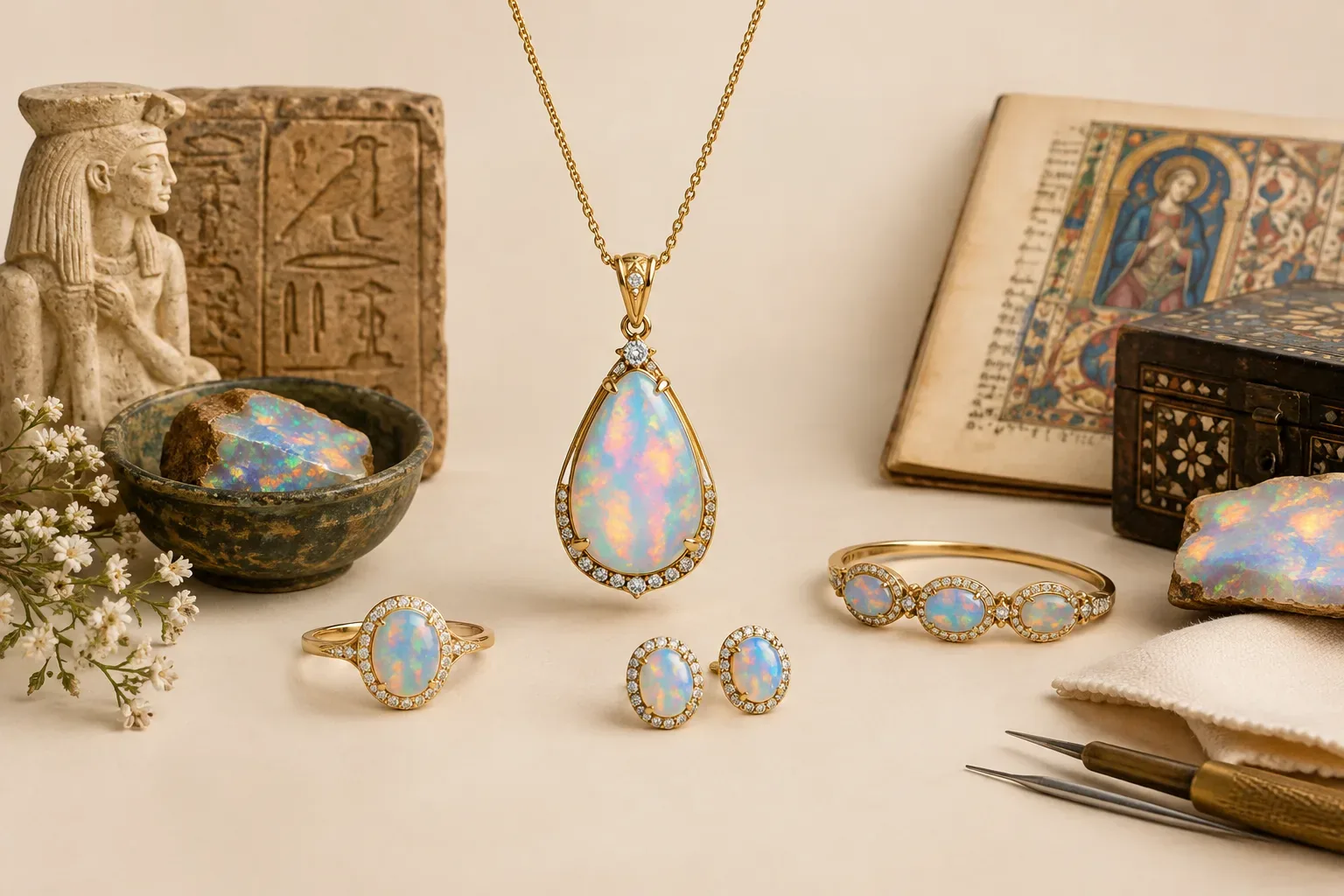
Meaning at a glance
Inspect opals for cracks, loosening, or separation in composite stones; clean gently with a soft cloth and mild soap; avoid extremes and harsh cleaners; seek a jeweler experienced with opals for structural damage, re-setting, or composite separation; sellers must disclose treatments or assembled stones under FTC guidelines.
What historical evidence tells us about opal in jewellery
Museum surveys and reference guides show that opal has been part of the European jewellery repertoire for centuries and that its social meanings and uses have changed over time. The Victoria and Albert Museum presents opals as one of many gemstones that appear across periods and styles in its collections and in its general histories of jewellery, documenting changing tastes, techniques, and contexts rather than a single, constant meaning (Victoria and Albert Museum).
The V&A’s A–Z of gemstones discusses how different gems, including opal, have had shifting popularity and have been used in a variety of object types—rings, brooches, pendants and more—reflecting technological developments, supply, and fashion rather than a single cultural story (Victoria and Albert Museum). These kinds of museum resources are useful for showing how the appearance and social role of opal jewellery evolved across particular historical periods and places.
Documented historical meanings versus modern personal interpretations
Documented meanings in museum records and jewellery histories tend to focus on social uses, fashion, and craftsmanship rather than universal symbolic definitions. For example, museum catalogues and surveys record that opal was included in particular styles and collections and that its desirability rose and fell with fashion currents; such documentation is descriptive and tied to periods and places (Victoria and Albert Museum).
By contrast, modern personal or New Age interpretations—claims that opal has specific healing powers, guarantees of luck, or universal spiritual meanings—are contemporary readings rather than statements recorded as historical fact in museum documentation. These personal interpretations may be meaningful to individuals, but they are not the same thing as the documented cultural roles and manufacturing choices recorded by institutions that collect jewellery.
How opal appears in jewellery and why that matters for care
In jewellery collections and dealers’ inventories opal most commonly appears as smooth cabochons, set as single stones or assembled as doublets and triplets. Museums and gemstone guides note these variations because they affect both appearance and how a stone should be treated; cabochons are a common cut for opal because it shows the stone’s play-of-colour well, while assembled stones use layers (thin opal slices bonded to backing material and sometimes capped) to give a larger-looking gem (Victoria and Albert Museum).
Because opals are used in rings, pendants, brooches and other formats, the choice of setting matters: protective settings, such as bezels or low-profile mountings, reduce the chance of knocks. Assembled stones (doublets and triplets) are mechanically different from single-piece opals and can separate if adhesives fail or if they are exposed to inappropriate solvents or heat. The Federal Trade Commission makes clear that sellers must disclose material treatments and assembled stones, which is an important consumer protection when selecting and caring for opal jewellery (Federal Trade Commission).
Practical maintenance: everyday care and home checks
Handle opal jewellery with care. Clean gently with a soft, lint-free cloth. For routine cleaning, many jewellers advise using lukewarm water with a tiny amount of mild soap, wiping gently, then drying completely with a soft cloth before storing. Avoid household bleach, strong acids, and aggressive solvents, and avoid ultrasonic or steam cleaners unless a trusted professional confirms a piece is safe for those methods.
Store opal items separately in soft pouches or padded compartments to prevent scratches from harder gems and metal. Keep jewellery away from prolonged exposure to direct heat and avoid rapid temperature changes. Check settings visually on a regular schedule: look for movement of the stone, loose prongs or bezel gaps, discoloration at joins, or any signs that a doublet or triplet is separating. If you see any of these problems, stop wearing the piece until a professional examines it.
Warning signs that require professional opal jewellery repair and maintenance
Visible cracks, chips, or a network of fine fractures (sometimes called crazing) in an opal are structural issues that need attention. Continued wear can enlarge damage. Loose stones or visible play of movement in a mounting mean the setting has lost its security and should be stabilized by a jeweller before more damage occurs.
If a stone in a doublet or triplet shows a dark gap between layers, a film or cloudiness at the join, or if the layers begin to separate, the adhesive bond has likely failed. Because assembled pieces are constructed, they often require careful re-bonding or replacement by someone familiar with opal composites. Discoloration, sticky residue, or unexpected softness around soldered joins or bezels are other reasons to consult a professional.
What a professional will normally do
A jeweller or conservator experienced with opal will first assess whether the piece contains a single opal or an assembled stone, whether metalwork is secure, and whether the stone can reasonably be conserved. Common professional interventions include tightening or replacing prongs, resetting in a more protective mount, stabilizing or replacing adhesive bonds in assembled stones, and—when a stone is beyond repair—sourcing a suitable replacement while documenting the change.
Professionals will also advise on safe cleaning methods for the specific object and on preventive steps to minimize future risk. For historically important or museum-quality pieces, a conservator with specialised gem-conservation experience is the appropriate choice; for modern commercial jewellery, a reputable jeweller with experience in opals will be the right first stop.
Choosing, gifting, and selecting opal jewellery respectfully
When buying or gifting opal jewellery, ask the seller whether the stone is a single opal or an assembled stone and whether any treatments have been applied; the Federal Trade Commission emphasises that sellers should disclose such facts for consumer protection. Knowing whether an opal is a doublet or triplet matters for both price expectation and future care needs.
For gifts intended for everyday wear, choose a design with protective settings such as bezels or low-profile mountings, and consider the recipient’s lifestyle. Explain any special care needs to the recipient in a respectful note: it is helpful and courteous to include storing and cleaning advice, and to flag whether the piece contains an assembled opal that needs extra attention.
Final guidance and a concise checklist
In short: monitor for cracks or movement, clean gently, store separately and avoid harsh chemicals, and consult a jeweller experienced with opals if you see structural problems or separation in assembled stones. Request disclosure of treatments and construction at purchase, then keep receipts and documentation so a professional has the object history when assessing repairs.
This approach respects both the documented history of opal as a changing element of jewellery fashions (as shown in museum references) and the modern practical needs of owners who want to enjoy and preserve their pieces.
Frequently asked questions
How can I tell if my opal is an assembled stone (doublet or triplet)?
Look closely at the stone edge under good light: assembled stones often show a visible line or change in material at the join. Triplets may have a clear cap over the opal layer. If you are unsure, ask your seller for documentation or take the piece to a jeweller for identification; sellers are required to disclose assembled stones under FTC guidance.
Can I clean opal jewellery at home with an ultrasonic cleaner?
Do not use an ultrasonic cleaner unless a trusted professional has confirmed that the specific piece is safe for that method. Ultrasonic and steam cleaners can be risky for delicate or assembled opals. A soft cloth and mild soapy water, applied gently and dried thoroughly, is the safer routine-cleaning approach.
What are the most important warning signs that mean I should see a professional?
Visible cracks, chips, fine networks of fracture (crazing), loose movement of the stone in its setting, or separation in doublets or triplets all indicate a need for professional assessment. Also consult a professional if soldered joins look discoloured or if adhesives appear soft or discoloured.
How often should I have my opal jewellery inspected?
As a practical rule, have wearable opal pieces inspected once a year or sooner if you notice any change. Frequent-wear items such as rings may need more frequent checks. A jeweller can tighten settings, check adhesive bonds, and advise on condition-specific care.
What should I ask the seller when buying opal jewellery as a gift?
Ask whether the opal is a single natural stone, a doublet or triplet, and whether any treatments have been applied. Request written disclosure of treatments or assembled construction, retain receipts and any gem reports, and consider a protective setting if the recipient plans to wear the piece daily.
Sources and further reading
- Bedazzled: A History of Jewellery — Victoria and Albert Museum
- An A-Z of Gemstones — Victoria and Albert Museum
- Buying Gemstones, Diamonds, and Pearls — Federal Trade Commission