Meaning at a glance
This guide explains the documented history and changing uses of turquoise in jewelry, separates historical meanings from modern interpretations, and gives safe cleaning, storage, and selection advice including what to avoid.
Documented history and which cultures used turquoise
Museum surveys and reference guides show that turquoise has been valued in many different places and periods for its color and durability in jewelry and ornament. The Victoria and Albert Museum presents turquoise within a broad narrative of jewelry history, noting its presence in objects across cultures and ages as part of wider material and decorative traditions. Curators and collections in museums such as the Victoria and Albert Museum document examples from ancient Egypt, Persian and wider Iranian traditions, and the Indigenous peoples of the American Southwest among others, each using turquoise in ways that reflected local technology, trade connections, and aesthetic preferences.
When discussing turquoise historically, it is important to name cultures and contexts precisely rather than treating meanings as the same everywhere. For example, archaeological and museum collections link turquoise in ancient Egyptian contexts to inlay and beadwork, in Persian and Central Asian contexts to ornamental inlay and settings with metals, and among Southwestern Native American makers to silver-and-turquoise forms that emerged and evolved in the 19th and 20th centuries. These are documented by museum catalogues and gemstone reference works that place turquoise within specific material histories and trade networks, as summarized in writing and exhibits from the Victoria and Albert Museum.
Documented meanings versus modern personal interpretations
Historical sources and museum descriptions can demonstrate that turquoise had symbolic uses in particular societies—for example, used as a prestige material, in ritual objects, or as ornament associated with status. Such cultural meanings are evidence-based when tied to archaeological or ethnographic records and object labels curated by museums like the Victoria and Albert Museum.
Modern claims that turquoise universally protects the wearer, heals specific ailments, or confers particular metaphysical properties are contemporary personal or commercial interpretations rather than universal historical facts. Those modern beliefs exist alongside long material histories, but they should be treated as personal meanings adopted by individuals or groups today rather than as evidence derived from the artifact record. Distinguishing these categories helps keep historical description and contemporary spiritual or wellness claims separate.
How the turquoise motif and stone appears in jewelry
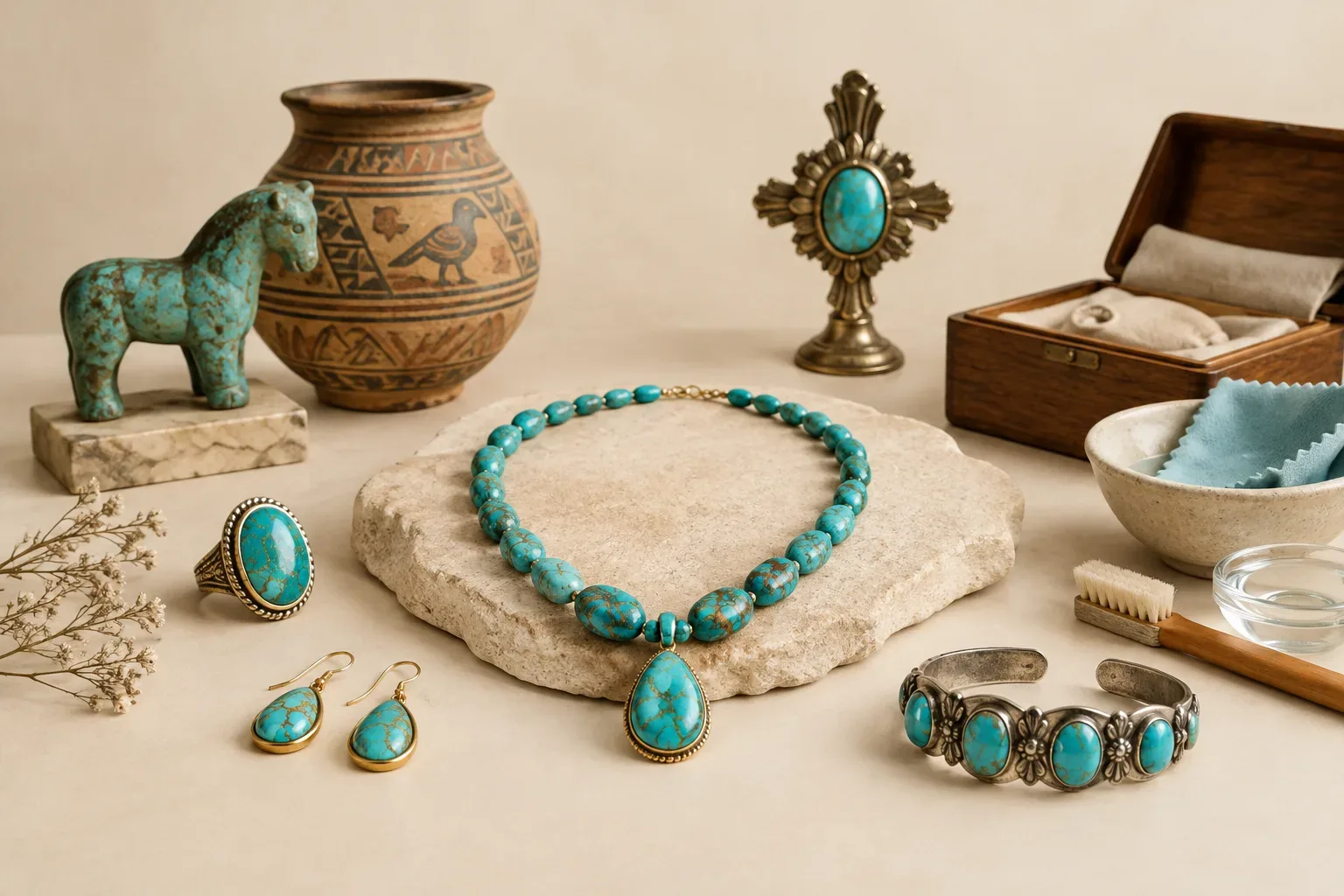
Turquoise appears in jewelry in several technical forms. It is commonly worked as cabochons—smooth, domed stones—set into bezels and frames in silver, gold, or other metals. In many traditions it is also used as beads, inlaid mosaic pieces, and as small carved elements within larger ensembles. In some modern and historic practices, turquoise is cut and used in composite forms such as doublets or mounted pieces that combine turquoise with backing materials to improve durability or appearance.
The visual motif of turquoise—its blue to green color rather than a specific symbolic figure—often becomes a recurring decorative theme: a single prominent turquoise cabochon in a ring, rows of small turquoise beads in a necklace, or densely inlaid panels in objects. Museum and reference literature record these technical treatments and stylistic variations, showing how the stone’s color and working properties have shaped decorative choices across time and place.
Safe cleaning methods
Start with the gentlest method: wipe turquoise with a clean, soft, dry cloth to remove surface dust and oils from handling. This is the least risky approach for everyday maintenance because many turquoise varieties are porous and can absorb liquids and chemicals.
If a deeper clean is needed, use lukewarm water with a drop of very mild, pH-neutral soap applied to a soft cloth. Lightly dab and then gently wipe the stone; do not soak the piece. Rinse the cloth and wipe again with plain water to remove soap residue, then pat dry immediately with a soft cloth. Avoid prolonged exposure to water because some turquoise will absorb moisture or dyes.
Avoid steam and ultrasonic cleaners because the heat, vibration, and rapid movement of liquids can fracture porous stones, loosen settings, or affect adhesives used in assembled pieces. Do not use bleach, ammonia, or household chemical cleaners on turquoise or its mounting metals because these can alter the stone’s surface and damage metal finishes.
Safe storage methods
Store turquoise jewelry in a padded, separate compartment or in a soft cloth pouch to protect it from scratches by harder gems and metal contact. Keep pieces individually wrapped when possible so settings cannot abrade the stone over time. Use a lined jewelry box or drawer inserts rather than loose piles of mixed jewellery.
Avoid storing turquoise in direct sunlight or with prolonged exposure to strong artificial light, as some turquoise can fade or change color when exposed to UV light or heat over long periods. Keep jewelry away from high temperatures and extreme humidity because environmental extremes can affect both stones and metal settings.
If a piece includes adhesives, composite layers, or treatments, store it in stable, moderate room conditions and avoid sudden temperature swings. For valuable or historically significant pieces, museum-standard archival storage—acid-free tissue and climate-controlled conditions—is appropriate, and professional conservation advice should be sought for long-term care.
Common mistakes to avoid
Do not assume turquoise is hard and scratch-resistant. It is substantially softer than sapphire or diamond, so contact with harder stones or rough handling will cause abrasion or surface damage. Do not sleep or exercise wearing turquoise jewelry, and remove rings when doing heavy manual tasks.
Do not use commercial jewelry dips, steam cleaners, or ultrasonic baths on turquoise. These aggressive methods are designed for harder, nonporous stones and can strip protective coatings, leach dyes, or dislodge glued assemblies in turquoise pieces.
Do not rely on appearance alone to infer whether a turquoise has been treated or stabilized. Many turquoise stones are stabilized, dyed, or assembled, and such treatments change how the stone reacts to cleaning and heat. Because treatments are common, sellers should disclose them; follow guidance from the Federal Trade Commission on disclosure of treatments, imitations, and enhancements when purchasing gemstones.
Selection and respectful gifting guidance
When choosing turquoise jewelry, decide how the recipient will wear the piece. For everyday wear, select pieces set securely with protective bezel settings and consider stabilized turquoise or pieces with protective design features. For occasional or ceremonial wear, traditional carved or bead forms may be appropriate, but treat them as delicate.
Ask the seller about treatments, stability, and origin. The Federal Trade Commission advises that sellers disclose material treatments, imitations, and assembled stones. A reputable seller will provide information about whether turquoise is natural, stabilized, dyed, or assembled, and whether the piece has been repaired or restored.
Be culturally respectful when buying or gifting pieces with specific cultural origins. If purchasing jewelry described as Native American, Southwestern, or made in a particular artisan tradition, verify maker attribution and provenance and prioritize buying from makers who belong to that culture or from dealers who can document fair procurement. Respect traditions and avoid using sacred designs or motifs as novelty items when they have continuing cultural or ritual significance for the originating community.
For gifts that convey thoughtfulness, pair the jewelry with context: a short note about the stone’s material history, the maker if known, and guidance on care and storage will help recipients preserve the object and understand its cultural background.
Final notes
Turquoise jewelry benefits from conservative care and informed purchase. Museums and reference works, such as materials and object collections summarized by the Victoria and Albert Museum, place turquoise within a wide history of decorative use and styles, helping us understand how the material has been valued in different places and times. Practical conservation of turquoise is straightforward: keep it clean with dry methods, use gentle soap and water only when necessary, avoid aggressive cleaners, and store pieces padded and separate.
Distinguishing documented historical evidence from modern personal interpretations will help you respect the stone’s cultural histories while making safe, practical choices about cleaning, storage, and gifting.
Frequently asked questions
Can I use jewelry cleaning dips on turquoise?
No. Jewelry cleaning dips and other aggressive chemical cleaners can damage the porous surface of turquoise, strip protective coatings, and affect dyes or stabilizing resins; use a soft cloth or very mild soap and water instead.
Is it safe to wear turquoise in the shower or pool?
Avoid wearing turquoise in chlorinated pools, hot tubs, or for showering. Prolonged exposure to water, chlorine, and heat can affect porous or treated stones and metal settings over time.
How do I know if my turquoise is treated or stabilized?
Ask the seller for disclosure. The Federal Trade Commission recommends that dealers disclose treatments, dyeing, stabilization, or assembled stone components; reputable sellers will provide this information.
What storage is best for vintage or valuable turquoise pieces?
For vintage or valuable items, use padded, separate compartments and avoid direct sunlight and extreme humidity. For historically significant pieces, consult a professional conservator for museum-grade storage recommendations.
Can I polish minor scratches out of turquoise?
Polishing to remove scratches is not recommended at home. Because turquoise is soft, attempting to polish it yourself risks altering the shape or removing surface treatments; seek a professional jeweler or conservator experienced with turquoise.
Is it disrespectful to wear turquoise from another culture?
Context matters. Wearing turquoise itself is not inherently disrespectful, but using sacred motifs or claiming cultural meanings without understanding or sourcing from makers in that culture can be insensitive. When in doubt, prioritize pieces made by artists of that culture or provide attribution and provenance when gifting.
Sources and further reading
- Bedazzled: A History of Jewellery — Victoria and Albert Museum
- An A-Z of Gemstones — Victoria and Albert Museum
- Buying Gemstones, Diamonds, and Pearls — Federal Trade Commission