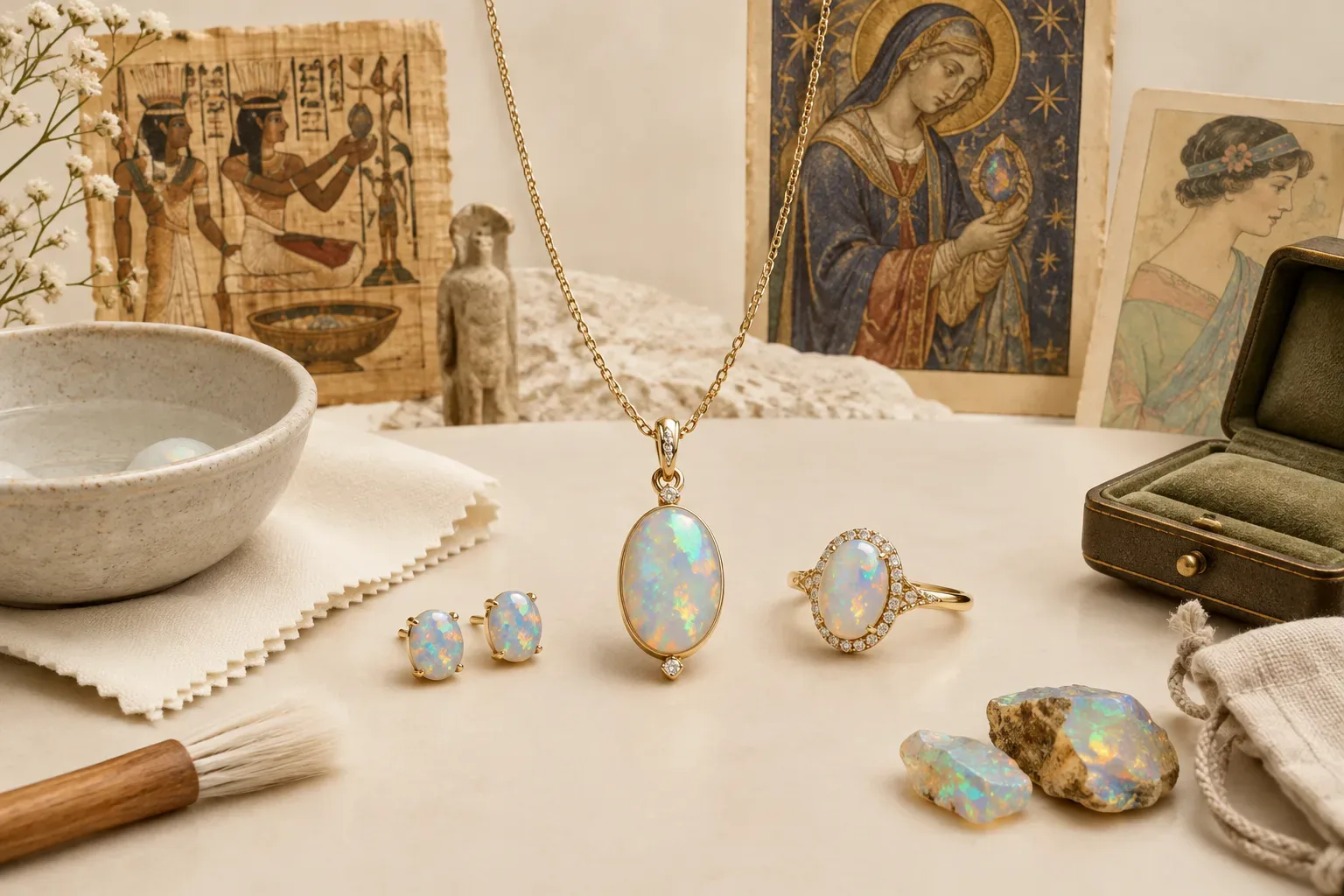
Meaning at a glance
This article outlines documented historical contexts for opal in jewelry (as recorded by museum sources), separates those records from later popular beliefs, explains how opal appears and is treated in jewelry, and gives conservative, practical guidance for cleaning, storing, selecting, and gifting opal pieces along with common mistakes to avoid.
Quick answer
Conservative care: clean opal jewelry gently with a soft, dry or slightly damp cloth, avoid harsh chemicals and ultrasonic cleaners, store pieces where temperature and humidity are stable and where settings cannot rub together, and always ask sellers about treatments or assembly (for example doublets or triplets) before purchase. The Victoria and Albert Museum documents opal’s changing uses and meanings in jewelry history, and the U.S. Federal Trade Commission advises buyers to seek clear disclosure about treatments and assembled stones; use that historical context and disclosure guidance to choose and care for opal responsibly.
Documented history and changing contexts
The Victoria and Albert Museum (V&A) places opal within the longer story of jewellery as a changing social and material practice. V&A resources discuss how gemstones, including opal, were used in different periods and social contexts, and how styles and meanings shifted as tastes and technologies changed. The museum’s exhibition and reference material identify opal as part of historic collections without endorsing uniform symbolic claims across cultures.
Museum documentation shows that the role of opal in jewellery has rarely been static: curators and catalogues at the V&A describe opal appearing in a range of settings—from decorative high jewellery to personal and sentimental objects—reflecting fashion, available cutting technology, and market preferences rather than a single, continuous cultural meaning.
Do not conflate museum records with later popular stories. Museums record how opals were used and collected; later folklore, advertising narratives, and modern spiritual or romantic interpretations were layered onto those historical uses. The V&A’s historical treatment is descriptive: it records presence and context rather than endorsing later symbolic readings.
Separate documented historical meanings from modern interpretations
Documented historical evidence in museum catalogues and exhibitions identifies the presence and use of opals in jewellery and notes changes in style and method. Those same sources do not claim a single, ancient universal symbolism for opal across all cultures and periods. Use the V&A’s records as primary documentation of how opals were worn and displayed, and as evidence for changing social contexts.
Modern personal or New Age interpretations of opal—about emotional effects, metaphysical powers, or fixed symbolic meanings—are contemporary layers of meaning applied by individuals and communities. Such modern meanings may be meaningful to wearers, but they are not the same as the documented historical record of how and when opals were used in jewellery as described by museum sources.
How opal appears in jewellery: forms, settings, and treatments
Opal appears in jewellery in several physical forms. Fine solid opals are cut and set like other cabochon gemstones, while assembled stones such as doublets and triplets combine thin slices of opal with backing materials and protective caps. These assemblies create attractive colour effects while conserving rare material. The V&A’s gemstone overview discusses how different gem materials have been worked across periods; assembled stones are part of that technological and commercial story.
Settings for opal vary from protective bezel settings and closed backs to more open prong mounts. Because opal appearance can rely on play-of-colour and surface condition, many jewellers choose settings that both show the stone and offer protection. Ask sellers whether a stone is a solid opal, a doublet, a triplet, or otherwise treated—FTC guidance stresses buyer disclosure about material treatments and assemblies to inform care and value expectations.
Treatment and imitation are relevant to cleaning and storage. The FTC’s consumer guidance on buying gemstones, diamonds, and pearls highlights that treatments, assembled stones, and imitations must be disclosed by sellers. If a stone has been stabilized, coated, or assembled, that affects which cleaning and storage methods are safe.
Practical cleaning: safe methods and common mistakes
Start conservatively: for most opal jewellery, a soft, clean cloth is the first and safest cleaning tool. Wipe away oils and surface dust without scrubbing, and dry the piece after any light damp cleaning to avoid prolonged moisture exposure against setting materials.
If a jeweller advises wet cleaning, use only a mild, neutral soap with minimal water and rinse quickly; always dry the piece thoroughly. Avoid strong solvents, commercial jewellery cleaners with unknown chemistry, and abrasive pastes. If the opal is assembled (doublet or triplet), avoid soaking; backing layers or adhesives can be compromised by prolonged moisture.
Avoid ultrasonic cleaners and steam cleaning unless a qualified gemmologist or the seller confirms those methods are safe for the specific piece. Ultrasonic and steam devices can adversely affect assembled stones and some adhesives used in modern jewellery construction.
A common mistake is treating every opal the same way. Because manufacturing methods and treatments vary, cleaning advice should follow the piece’s construction and any seller disclosures. When in doubt, consult a professional jeweller experienced with opal.
Practical storage: what to do and what to avoid
Store opal jewellery where it cannot be scratched by other pieces; soft cloth pouches or separate compartments in a jewellery box are sensible. Protecting each item from friction reduces the risk of surface damage to polish and play-of-colour.
Keep storage conditions stable. Sudden and extreme changes in temperature or humidity can stress gemstones and some mounting materials. Wherever possible, avoid prolonged exposure to intense heat or to environments that are excessively dry or humid. If a particular piece has a disclosed filling, adhesive, or laminate, follow any storage warnings the seller provides.
Avoid storing opal next to abrasive items or harsh chemicals (including household cleaners, cosmetics, and perfumes) that could make contact during storage or wear. When travelling, keep opal jewellery in a rigid container with padding so it will not be crushed or abraded in transit.
Selection and gifting guidance
When choosing opal jewellery as a gift, start by clarifying the recipient’s lifestyle and taste. If the wearer is active or works with their hands, favour protective settings (such as bezels) and harder companion materials in the piece. If the piece is intended as occasional wear, a showy open setting may be fine.
Ask the seller for written disclosure about the stone’s identity and any treatments, enhancements, or assembly. The Federal Trade Commission advises buyers to seek and keep documentation of these disclosures so you understand how to care for the piece and what its market value may be.
Consider provenance and authenticity if those attributes matter to the wearer. Museums such as the V&A document how material sources and cutting technologies influence appearance and value; for buyers this means asking useful questions about where, how, and by whom a stone was prepared.
Respect personal meanings. Modern symbolic or spiritual associations with opal are personal and may add sentimental value to a gift. Make a distinction between those personal meanings and the historical record when discussing the piece with the recipient.
When to consult a professional
Seek professional advice when a piece is valuable, shows signs of loose settings, or has unclear documentation about treatment. A qualified jeweller or gemmologist can identify whether a stone is a solid opal, a doublet, a triplet, or otherwise treated, and can recommend tailored cleaning, setting repair, or safe storage.
Consult a professional before attempting any restoration on historic or heirloom opal jewellery. Museums document how past repairs and alterations affect the integrity of a piece, and professionals can advise on reversible and conservation-minded options.
Closing guidance: balance caution with enjoyment
Opal jewellery can be both beautiful and meaningful. Use the V&A’s historical documentation to appreciate how opals have changed their place in adornment over time, and follow the FTC’s guidance on disclosure to understand a specific piece’s construction and care needs. With conservative cleaning, careful storage, informed selection, and occasional professional consultation, you can protect opal jewellery while enjoying it.
Remember that documented historical uses in museum collections are not the same as modern personal symbolism. Keep those categories separate when researching, selecting, or gifting opal jewellery to maintain clarity about provenance, value, and meaning.
Frequently asked questions
Can I use commercial jewellery cleaners on opal?
Not without confirmation. Because opals and assembled stones vary in construction, many professionals advise avoiding generic commercial cleaners unless the seller or a qualified jeweller confirms they are safe for that specific piece; the Federal Trade Commission recommends asking sellers for treatment and construction disclosures before cleaning.
How will I know if my opal is a solid stone, a doublet, or a triplet?
Ask the seller for written disclosure at purchase. The FTC advises that sellers must disclose treatments and assembled stones; if documentation is absent, a professional jeweller or gemmologist can identify the construction and advise on care.
What is the safest everyday cleaning method for opal jewellery?
A soft, clean cloth to remove surface oils and dust is the least risky starting point. If any wet cleaning is needed, use minimal water with a mild soap and dry quickly, but seek professional advice for valuable or treated pieces.
How should I store opal jewellery long term?
Store each piece separately in a soft pouch or compartment to prevent abrasion, and keep jewellery where temperature and humidity are stable. Avoid storing opals near harsh chemicals or abrasive materials.
Should I avoid giving opal as a gift because it’s fragile?
Not necessarily. Choose a style and setting that suit the recipient’s lifestyle, and confirm stone type and treatments with the seller. Choosing a protective setting and providing care notes with the gift can help the recipient enjoy the piece safely.
Sources and further reading
- Bedazzled: A History of Jewellery — Victoria and Albert Museum
- An A-Z of Gemstones — Victoria and Albert Museum
- Buying Gemstones, Diamonds, and Pearls — Federal Trade Commission