Meaning at a glance
Viking Age jewelry contains stylized interlaced animals and serpentine forms, but not every creature can be securely named as a dragon or a particular mythic serpent; modern designs should state where interpretation begins.
What the archaeological record actually shows
Archaeological and museum records demonstrate that metalworkers of the Migration period and Viking Age used highly stylized animal and snake-like motifs in brooches, pins, pendants and fittings. The Metropolitan Museum of Art’s study of Migration period art (A.D. 300–800) documents the long tradition of interlaced and elongated animal forms that feed directly into later Viking animal styles. These forms can be sinuous, hooked and arranged in repeating knots, and they appear across northern Europe in metalwork and small-scale objects.
The National Museum of Denmark summarizes finds from the Viking Age showing how jewellery was integrated with dress: brooches, arm rings, neck-rings and bead strings appear in graves and hoards, often combined with zoomorphic terminals and decorative fittings. The Swedish History Museum emphasizes the variety of sources we use—archaeological finds, burial contexts, and later written records—to reconstruct style and use. Taken together, these museum catalogues show clear physical continuity in motifs and techniques, but they do not provide a one-to-one mapping between every decorative creature on a brooch and a named mythic animal.
Where careful interpretation ends and modern meaning begins
Documented, historical meanings: The objects themselves and their contexts show that many pieces functioned as dress fittings, status markers, trade goods and personal ornaments. Museums and archaeologists use find contexts, workshop marks and wear patterns to draw these conclusions. For example, some ornate arm rings and neck-rings in burial contexts indicate social display or wealth, while small zoomorphic terminals on brooches often served as decorative closures or identity markers for dress.
Modern and literary interpretation: Assigning a particular design to a named creature from later Norse literature (for example, the Midgard Serpent Jörmungandr) goes beyond what the material record alone can prove. The Swedish History Museum and the National Museum of Denmark both note that written sources such as sagas and eddas were composed or written down later than many of the objects we excavate. Where a modern maker or seller labels a piece “dragon” or “Jörmungandr-inspired,” that is a contemporary interpretive choice that may combine archaeological forms with later literary motifs. The Metropolitan Museum of Art’s overview of animal styles underlines this same caution: animal and serpentine shapes are widespread, but names and mythic identities are not always recoverable from the objects themselves.
How dragon and serpent motifs appear in Viking jewelry
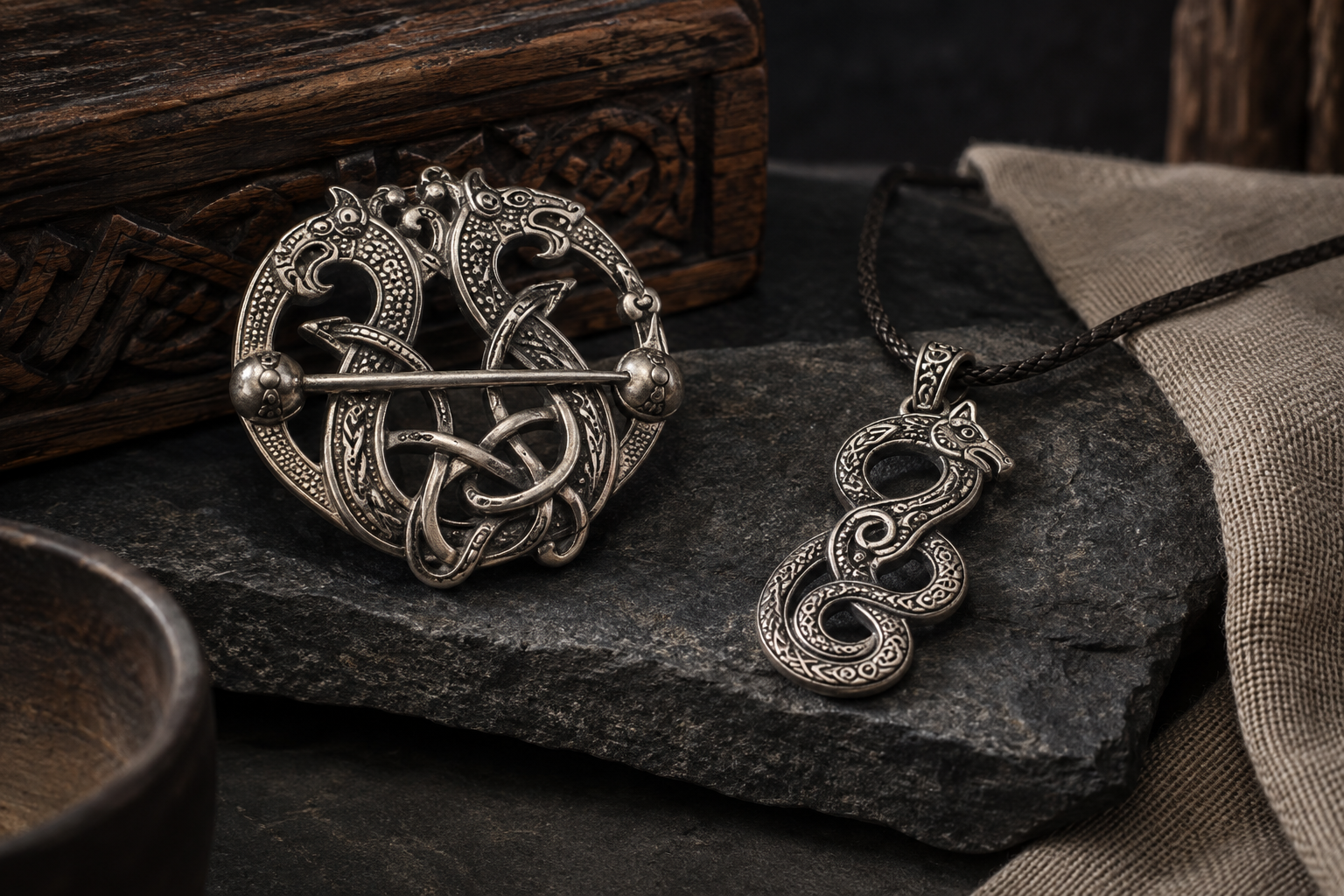
The motif appears most commonly as elongated, sinuous terminals, interlaced bodies and hook-shaped heads worked in silver, bronze or gold alloy. On brooches and pendants you will see heads formed from flattened loops or zoomorphic terminals that mirror a creature’s jaw or muzzle, and bodies rendered as twisting ribbon-like bands that knot and weave around themselves. These are the same visual principles recorded in Migration and Viking animal styles, where emphasis is on repeated, flowing line and stylization rather than realistic anatomy.
Designers today adopt these structural conventions when they create pieces labelled as dragon or serpent jewelry. A modern pendant described as “dragon” often uses the hooked head and undulating body derived from Viking-era animal ornament, while a “serpent” bead string might repeat a simpler S-curve motif. Responsible makers will indicate whether a piece is a faithful reproduction of a specific archaeological find, an informed reinterpretation, or a contemporary design inspired by Viking motifs.
Gemstones, materials and techniques in practice
Surviving Viking jewellery is typically metalwork—silver, gold or base metal alloys—often combined with glass and organic beads. Transparent and opaque glass beads occur frequently in finds described by the National Museum of Denmark as components of necklaces, while metal arm-rings and brooches carry the more durable animal terminals. Hardstones and gem settings are less common in typical Viking gravegoods than in later medieval high-status pieces, but enamel and inlaid glass do appear in some objects.
Techniques recorded in museum catalogues include casting, inlay and fine tooling to create incised lines and interlaced patterns. The visual effect of a “dragon” may be achieved through raised ridges, punched dots for eyes, and careful bending of terminals. Modern makers who aim for historical accuracy often use lost-wax casting, hand engraving or openwork to reproduce the line-based character of Viking animal ornament.
Practical and respectful selection or gifting guidance
If you are buying or giving a piece described as Viking dragon or serpent jewelry, check whether the maker or seller identifies the piece as an archaeological reproduction, a historical interpretation, or a contemporary design inspired by Viking art. Sellers who cite specific finds or museum references—such as publications from the Metropolitan Museum of Art, the National Museum of Denmark, or the Swedish History Museum—make it easier to understand what part of the design is historical versus interpretive.
Consider materials and wearability. Reproductions in silver or gold will handle daily wear better than plated pieces; glass beads or organic components may require more care. If cultural sensitivity is a concern for the recipient, choose pieces framed as “inspired by” rather than claiming authentic magical or religious properties. For gifts intended to evoke heritage, ask the recipient whether they prefer accurate reproductions or contemporary reinterpretations, and be explicit about what you mean by “Viking” when you present the item.
A final note on claims of meaning
Museum evidence supports the importance of animal and serpentine imagery in northern European metalwork across the Migration and Viking periods, but the archaeological record rarely gives us direct labels for the creatures depicted. When you encounter products or interpretations that claim a single, universal meaning for a “Viking dragon” or that link every serpentine motif to a particular mythic being, remember the difference between the physical evidence compiled by museums and the later stories or modern branding that supply names and narratives.
If you need a short takeaway: appreciate the design and its historical roots, but distinguish documented archaeological function from the later or personal meanings applied today. Makers and sellers who make that distinction public are following the same scholarly caution reflected in museum publications.
Frequently asked questions
What does "Viking dragon jewelry" mean historically?
Historically, Viking and Migration-period metalwork features stylized animal and serpentine motifs. Museums note that these shapes appear as decorative terminals and interlaced ornament, but the archaeological record does not usually provide direct labels that name those creatures as specific dragons from later Norse literature.
Can a Viking-era piece be identified as a specific mythic serpent like Jörmungandr?
No archaeological single-piece identification is provable as a named mythic serpent; written sagas were composed later and assigning a particular archaeological motif to a named mythic creature is an interpretive, not strictly archaeological, act.
How can I tell if a piece is a reproduction or a modern interpretation?
Look for seller information: reproductions usually cite the specific find or museum reference and describe the techniques used, while modern interpretations will often use wording like “inspired by.” Reliable sellers will disclose which elements are historical and which are creative additions.
Were gemstones common in Viking dragon or serpent jewelry?
Glass beads and organic beads are common in Viking-period finds and appear alongside metal terminals; however, gem-set jewellery is less typical in everyday Viking graves than metalwork and beads, though occasional high-status pieces do show inlay or glass imitation gems.
Is it respectful to wear Viking-style dragon jewellery today?
Yes, provided you avoid implying contemporary or universal spiritual claims and respect the distinction between archaeological evidence and modern beliefs. Choose makers who are transparent about whether a design is a reproduction, historical interpretation, or a contemporary piece inspired by Viking motifs.
Where can I read more about the archaeological evidence for these motifs?
Museum publications provide accessible overviews. Recommended starting points are the Metropolitan Museum of Art’s Migration Art catalogue, the National Museum of Denmark’s pages on clothes and jewellery, and the Swedish History Museum’s guidance on sources.
Sources and further reading
- Migration Art A.D. 300–800 — The Metropolitan Museum of Art
- Clothes and jewellery — National Museum of Denmark
- The sources for what we know — Swedish History Museum