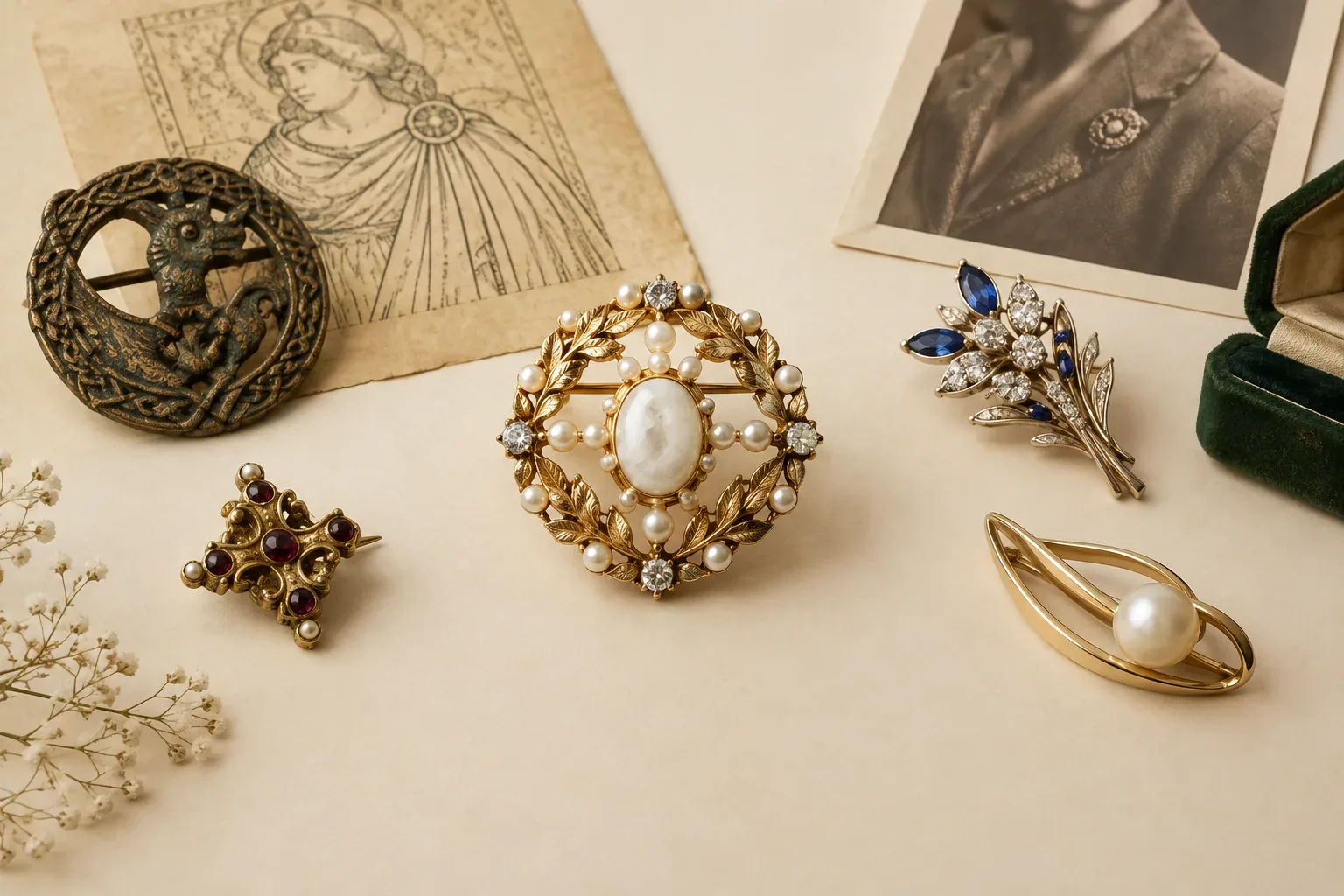
Meaning at a glance
This brooch buying guide explains documented historical uses and changing contexts for brooches, separates recorded cultural meanings from modern personal interpretations, and gives practical tips on assessing quality, materials, and price when buying or gifting brooches.
Quick answer
A responsible brooch buying guide explains documented history and changing contexts, distinguishes recorded cultural or religious meanings from later popular interpretation, and provides practical checks on quality, materials, and price so you can choose or gift a brooch with confidence. Use museum-published history to understand past functions and symbols, follow government guidance on gemstone treatments and disclosure when evaluating materials, and apply everyday quality checks to fastening, soldering, and hallmarks before you buy.
Documented history: where brooches come from and how museums describe them
Brooches appear throughout many cultures as both functional fasteners and visible personal adornment. The Victoria and Albert Museum (V&A) treats brooches as part of a long material history of jewellery, showing examples across ancient Roman and Byzantine contexts, medieval and early modern Europe, and later Georgian and Victorian fashions. The V&A frames these objects in terms of changing techniques, social use, and decorative tastes rather than a single, static meaning.
In early periods such as the Roman and Byzantine worlds, brooch-like pins often served primarily as garment fasteners and could indicate regional style or status through materials and decoration, a point emphasized in the V&A’s coverage of jewellery history. In medieval and later European contexts, brooches could still be functional while also signalling rank, affiliation, or mourning; the V&A’s historical displays show shifts in technique—enamelling, gem-setting, and metalwork—that accompanied changes in social meaning and fashion. The museum’s narrative stresses that the roles of brooches have varied by culture, class, and period rather than being universally equivalent.
Separating documented historical meanings from modern interpretation
When a brooch motif is described as ‘symbolic’ in popular sources, it helps to ask whether that symbolism is documented historically or is a later interpretation. The V&A documents the contexts in which particular designs were used and notes that meanings often depend on social context: a knot motif might appear on a Georgian brooch as a fashionable design; in another time or place the same motif might be reinterpreted as a sentimental emblem.
Modern personal or commercial interpretations—such as attributing a fixed spiritual, political, or emotional meaning to a motif—are often contemporary overlays. These personal readings are valid for the wearer but should not be presented as historical fact unless supported by primary evidence. Use museum resources like the V&A to identify what is documented and treat contemporary symbolic claims as modern usages unless explicitly attested by historical sources.
How motifs, gemstones, and tradition appear in brooches
Motifs: Historical brooches display a wide range of motifs—animals, plants, knots, religious symbols, heraldic devices and abstract ornament. The V&A’s collections and interpretive materials show how certain motifs were fashionable in particular periods and places, and how technique and motif combined to signal status or taste. A single motif can appear across centuries with different decorative techniques and distinct social meanings each time.
Gemstones and materials: The Victoria and Albert Museum’s A–Z of Gemstones provides context for stones commonly set in brooches, including pearls, garnet, turquoise and later-use diamonds. The resource explains how choice of gem related to availability, trade networks, and taste. For buyers today, that history explains why a garnet-set brooch might be common among certain antique types while diamonds became widespread in later eras.
Treatment, imitation and disclosure: When evaluating the material side of a brooch, be aware of treatments, enhancements and imitations. The U.S. Federal Trade Commission (FTC) provides guidance that sellers should disclose material treatments and whether gems are synthetic or imitations. That guidance is practical for buyers: ask for written information about any treatments or enhancements and check whether the seller follows accepted disclosure practices.
Assessing quality: construction, materials, and condition
Start by looking at the construction. A secure hinge, a straight pin with proper spring tension, and a well-soldered catch are fundamental for safe, wearable brooches. Examine the joint work under magnification if you can; poor soldering or loose prongs are signs of a piece that will need repair.
Check the metal. Look for hallmarks or maker’s marks which can indicate metal content and sometimes provenance. While hallmarks do not guarantee higher value, they do provide information. For plated items, note wear through to the base metal on edges and high points; substantial wear decreases intrinsic metal value and may affect how the brooch should be priced.
Examine gems and settings. Stones should be secure in their settings; loose stones reduce both aesthetic and monetary value. Ask the seller about any treatments, enhancements, or synthetic origins. Rely on written disclosures where possible, in line with FTC recommendations, and consider a gem lab report for high-value purchases.
Price questions: what affects value and what to ask
Value reflects materials, craftsmanship, condition, provenance and market demand. A well-made brooch in gold with intact period gemstones and documented provenance will command more than a mass-produced plated piece with replaced stones. Condition matters: dents, missing stones, and repairs lower value and may require additional investment for restoration.
Ask for documentation when price seems inconsistent with what is offered. Provenance, maker’s marks and previous appraisals help justify price. For gemstones, ask whether the seller provides lab reports or written disclosures about treatments, and request return or repair policies. If buying online, inspect clear photos of the pin mechanism and any hallmarks and ensure a trustworthy returns policy.
Choosing and gifting with respect
Choose a brooch for yourself or as a gift by considering the recipient’s style, cultural background and the object’s original meaning where documented. If a motif has religious or cultural significance that is documented by trustworthy sources such as museum scholarship, be cautious about gifting it to someone whose beliefs or heritage you do not understand. Respectful gifting means researching the motif and, when in doubt, asking the recipient or choosing a neutral design.
If you are giving a period brooch as a sentimental gift, explain any historical context you know and be clear about what is documented history versus your personal interpretation. For heirloom or vintage pieces, consider professional cleaning and a simple appraisal before gifting, and share any documentation you have about the item’s age, materials, and provenance.
Practical buying checklist
Before you buy, verify the clasp and pin condition, check for hallmarks or maker’s marks, and ask for written disclosure about gemstone treatments and any replacements. Confirm the return policy, request close-up images for online purchases, and consider a third-party appraisal for higher-value items. When a design references a specific cultural or religious symbol, research its documented use through reliable museum sources or avoid assuming it carries a single meaning for all people.
Care and longevity
Store brooches flat or in separate compartments to avoid scratching and to protect delicate settings. Clean according to the materials involved; softer stones and certain enamels need gentle, specialist care. Professional servicing can tighten settings and repair soldered joins; for valuable or sentimental pieces, find a conservator or experienced jeweller rather than attempting risky DIY repairs.
Frequently asked questions
How do I assess a brooch’s construction quality?
Inspect the hinge, pin and catch for secure function and correct spring tension; examine solder joints and prongs for cracks or poor work; look for hallmarks and test for consistent metal tone. If possible, view the piece under magnification or ask for close-up photos before purchase.
What should I ask about gemstones and treatments?
Ask whether any stones are synthetic, treated, or imitations and request written disclosure. For higher-value stones, ask for a lab report and check the seller’s stated return policy. The FTC recommends that sellers disclose treatments and origins of gems.
Are vintage brooches worth buying?
Vintage and antique brooches can offer good value for craftsmanship and unique design, but condition, authenticity, and provenance strongly affect price. Verify condition and any repairs, and consider a professional appraisal for substantial purchases.
How do I gift a brooch respectfully?
Research the motif’s recorded history using reliable sources and avoid assuming a single meaning. If a design has clear religious or cultural significance, ask the recipient or choose a neutral motif to avoid unintended offense. Share any known provenance or historical context with the recipient.
What are sensible return and authentication practices?
Buy from sellers who provide clear return policies, written disclosures about materials and treatments, and as much provenance documentation as possible. For expensive pieces, obtain a third-party appraisal or lab report to confirm material and gemstone claims.
Sources and further reading
- Bedazzled: A History of Jewellery — Victoria and Albert Museum
- An A-Z of Gemstones — Victoria and Albert Museum
- Buying Gemstones, Diamonds, and Pearls — Federal Trade Commission