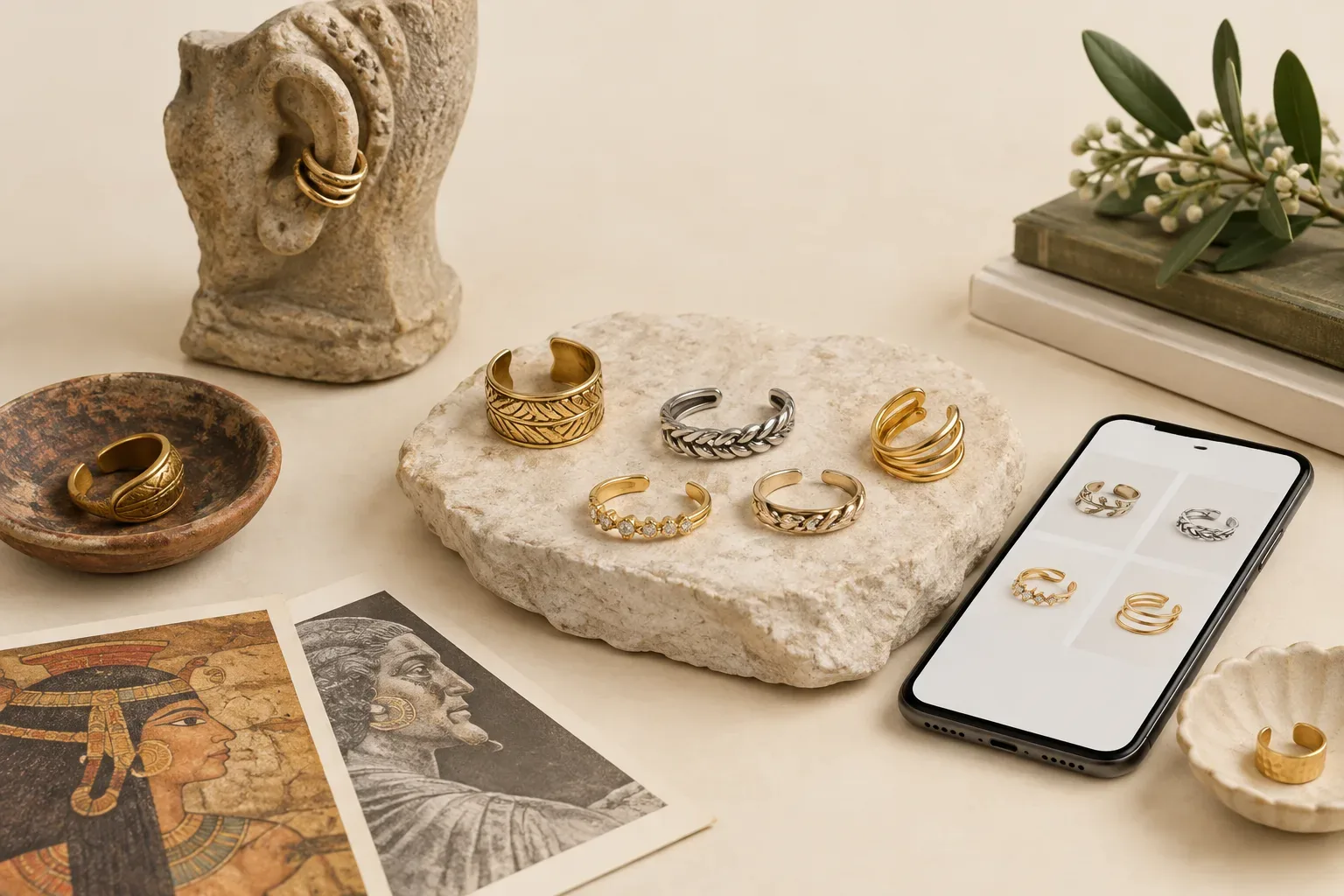
Meaning at a glance
Explain the documented history and changing contexts of the ear cuff online shopping guide motif, separate cultural or religious evidence from later popular interpretations, and give practical guidance for choosing and wearing the motif in modern jewelry.
What museum history documents about ear ornaments
Museum scholarship places ear ornaments in a long, variable history of jewellery use rather than as a single universal symbol. The Victoria and Albert Museum's overview of jewellery history stresses that jewellery has changed social meaning over time and across places, appearing in archaeological and museum collections from ancient through modern periods. Those collections include a wide range of ear ornaments, often shaped to clasp or decorate the ear without requiring a pierced lobe.
When you read historical claims about ear cuffs, look for specific cultural attribution. Museums and catalogues will identify whether an item comes from a particular ancient culture, region, or period, for example antique clasps or ear rings from Greek or Roman contexts or European pieces from the 19th century. The V&A's material makes clear that context — who owned the object, how it was worn, and where it was found — matters for interpretation.
Documented historical meanings versus modern interpretations
Documented historical meanings of jewellery tend to be specific to time and place: museum records and provenance can show that a piece served as a status marker, a trade good, a funerary inclusion, or a fashion accessory. The V&A emphasizes that such social functions change. For example, in some historical contexts an elaborate ear ornament could mark social rank or a rite of passage; in others it simply reflected a fashionable taste among a narrow social group.
Modern interpretations — for instance the idea that wearing an ear cuff expresses rebellion, feminism, or spiritual protection — are contemporary personal or marketing meanings layered onto that longer history. Those modern meanings may be meaningful to wearers, but they are not the same as documented historical functions unless supported by provenance or contemporary textual evidence. Treat historical claims that lack specific cultural or provenance evidence as modern interpretation rather than fact.
How motifs, gemstones, and traditions appear in ear cuff jewelry
Ear cuffs can carry motifs drawn from many jewellery traditions: vegetal scrolls, animal forms, serpents, geometric shapes, and abstract modern designs. Historically documented motifs appear in museum collections; the V&A notes how motifs move between periods and regions as tastes change. When a seller describes a cuff as 'Victorian-inspired' or 'Ancient-style,' check whether those attributions are descriptive design notes or claims of genuine antique provenance.
Gemstones appear in ear cuffs in many ways: faceted stones set into bezels, cabochons mounted in low settings, and beads strung or soldered into metalwork. The V&A's A–Z of Gemstones explains the historical use and identification of stones in jewellery, giving context for what types of gems are commonly used and how they are presented. The Federal Trade Commission reminds buyers that treatments and imitations are common in the market and should be disclosed; a seller must not intentionally misrepresent a treated stone as untreated or an imitation as natural.
Reading seller photos: what to demand and why
High-quality photos are the single most important element when buying an ear cuff online. Ask for multiple-angle images that show the cuff on a model or a mannequin at actual size, a close-up that reveals finish and stone setting, and a clear shot of any hallmarks or metal stamps. A scale reference (a ruler or a coin) helps you judge how tall and deep the cuff will sit on an ear.
Look for images that show the clasping mechanism. Ear cuffs that are described as non-pierced should show the back and inside where the metal contacts the skin. For designs using glued-on stones or plated finishes, close-ups will show whether stones are securely set and whether plating looks thin or uneven. If photos are stock images or appear reused for multiple listings, request original photos; lack of original imagery is a reasonable concern.
Policies and disclosures to verify before you buy
Check the seller's material disclosure and return policy before buying. The Federal Trade Commission guidance on buying gemstones, diamonds, and pearls underscores that sellers should disclose treatments, synthetic or imitation materials, and the metal content of jewellery. If a listing simply says 'stone' or 'gold-coloured' without specifics, ask for clarity on metal type, plating thickness, and gemstone origin or treatment.
Return, repair, and shipping policies are essential. Confirm the window for returns, who pays return shipping, turnaround for repairs (if any), and whether the seller insures parcels in transit. For delicate or bespoke ear cuffs, verify that the seller accepts returns if the cuff fails to fit or causes skin reactions. A clear, published policy is a sign of a reputable retailer.
Common red flags when buying ear cuffs online
Several practical red flags indicate increased buyer risk: absence of clear material or gemstone information, no close-up or size-referenced images, listings that use vague language about origin, and sellers who refuse to confirm whether a cuff is for pierced or non-pierced wear. Another warning sign is a shop that cannot or will not provide provenance when claiming an item is antique or culturally specific.
Also be cautious when price and description do not match. An unusually low price for a supposedly natural gemstone set in solid gold, with no certification or explanation for the discrepancy, should prompt questions. The FTC specifically advises consumers to be skeptical of claims about gemstones and to ask about treatments, synthetics, and the return of suspect items.
Practical selection and respectful gifting guidance
Fit and comfort matter more for ear cuffs than for many other types of jewellery. Look for measurements for internal width and the curve depth of the cuff. If a seller gives only one dimension, ask for the others. Materials affect skin reaction: sellers should state metal type and whether the piece is plated. If the recipient has metal sensitivities, prefer solid hypoallergenic metals such as surgical steel, titanium, or confirmed nickel-free gold alloys, and request testable information from the seller.
When gifting, respect personal and cultural meanings. If a design is described as deriving from a particular cultural or religious tradition, confirm whether it is a modern adaptation or an authentic piece with provenance. If you are unsure, choose a neutral design or discuss preferences with the recipient. For sentimental gifting, include sizing and return options on the receipt so the recipient can exchange or return the cuff without embarrassment.
A short buying checklist
Before checkout: confirm whether the cuff is for pierced or non-pierced ears, request measurements and scale photos, ask about metal type and gemstone treatments, verify the seller's return and repair policy, and check for hallmark images or certifications when applicable. If any of these are missing or answered evasively, treat the listing with caution.
Frequently asked questions
How can I tell if an ear cuff is for pierced or non-pierced ears?
The listing or seller should specify whether a cuff requires a piercing. Confirm by requesting close-up photos of the inside and the clasping area; non-pierced cuffs will show a clamp or open-backed curve designed to pinch the helix, while pierced designs often include a post or loop intended to thread through a hole.
What should I ask about gemstones used in an ear cuff?
Ask the seller to disclose whether stones are natural, synthetic, or treated, and request information about cut, setting security, and origin if available. The Federal Trade Commission recommends asking about any treatments or imitations because sellers must not misrepresent treated or synthetic stones as natural.
Are there common materials that reduce skin irritation?
If you are prone to reactions, request confirmation of metal alloy content. Hypoallergenic options often include surgical stainless steel, titanium, or verified nickel-free alloys. Ask the seller for metal stamps or alloy details and check whether plating is used, since plating can wear and expose base metals.
What photo angles are essential when buying an ear cuff online?
Essential photos show the cuff on a head or ear model at life size, close-ups of the front and back, a clear image of hallmarks or stamps, and a scale reference such as a ruler. Also request a photo of the clasping mechanism so you can judge comfort and fit.
How long should a reasonable return policy be for jewellery?
Reasonable return policies vary, but a transparent seller will state a clear time window for returns (commonly 14–30 days), who pays return shipping, and conditions for accepting returns. For custom or engraved items, ask whether returns are accepted and under what circumstances.
If a seller claims an ear cuff is 'antique' or 'from a culture,' what should I expect?
Expect specific provenance information. Reputable sellers should provide evidence such as a museum or auction record, a clear description of origin, or photographic provenance. If the claim is vague or unsupported, treat it as a stylistic description rather than confirmed antique or culturally specific provenance.
Sources and further reading
- Bedazzled: A History of Jewellery — Victoria and Albert Museum
- An A-Z of Gemstones — Victoria and Albert Museum
- Buying Gemstones, Diamonds, and Pearls — Federal Trade Commission