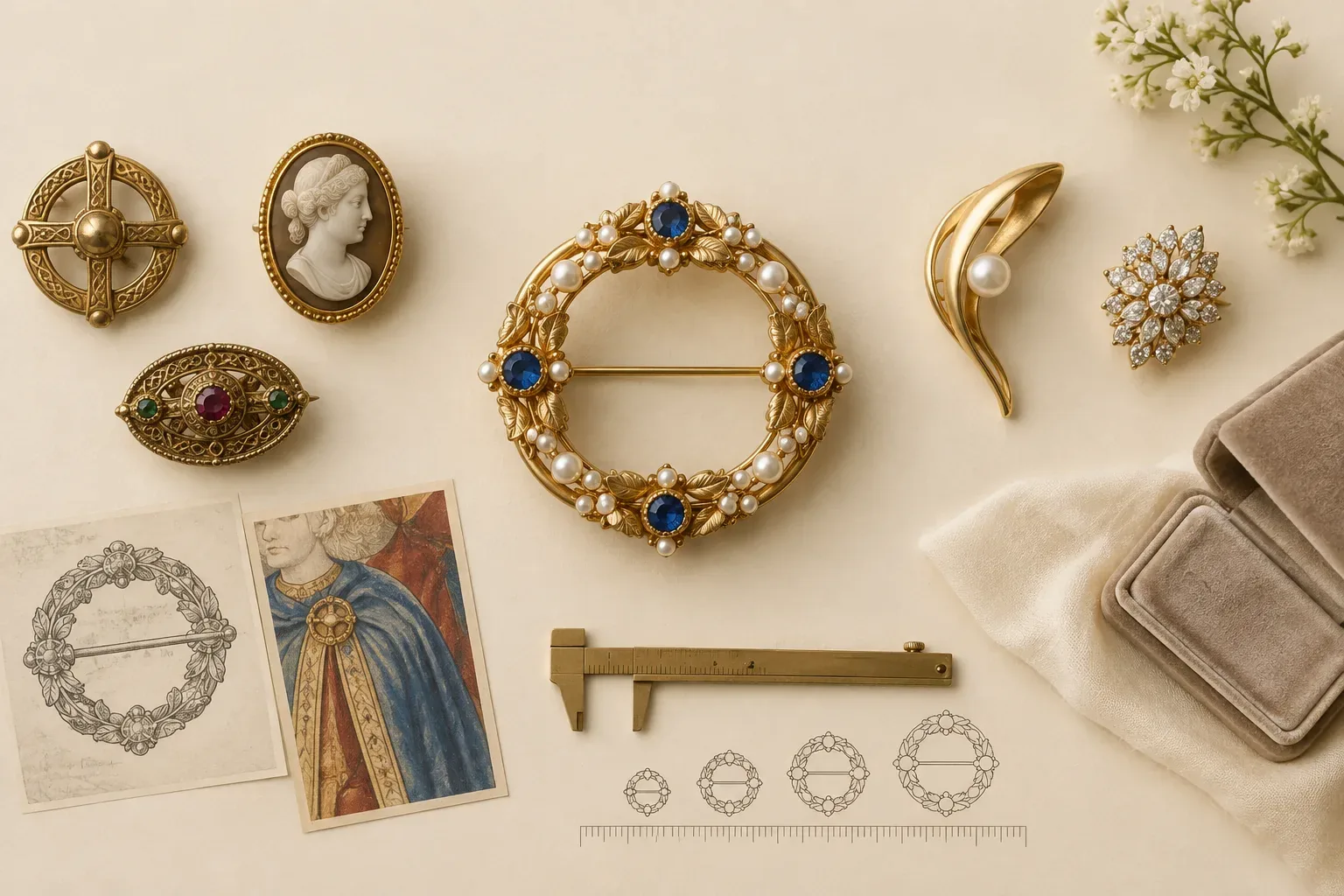
Meaning at a glance
This guide explains which measurements matter when choosing or assessing a brooch—overall dimensions, pin length and closure, weight and depth—and places those practical rules in historical context using museum and gem-buying guidance; it separates documented historical functions from modern personal symbolism and gives respectful selection and gifting advice.
Quick answer
Choose a brooch whose overall length and width suit the intended placement, whose pin length and clasp engage the fabric, and whose weight matches the garment’s weave and the wearer’s comfort. Measure overall size, pin length, depth (how far it stands off the fabric), and weight, and check the clasp type; these are the measurements that matter for fit and stability.
What historical evidence tells us about brooch size and use
Museum collections and exhibitions make clear that the size and function of brooches have changed with dress, technology, and social meaning. The Victoria and Albert Museum’s Bedazzled: A History of Jewellery frames brooches as functional fasteners, dress ornaments, and status markers at different times and places, and shows how sizing shifted with changing garments and tastes.
For example, early clothing fasteners that we now call fibulae or cloak pins were primarily functional, made to secure heavy outer garments; later personal brooches in civic or court dress often became smaller or more delicate as tailoring changed. In the modern era the brooch has alternated between subtle utility and large decorative statements depending on fashion and social signaling. The V&A’s materials emphasize changing social context rather than any single, unchanging meaning.
Separate documented historical meanings from modern interpretations
Documented historical meanings are those supported by museum cataloguing and contemporary records: brooches used to fasten garments, to show rank or affiliation, or to carry a portrait or lock of hair in mourning jewelry. The V&A documentation supports these functional and social readings rather than universal symbolic claims.
Modern personal or popular meanings—such as reading a particular motif as universally lucky, romantic, or political—are contemporary interpretations and vary by culture, community, and individual. Treat such interpretations as personal or contextual rather than historically universal. When in doubt, look for provenance or maker’s notes for a period piece and ask the seller or museum catalog for documented function.
Measurements that matter and how to take them
Overall dimensions: Measure the longest point from tip to tip for length and the widest point for width. Small brooches (often under about 3 cm in length) suit collars and shirt fronts; medium brooches (roughly 3–6 cm) work well on lapels and scarves; larger brooches (above about 6 cm) are statement pieces that need sturdier fabric or additional support. These ranges are practical guidelines rather than strict rules.
Pin length and clasp engagement: Measure the pin shaft from where it leaves the body of the brooch to its tip. The pin should extend at least a few millimetres beyond the fabric it is intended to puncture so you can engage the catch securely. Note the clasp type (simple C-clasp, rotating safety catch, trombone, roll-over lock) and test that it locks reliably; a secure locking clasp is essential for heavier pieces.
Depth and distance from fabric: Measure how far the brooch stands off the mounting plane (the 'depth'). A piece that projects more will swing and can snag on loose or delicate weaves; a shallow profile lies flatter and is better for thinner fabrics. Depth also affects how a brooch sits on layered clothing.
Weight: Weigh the brooch or ask the seller for weight. As a rough guideline, very lightweight brooches are comfortable on silk or knitwear, medium-weight pieces suit wool and structured fabrics, and heavy brooches need thick fabrics, reinforcement, or a supporting pin pad. If you will pin to a lightweight garment, choose a lighter item or provide a backing to distribute force.
How motifs, gemstones, and traditions appear in brooches
Motifs: Historical brooch motifs are diverse—geometric, floral, heraldic, religious, and sentimental—and appear at different scales. Smaller, finely chased motifs often indicate delicate working suited to collars and close-fitting dress. Larger, sculptural motifs tend to be used for statement brooches and outerwear.
Gemstones and materials: The Victoria and Albert Museum’s A–Z of Gemstones explains how different stones have been used historically for color, durability, and status. Gemstones change how a piece must be set and worn: large cabochons or high-set stones add depth and weight, while pavé or seed-stone settings create surface sparkle with less projection. When buying gemstones today, follow Federal Trade Commission guidance about disclosure: sellers should identify treatments, imitations, or simulants rather than leave buyers to assume stones are natural and untreated.
Tradition and technique: Certain settings and closures are associated with particular periods and traditions. For example, period pieces may retain earlier clasp types that are less secure by modern standards; small repairs or replacement fittings can affect both fit and value. Museums like the V&A document such changes to help identify original construction versus later alteration.
Practical choices: selecting a brooch for fit and comfort
Match brooch size to garment and placement. For a shirt collar or narrow lapel choose smaller, flatter pieces so the brooch doesn’t overwhelm the fabric. For a thick coat or a wool scarf you can wear larger, heavier brooches. Consider overall proportion: a very large brooch on a small lapel will look crowded, while a tiny brooch on an expansive shawl may be visually lost.
Consider fabric and reinforcement. Fragile fabrics like silk or open knits need lighter brooches or a small backing patch to protect the weave. If a special brooch is heavy and the recipient often wears delicate fabrics, include a discreet brooch pad or lightweight supportive backing when gifting.
Clasp and security matter. If the wearer is active or will travel, choose a brooch with a modern locking clasp or add a safety catch. For valuable gemstones or historic pieces, ask a jeweller to test and, if necessary, replace a worn or unsafe fitting while documenting the change for provenance.
Respectful selection and gifting guidance
Respect cultural and personal context. Some motifs carry community-specific meanings or are associated with ceremonies. Avoid assuming that a motif is neutral; ask the recipient about preferences or consult trusted cultural sources if you are gifting across cultural boundaries. Remember that historical uses recorded by museums are not always transferrable as present-day meanings.
Document and disclose. If you are gifting a period piece, include any available documentation or a clear note about condition and repairs. If gemstones are important to the gift’s meaning, follow the seller’s disclosures about treatments and imitations; the FTC emphasizes truthful disclosure of treatments and simulants so the recipient knows what they are receiving.
Practical presentation. When you give a brooch, include a small note about recommended wear and care: suggested placements, weight considerations, and any recommended backing or clasp upgrades for safety. A respectful gift shows you considered both the brooch’s history and how the recipient will use it.
Care, alterations, and what to ask a seller or restorer
Ask whether the pin and clasp are original and whether they function safely. Period pieces often retain older clasp types that may need updating for daily wear; a qualified conservator or jeweller can make reversible or documented changes.
When gemstones are present, request disclosure of treatments and whether stones are natural, lab-grown, or simulant, in line with FTC guidance about buying gemstones. For valuable or historical brooches, request condition reports and any provenance the seller can supply; museums such as the V&A catalogue contextual information that helps separate period function from later interpretation.
For heavy brooches or those intended for delicate fabrics, ask about mounting reinforcement or purchase a fabric backing or brooch pad to protect clothing. For travel or active wear consider a safety catch or a locking mechanism.
Final checklist before buying or gifting
Measure overall length and width and compare to intended placement. Check pin length and that the clasp locks reliably. Note the brooch’s depth off the fabric and weigh the piece. Consider the wearer’s wardrobe fabrics and habits. Ask about gemstone treatments and whether any restoration work has been carried out. Include a small, respectful note about recommended wear and care when you give the piece.
Frequently asked questions
How do I measure a brooch to know if it will fit my garment?
Measure the brooch’s overall length from tip to tip and its widest width. Measure the pin shaft from where it leaves the body to its tip to ensure it will pass through the fabric and engage the catch. Also note depth (how far it projects off the mounting plane) and weight to judge whether the garment can support it.
What size brooch is best for a lapel versus a collar?
As a practical guide, smaller brooches (under about 3 cm) suit collars and narrow shirt fronts, medium brooches (around 3–6 cm) work well on lapels and scarves, and larger brooches (over 6 cm) are statement pieces best for coats or shawls. Match the brooch to the lapel width and fabric sturdiness.
Will wearing a brooch damage delicate fabrics like silk?
A heavy or projecting brooch can stress delicate fibres. For lightweight fabrics choose a lighter brooch, use a small backing or brooch pad to distribute pressure, and avoid repeatedly attaching heavy pieces in the same small area.
How important is the clasp type for fit and security?
Very important. Modern locking clasps provide greater security for travel and daily wear; older clasp types may be decorative but less secure. Always test that the clasp engages reliably and consider having a jeweller fit a safety catch if you intend regular use.
How do I verify gemstone claims on a brooch?
Ask the seller for disclosure of whether stones are natural, lab-grown, treated, or simulants, following Federal Trade Commission guidance on gemstone buying. For valuable or historic pieces request documentation or a condition report and consider professional appraisal.
Is it appropriate to gift a brooch with cultural motifs?
Be respectful and informed. Some motifs have community-specific meanings or ceremonial associations. If you are unsure, ask the recipient or consult knowledgeable sources; when gifting across cultures, choose neutral designs or ensure the motif is appropriate for the recipient’s context.
Sources and further reading
- Bedazzled: A History of Jewellery — Victoria and Albert Museum
- An A-Z of Gemstones — Victoria and Albert Museum
- Buying Gemstones, Diamonds, and Pearls — Federal Trade Commission