Meaning at a glance
This article documents the historical context of ear and ear-cuff-like ornaments, separates recorded cultural meanings from later popular interpretations, and gives a practical checklist for evaluating construction, comfort, and durability when choosing or gifting an ear cuff.
What history tells us about ear ornaments and their meanings
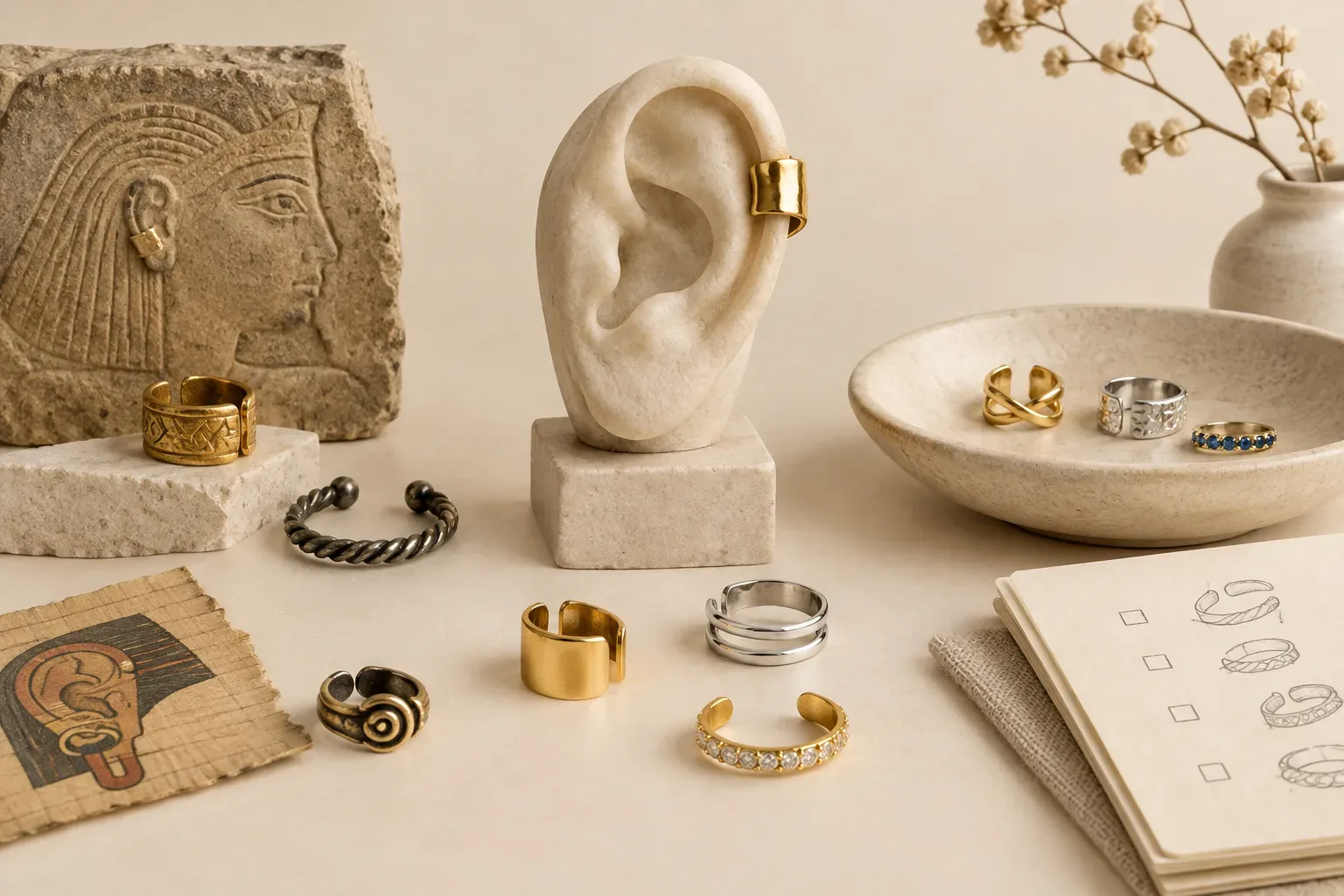
Museums and historic collections show that ear adornment has existed in many societies and changed meaning across time and place. The Victoria and Albert Museum presents jewelry as an object type whose social role shifts between eras and cultures, from status markers to personal decoration to signifiers of identity; that context helps explain why ear ornaments vary in construction and form. When tracing precursors to modern ear cuffs, scholarship and museum collections point to a range of practices rather than a single origin.
For example, the V&A’s surveys of jewellery history identify prominent periods and regions where ear ornaments were significant: ancient Egypt where ear rings and plugs appear in burial and portraiture, classical Greece and Rome where various ear hangings and hoops were fashionable, Mughal India and other South Asian traditions with elaborate ear chains and paan-adornments, and later European periods such as the Georgian and Victorian eras when ear jewellery followed broader stylistic and technological shifts. The V&A’s approach emphasizes changing social context rather than fixed symbolic content for any one object.
These documented appearances are valuable for design precedent and technique: historical examples show different manufacturing approaches (for instance, hammered sheet metal, granulation or early soldering) and different attitudes to comfort and wear. That historical evidence is descriptive—what people did and how objects were made—rather than prescriptive about what a modern ear cuff must mean.
Separate documented historical meanings from modern interpretations
Where museums record ritual or status uses, those are specific to a culture and period. The V&A’s materials and exhibitions document social functions—status, wealth display, ritual dress—but you should not assume those meanings carry unchanged into contemporary contexts. An ear ornament used as a death ritual in one place and time does not automatically carry that connotation when worn as a fashion accessory today.
Modern meanings often arise from subcultural fashion, marketing, or personal narratives. Contemporary wearers may adopt an ear cuff for purely aesthetic reasons, to evoke a perceived historical look, or to make an identity statement. Those modern interpretations are valid as personal or social uses, but they are distinct from the documented uses preserved in museum records. When selecting or gifting, name the historical provenance where known and allow recipients to interpret objects in their own terms rather than asserting a single, universal meaning.
How motifs, gemstones, and traditions appear in ear cuff design
Motifs: Designers borrow motifs from many eras—foliate scrolls from classical bronzes, filigree patterns from South Asian jewellery, or geometric shapes from Art Deco. Museums show how motifs travel: a leaf scroll carved for a bracelet in one period can reappear as a decorative motif on contemporary ear cuffs. The motif itself does not guarantee the same social meaning as in its original context.
Gemstones: The Victoria and Albert Museum’s A–Z of Gemstones briefs readers on how specific stones carry different histories and aesthetic uses. Gemstones in ear cuffs tend to be chosen for durability at the scale of the piece: small faceted stones, cabochons, or accent pearls that can withstand prong or bezel settings. The choice of stone can be historically informed—seed pearls or garnets for Victorian revival pieces, turquoise for designs referencing Central Asian or Native American traditions—but modern use often prioritizes color, hardness and setting style.
Traditions and motifs in practice: In contemporary ear cuff production you will find variations that echo historic techniques (open cuff shapes that clip on like early hoops, filigree panels set against the ear, or bezel-set cabochons). The construction methods—how metal is worked and how stones are set—determine both the look and the long-term wearability of the motif.
Ear cuff quality checklist: construction
Metal and hallmarking: Check the piece for clear material information. Solid precious metals (sterling silver, 9k/14k/18k gold) will be hallmarked or otherwise identified; plated items should be clearly described as plated. The Federal Trade Commission recommends that sellers disclose material treatments and imitation stones, so accurate labeling is a basic quality expectation.
Joints, seams and finish: Inspect solder joints and seams for smoothness and even finishing. A well-made ear cuff will have no visible rough edges, poorly filed joints, or uneven surfaces where the wearer’s skin contacts the metal. Poor finishing accelerates wear and can cause irritation.
Construction strategy: Consider how the cuff is formed. Cuffs made from a single piece of shaped metal typically tolerate stress better than those assembled from many small, soldered components, although fine assembly can also be durable when executed well. Where stones are present, prefer bezel or flush settings to lightly pegged prongs on small-scale cuffs because bezels protect edges better in pieces that may rub against fabric or hair.
Ear cuff quality checklist: comfort
Fit to anatomy: Ear shapes vary widely. A quality cuff offers slight adjustability in the gap or hinge and has contact points that match common anatomical areas (helix, upper lobe, concha) without pinching. If the cuff is specified for a particular part of the ear, verify that measurement or try the piece on if possible.
Weight and balance: Even visually small cuffs can feel heavy if balance is off. A cuff that pulls downward will shift during wear and create pressure elsewhere on the ear. Lightweight alloys or hollow construction can be comfortable, provided the finish and edges remain smooth.
Edge and surface comfort: The inner surface that contacts skin should be polished and rounded. Decorative elements should be positioned so they do not press into cartilage. If the design includes woven wire or granulation, ensure those features are secured and do not lift or snag hair.
Ear cuff quality checklist: durability and maintenance
Plating and surface treatments: Plating is not inherently poor quality, but it affects longevity. Thicker plating and hard-wearing alloys last longer; thin plating will wear at contact points. Ask the seller about plating thickness or expected wear patterns. The FTC advises that treatments and imitations be disclosed, so request that information before purchase.
Stone security and settings: Check that stones are firmly seated with no movement. For small stones, tightly flush-set or bezel-set stones resist damage during everyday actions better than open prongs. For pearls or soft stones, confirm that adhesives were not substituted for proper mechanical seats.
Mechanical stress points: Identify where bending occurs—at the cuff gap, hinges, or decorative joins. Repeated bending of soft metals can work-harden and crack over time. Jewelry makers sometimes design discreet reinforcement where the most movement occurs; that is a mark of considered construction.
Practical buying and gifting guidance
Research the seller and disclosures: Prefer vendors who list metal content, origin, and any treatments. The Federal Trade Commission recommends that buyers expect disclosure of gemstone treatments and imitations; ask questions when the listing is silent. For valuable gemstones, request grading or identification where available.
Consider the recipient’s anatomy and lifestyle: If gifting, choose a cuff style that matches the wearer’s typical activities. A sporty, minimalist cuff in a durable metal may suit an active person, while an ornate filigree piece fits less active wardrobes. When in doubt, present the gift with a store return or exchange option and include a note suggesting a try-on for fit.
Respect cultural provenance and personal preference: If a design references a specific culture’s traditional jewellery, acknowledge that origin when gifting and avoid asserting a single symbolic meaning. Some wearers appreciate historical notes; others prefer contemporary styling without historical claims. If the piece is intended as a meaningful cultural symbol, research provenance carefully and, where appropriate, choose artisans from the originating tradition.
Care and troubleshooting
Cleaning and storage: Store cuffs flat or in separate compartments to avoid tangling or abrasion. Clean according to metal and stone type: basic soap-and-water and a soft brush is safe for many modern pieces, while certain stones and composite materials require specialist care. If stones are treated or glued, avoid ultrasonic cleaners without confirmation from the maker.
When to consult a professional: If a cuff needs adjustment for fit, a trained jeweller can resize, solder reinforcements, or replate durable finishes. For any piece with significant gemstone value, seek jeweller evaluation before repair work.
Longevity expectations: Well-made solid-metal cuffs with mechanical stone settings can last decades with care. Plated or fashion pieces are best treated as seasonal or style-forward and may require re-plating or repair over time.
Frequently asked questions
How do I size an ear cuff?
Measure where the cuff will sit—upper helix, mid-helix or concha—and compare to the seller’s stated internal width. If possible, try on similar widths in person. Choose slightly adjustable designs or confirm an exchange option when gifting.
Are ear cuffs safe for sensitive ears?
They can be if made from hypoallergenic metals such as solid sterling silver or higher-karat gold and if the finish is smooth. Avoid plated base metals against skin for prolonged wear if you have known sensitivities, and ask the seller about metal content.
Can I sleep with an ear cuff?
It is not recommended. Sleeping can bend thin metals, loosen settings, and create pressure points that irritate cartilage. Remove cuffs before sleep to prolong their life and protect your ear.
How can I test if a stone or metal is real?
Ask the seller for documentation or identification. For gemstones and precious metals, reputable vendors will disclose treatments and provide testing or certification upon request. The FTC advises buyers to expect disclosure of treatments and imitations.
What maintenance will extend an ear cuff’s life?
Store individually to avoid abrasion, clean gently according to the metal and stones used, avoid exposing plated pieces to chemicals, and have a jeweller check settings and replate or repair joins as needed.
Sources and further reading
- Bedazzled: A History of Jewellery — Victoria and Albert Museum
- An A-Z of Gemstones — Victoria and Albert Museum
- Buying Gemstones, Diamonds, and Pearls — Federal Trade Commission